Recommended Blogs

How Acceptance Test-Driven Development (ATDD) Drives Business Value and Growth
Table of Content
- What is Acceptance Test-Driven Development (ATDD)?
- What Are the 4 Stages of Acceptance Test-Driven Development (ATDD)?
- Difference between ATDD, BDD, and TDD
- Business Benefits of Acceptance Test-Driven Development (ATDD)
- 4 Popular ATDD Frameworks
- Integrating ATDD in Agile and DevOps Workflows
- How Does Collaboration Between Developers, Testers, and Business Analysts Work in ATDD?
- Summary
Share On


Acceptance tests are one of the best QA strategies for ensuring a quality-centric and consistent software development lifecycle. However, in an agile environment, the time needed for their implementation must not hinder the timeline of functionality delivery, and the code must comply with the organization’s technical guidelines.
A sub-branch of TDD, Acceptance Test-Driven Development (ATDD), keeps the customer first by making acceptance test cases the core of the software development cycle. It allows teams to create acceptance test cases before the code generation stage. Developers use these test cases as a reference for coding, and if they fail in these test cases, it means standards have not been followed.
Align Dev and Business Goals with ATDD - Our QA experts help you implement Acceptance Test Driven Development to ship features that always meet business requirements.
Get a Free ConsultationWhat is Acceptance Test-Driven Development (ATDD)?
Acceptance test-driven development (ATDD) follows the same principles of TDD (test-driven development) and involves creating acceptance test cases before implementing new software functionality. It represents the user’s POV (point-of-view) and validates whether the software is working as intended. ATDD is somewhat similar to BDD (behavior-driven development) except for a small difference, i.e., BDD focuses on the system behavior while ATDD focuses on customer requirements.
ATDD has multiple team members with different roles and work in collaboration. For example, QA, product owners (POs), and developers collaborate to generate acceptance criteria. The criteria are converted into acceptance tests, which validate system usage scenarios. These tests follow the “Failure – Refractor – Success” cycle until delivery. TestNG, easyB, Thucydides, Concordion, FitNesse, and Cucumber, are some of the ATDD tools software development businesses use.
What Are the 4 Stages of Acceptance Test-Driven Development (ATDD)?
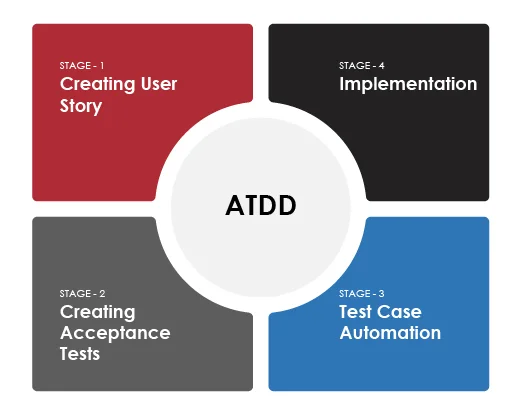
Stage 1: Creating User Story:
The process starts with creating a user story that shows the user’s expectations at the end of development. It is then implemented to meet the user objectives.
Stage 2 Creating Acceptance Tests:
The first stage output is the input for drafting acceptance test criteria. These test cases will consist of all the real-world scenarios and how the system would react in each scenario.
Stage 3 Test Case Automation:
The third stage automates the acceptance test cases by turning them into an executable format and loading them into a testing tool. The QA teams usually use Concordion, FitNesse, and Cucumber tools for ATDD automation.
Stage 4 Implementation:
QA and dev teams use acceptance test criteria as a core for software development. This may involve leveraging the TDD model to code, test, and refactor until they get the go-ahead from the test case. After several iterations, they develop new features and release them.
Difference between ATDD, BDD, and TDD
| Aspect | Acceptance Test-driven Development (ATDD) | Test-driven Development (TDD) | Behavior-driven Development (BDD) |
| Meaning | It’s an approach where teams collaborate to draft acceptance tests before development starts. | It’s a software development approach where developers write tests before code. | It’s a collaborative approach in which system behavior scenarios guide development. |
| Focus | The primary focus is validating that the system meets user and business requirements. | This approach ensures that the code functions as expected at the unit level. | It focuses on describing the system’s behavior from a user’s perspective. |
| Stakeholders | Business analysts, testers, developers, and other stakeholders. | Primarily developers. | Developers, testers, and other business stakeholders. |
| Tests Written For | High-level acceptance criteria for features or user stories. | Unit tests for individual code units. | Business behaviors or user scenarios. |
| Language | Plain English phrases or domain-specific language for acceptance tests. | Programming language-specific test code. | Human-readable language like Gherkin (Given-When-Then syntax). |
| Purpose | Validate whether the new functionality delivers the expected business value. | Ensure code correctness and refactorability. | Align technical implementation with business expectations. |
| Testing Level | Acceptance level (E2E or integration testing). | Unit testing. | Behavioral level testing (aligned with user stories). |
| Tools | Cucumber, FitNesse, Concordion. | JUnit, NUnit, PyTest, etc. | Cucumber, SpecFlow, Behave, etc. |
| Communication Type | Collaborative, focusing on user requirements and acceptance criteria. | Technical, focused on code-level functionality. | Collaborative, emphasizing user and business intent. |
| Outcome | A shared understanding of feature requirements and tests to validate them. | Reliable, maintainable, and refactored code. | Clear documentation of system behavior and aligned expectations. |
Business Benefits of Acceptance Test-Driven Development (ATDD)
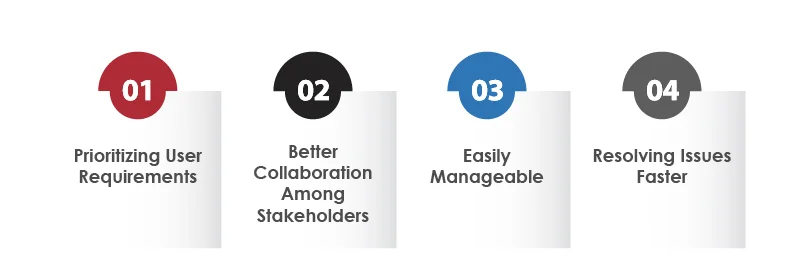
Prioritizing User Requirements:
User acceptance test criteria are the basis of the development cycle, so customer requirements and objectives remain the prime focus throughout the process. Teams can hypothetically predict the end result for better coding and unit testing. ATDD encourages developers to think from end-user perspectives and prioritize their requirements at every development stage.
Better Collaboration Among Stakeholders:
Collaboration begins from the initial stage i.e., user story creation, and continues till the code fulfills the user acceptance criteria. Business analysts, product owners, developers, and testers collaborate to work throughout the development process. ATDD gives a clear picture of the main objectives and ensures better compliance with requirements.
Easily Manageable:
ATDD projects consist of small iterations and require a small team to manage. This means the teams are often small and consist of experienced individuals who have the right skillset related to the job. With Acceptance Test-driven Development (ATDD), businesses can easily manage team infrastructure and resources and would have a better rapport and collaboration than larger teams.
Resolving Issues Faster:
Compared to regular development cycles, ATDD is an integral part of the process and is performed multiple times to ensure that the code perfectly aligns with the user’s expectations. It is not an isolated strategy meant to be run before rollout. Businesses can easily identify and resolve issues early before they become a nuisance.
4 Popular ATDD Frameworks

FitNesse:
FitNesse is a web server, a wiki, and an automated testing framework for software testing that enables teams to write acceptance tests in a collaborative environment. It’s highly iterative and integrates perfectly with multiple programming languages.
Key Characteristics:
-
- Teams can write tests in tabular format.
-
- Language-agnostic and supports multiple libraries
-
- Extensible via custom keywords and plugins.
Cucumber:
Although it’s a BDD framework, Cucumber can also be leveraged for ATDD by generating acceptance criteria in the Gherkin language.
Key Characteristics:
-
- Utilize the “Given-When-Then” format for test scenarios.
-
- Highly compatible with languages like Ruby, Python, and Java.
-
- Facilitate communication between technical and non-technical teams.
SpecFlow:
SpecFlow is a .Net-based framework that brings Gherkin-based acceptance testing to the Microsoft Stack. It allows users to define acceptance criteria in Gherkin syntax and is ideal for .Net projects.
Key Characteristics:
-
- Integrates with Visual Studio and other CI/CD tools.
-
- Facilitates collaboration by writing plain-text test cases.
-
- Support both BDD and ATDD practices.
Robot Framework:
Robot Framework is an open-source automation framework that supports Acceptance Test-driven Development (ATDD) through a keyword-driven testing approach. Teams use this framework to run acceptance tests for web applications, APIs, and more.
Key Characteristics:
-
- Enable test case generation in tabular format.
-
- Language-agnostic framework and supports multiple libraries.
- Extensible via custom keywords and plugins.
Integrating ATDD in Agile and DevOps Workflows
ATDD works well with Agile and DevOps because it focuses on shared acceptance criteria instead of validation at the end of the process.
- Before development starts, acceptance tests are set during backlog refinement and sprint preparation.
- These tests are the only thing that is true for user stories, code, and automation.
- In DevOps pipelines, automated acceptance tests run at the same time as CI builds to check business flows early on.
- This method reduces handoffs and ensures that releases meet both speed and quality criteria.
What this truly implies is that ATDD enables Agile teams to work quickly without having to guess if they are making the proper thing.
How Does Collaboration Between Developers, Testers, and Business Analysts Work in ATDD?
ATDD makes it easier for people to work together by replacing assumptions with shared, testable expectations.
Business analysts and product owners use simple language to explain acceptance criteria.
Testers turn these criteria into acceptance tests that may be run.
Developers use those tests to guide their work, not their own ideas.
Everyone looks at the results in light of the identical acceptance scenarios.
This unified approach clears up any confusion early on, which reduces rework and problems later on.
Summary
Acceptance Test-driven Development (ATDD) integrates acceptance testing within the software business development lifecycle to align end results with user expectations. This approach facilitates better stakeholder collaboration and uses the “Failure-Refactor-Success” cycle for iteration. It allows businesses to deliver high-quality, user-focused solutions, driving value and promoting agile development success. By adopting practices like test driven development in agile, teams can ensure that testing is embedded early, enabling faster feedback and improved product quality.
At Tx, we focus on delivering high-quality software despite time constraints in the development and QA environment. We offer distributed Agile test services to enable our clients to leverage the benefit of robust QA services in today’s tech-driven business environment. Contact our experts now to know more about our agile testing solutions and how Tx can help.


Amar Jamadhiar
VP, Delivery North America
Amar Jamdhiar is the Vice President of Delivery for TestingXperts's North America region, driving innovation and strategic partnerships. With over 30 years of experience, he has played a key role in forging alliances with UiPath, Tricentis, AccelQ, and others. His expertise helps TestingXperts explore AI, ML, and data engineering advancements.
FAQs
What are the benefits of acceptance test-driven development?
Acceptance Test-driven Development has several benefits like improved collaboration, better understanding of requirements, faster issues resolving, streamlined development processes, and enhanced software quality.
Why do developers need both Test-Driven Development (TDD) and behavior-driven development (BDD)?
Developers require TDD and BDD to focus on individual code units and get a broader perspective of the system’s behavior from the user POV. It helps in bridging the gap between business requirements and technical implementation.
What is the main purpose of acceptance testing?
Acceptance testing ensures that the software application meets all the requirements and is ready for release. It is the critical final stage in the software development lifecycle and is performed after unit and integration testing.
What is the role of QA in TDD?
QA plays a critical role in TDD by allowing developers to ensure the software meets user requirements and is of high quality. QA engineers collaborate with developers to ensure all functionalities are tested against project goals.
Is acceptance test-driven development ATDD supported by agile?
Yes, ATDD is supported by Agile. It is a software development methodology often leveraged in Agile development to ensure all project stakeholders are aligned with the outcome from the beginning.
How does ATDD improve collaboration among stakeholders?
Acceptance criteria that both the business and technical sides agree on before development starts make ATDD a common language. This cuts down on misunderstandings, makes things more clear, and puts everyone on the same page about results instead of assumptions.
What are the challenges of implementing ATDD in large teams?
Inconsistent acceptance criteria, the need to keep tests up to date, and the need to work together across teams that are spread out are all common problems. Standardization, automation, governance, and explicit ownership models can help with these issues.
How does ATDD ensure business requirements are met?
ATDD begins with acceptance criteria set by the business and uses them as success conditions for development. Teams can see that requirements have been met if acceptance tests pass.
Discover more