Recommended Blogs

Workday Testing Delays Risking Go-Live? Ensure a Smooth Release with the Right Testing Types

 Last Updated: April 8th, 2026
 Read Time: 2 minutes
Table of Content
- How Does Workday Testing Work During Implementation?
- What Are the Types of Workday Testing and Why They Matter
- Workday Functional Testing: Validating Core Business Processes
- Workday Integration and System Testing: Ensuring Data Flows Without Failure
- Workday Regression and UAT Testing: Reducing Risk Before Go-Live
- Why Choose TestingXperts for End-to-End Workday Testing Success
- Conclusion
Share On


Enterprise Workday implementations promise change, but gaps in testing might delay operations and go-live. Recent ERP data shows that 58% of companies struggle with user acceptance testing and 38% with integration testing. These problems directly affect schedules and user adoption.
At the same time, defects identified in post-production can lead to significantly higher remediation costs, operational disruption, and delayed business outcomes. In short, this means that testing is not a phase; it is a way to control risk. To ensure go-live results are predictable and error-free, it is important to understand the different forms of Workday testing and how they fit into the implementation.
How Does Workday Testing Work During Implementation?
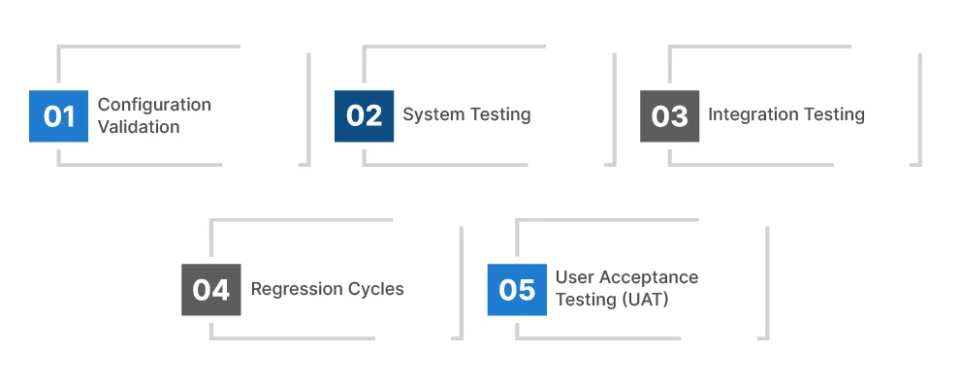
Workday testing is not linear; it is iterative and closely linked to the implementation phases. Testing changes over time, from the first setup to the time when the system is ready to go live, to make sure that business processes, integrations, and user expectations are all met.
Here’s how Workday testing typically works during implementation:
Configuration Validation
Testing from the beginning makes sure that business rules, workflows, and security responsibilities are set up appropriately.
System Testing
Validating the Workday system from start to finish across all modules makes sure that processes work together.
Integration Testing
This checks that the system works with payroll providers, finance tools, and other systems from other companies.
Regression Cycles
Continuous testing ensures that upgrades or patches don’t break existing features.
User Acceptance Testing (UAT)
Business users check real-world situations before the product goes live.
This layered approach shows the various testing methods used in a Workday implementation. It ensures risks are identified early and managed before they affect operations.
What Are the Types of Workday Testing and Why They Matter
When leaders ask, “What are the types of Workday testing?” they truly want to know how risk is handled throughout the system.
The main forms of Workday testing are:
- Functional Testing
- System Testing
- Regression Testing
- User Acceptance Testing (UAT)
Each type has its own role, but together they make the Workday ecosystem safer.
Why this is important:
- Workday tracks important HR, payroll, and financial information.
- Failures affect compliance, employee experience, and financial accuracy.
- Poorly tested code causes problems with data and operations.
In simple terms, these testing types ensure that Workday doesn’t just work. It works reliably on scale.
Workday Functional Testing: Validating Core Business Processes
Workday functional testing is ensuring that the business processes set up work as intended.
This includes:
- Hire-to-retire workflows
- Payroll processing and compensation rules
- Financial transactions and approvals
- Security roles and access controls
The goal is to ensure that Workday meets the business’s needs, not just the way the system is set up.
Why it matters for leaders:
- Errors in functional logic can lead to payroll discrepancies or compliance issues
- Business workflows must reflect real-world operations, not assumptions
- Functional testing acts as the foundation layer. If this fails, every downstream testing effort becomes unreliable.
Workday Integration and System Testing: Ensuring Data Flows Without Failure
Most businesses today don’t use Workday software alone. It works with:
- Payroll providers
- Banking systems
- Benefits platforms
- Third-party applications
This is when workday system testing and workday integration testing become very important.
Workday integration testing validates:
- Data exchange accuracy across systems
- API reliability and transformation logic
- Real-time and batch processing flows
Workday system testing ensures:
- End-to-end workflows function across modules
- Data moves smoothly between HR, finance, and outside systems.
Here’s the thing: this is where most businesses fail. Integration gaps can cause:
- Incorrect payroll calculations
- Data mismatches across systems
- Reporting inconsistencies
- End-to-end testing ensures that the system behaves as a single platform rather than separate pieces.
Workday Regression and UAT Testing: Reducing Risk Before Go-Live
Changes are always happening as implementations move forward. This means that workday regression testing and Workday UAT testing are very important before going live.
Workday Regression Testing
- Regression testing ensures that:
- New updates do not break existing functionality
- Configurations remain stable across releases
- Previously validated workflows continue to work
- In ERP setups, where updates happen often, regression testing stops the cycle of “fix one problem, create another.”
Workday UAT Testing
User Acceptance Testing changes the focus from checking the system to checking the business.
It answers one important question: Does Workday software really help the business?
UAT includes:
- Real users executing real scenarios
- Checking that workflows and usability work
- Final approval before going live
Because UAT is one of the hardest tests for businesses to pass, this phase often determines whether the implementation will succeed or fail.
Why Choose TestingXperts for End-to-End Workday Testing Success
Workday Testing involves more than just tools; it also requires defined frameworks, subject-matter expertise, and the flexibility to grow.
TestingXperts offers:
- End-to-end Workday testing coverage across functional, integration, regression, and UAT
- Automation-driven validation aligned with Workday’s biannual updates
- Domain expertise in HCM, Finance, and Payroll workflows
- Faster release cycles and reduced post-deployment defects
- Companies feel more confident in every release cycle when they see results like 80% faster time-to-market and 40% fewer faults.
In other words, you go from testing things that happen to you to managing releases that you can forecast.
Conclusion
It’s not the day of the Workday that matters; it’s how well risks are handled before it. Functional, integration, regression, and UAT testing all need to be done in the right amounts to make sure everything is correct, stable, and ready for business.
Structured testing is the difference between delays and reliable deliveries for companies that must deal with complex implementations. With TestingXperts help, you can have that control with full Workday testing. Get in touch with TestingXperts to speed up your Workday installation and ensure your go-live is safe and successful.

VP, Delivery Quality Engineering
Manjeet Kumar, Vice President at TestingXperts, is a results-driven leader with 19 years of experience in Quality Engineering. Prior to TestingXperts, Manjeet worked with leading brands like HCL Technologies and BirlaSoft. He ensures clients receive best-in-class QA services by optimizing testing strategies, enhancing efficiency, and driving innovation. His passion for building high-performing teams and delivering value-driven solutions empowers businesses to achieve excellence in the evolving digital landscape.
FAQs
Why do enterprises rely on Workday regression testing services before deployment?
Enterprises rely on regression testing to ensure new updates or configuration changes don’t break existing workflows. It helps maintain system stability, prevents recurring defects, and protects critical HR and financial processes from unexpected disruptions right before go-live.
How do I choose the right provider for Workday functional testing and integration testing?
Look for providers with strong domain expertise in HCM and Finance, proven automation capabilities, and experience handling complex integrations. The right partner should align testing with business workflows, not just technical validation, while ensuring scalability and faster release cycles.
What are the key outcomes of effective Workday system testing?
Effective system testing ensures end-to-end process validation across modules, seamless data flow, and consistent performance. It reduces operational risks, eliminates process gaps, and ensures that Workday functions as a unified system supporting real business scenarios.
How does Workday UAT testing improve business readiness and user adoption?
Workday UAT testing brings real users into the validation process, ensuring workflows align with daily operations. It builds confidence, uncovers usability issues early, and ensures employees are prepared—leading to smoother adoption and fewer disruptions post-deployment.
What are the business benefits of strong Workday UAT testing?
Strong UAT testing ensures the system truly supports business needs before go-live. It reduces rework, minimizes user resistance, and accelerates adoption by validating real-world scenarios, helping organizations transition smoothly without productivity loss or operational confusion.
How can TestingXperts improve release confidence through Workday integration testing?
TestingXperts strengthens release confidence by combining domain expertise with automation-led integration testing. Their approach ensures accurate data flows, stable APIs, and end-to-end validation, helping enterprises minimize risks, accelerate deployments, and maintain consistency across connected systems.
What business benefits can TestingXperts deliver through Workday functional testing services?
TestingXperts ensures business-critical workflows are validated against real-world scenarios, not just configurations. This leads to fewer defects, improved process accuracy, faster releases, and greater confidence that Workday aligns perfectly with organizational goals from day one.
Discover more