











Accelerate Test Automation Migration with Tx-Migrator

Stop Rewriting and start Migrating

Move Test Automation Across Your Entire Stack – Any Source, Any Target – with Tx-Migrator

Your test scripts carry years of business logic and significant investment. Switching tools shouldn't mean losing that logic, or rebuilding it from scratch. Tx-Migrator moves your automation assets from any source to any target, preserving business logic, freeing your QA teams from rework, and keeping your release timelines intact.

Book a Migration Assessment

Leading With Proven Outcomes

35-40%

Effort Reduction

3K+

Test Cases Migrated

Zero

Scripts Built From Scratch

UI+API

Coverage Preserved

The Challenge

The Hidden Cost of Test Automation Migration

Tool migration rarely fails loudly. They fail through attrition, scripts that get rewritten, logic that gets lost, and release cycles that quietly slip. Most teams do not have a testing problem; the tools have changed, but the migration process has not.

  • Manual Migration is Costly
    Rewriting thousands of automation scripts by hand drains your QA team, inflates avoidable costs, and stalls your modernization roadmap. At enterprise scale, every week spent on manual migration is a week not spent on delivery.

  • Lost Return-on-Investment
    Your test assets are not just scripts. They carry years of business rules, edge cases, and validated logic. Manual migration puts all of that at risk, with no structural guarantee that your logic survives the transition.

  • Tool Fragmentation
    When your tools do not communicate with each other, your QA program suffers. Gaps between source and target platforms slow down legacy automation adoption and leave your teams operating in silos.

  • Test Coverage Blind Spots
    Inconsistent migration means inconsistent coverage. And when gaps surface after go-live, fixing them costs far more than the migration itself.

The Hidden Cost of Halting Your Test Automation Migration

How Tx-Migrator Moves Your Automation Forward

Any-to-Any Tool Migration Built for Teams That Can't Afford to Start Over

Most migration projects fail quietly. Scripts get rewritten. Business logic gets lost. Three months later, your QA team is back where it started, just with a different tool. Tx-Migrator will break that cycle for you.

Your team will not lose what they have already built, Tx-Migrator carries your existing assets forward, so there is nothing to rebuild Tx-Migrator operates through two concurrent AI agents, one continuously monitors your version control and issue tracking for pre-migration risks, while the other tracks platform changes and auto-updates scripts in real time. Your migration doesn't pause when your environment shifts

  • Preserving your existing test logic and business rules

  • Reducing manual efforts of migration of automation scripts through AI-assisted conversion

  • Validate functional parity continuously during migration, not as an afterthought after go-live

  • Enable faster modernization of your QA ecosystem without freezing your delivery pipeline

Your Complete Tosca to Katalon Migration Accelerator

Our Key Clients

software testing and QA testingxperts
Frankcrum Client
software testing and QA testingxperts
key client payfare

Get a Consultation

  • Speak directly with a migration specialist

  • Identify which of your automation scripts are worth migrating, and which ones should be retired

  • Identify your most critical automation assets and build a risk-free migration roadmap for success

  • Get a tailored migration plan designed as per your frameworks, your tools, and your go-live timeline


    Core Capabilities

    One Accelerator. Any Tool. Full Coverage.

    Tx-Migrator handles the full scope of automation migration across any tools and any frameworks. It will lead to less manual work, fewer gaps, and faster delivery on the other side. It delivers:

    Decode

    Automated Script Conversion

    Rule-based mapping handles structured conversions, while AI fills the gaps where logic requires interpretation. Together, they eliminate the need for manual script rewriting.

    Reuse

    Reusable Test Asset

    Test data, object repositories, and workflows migrate with your scripts. What your team built stays usable and they do not need to rebuild from scratch in the new environment.

    Continuous Integration

    CI/CD and Framework Integration

    Migrated scripts can plug into your existing pipelines. Migrated scripts integrate cleanly with your test management tools, defect tracking systems, and CI/CD workflows, without disrupting ongoing delivery.

    Checklist

    Full Functional Coverage

    Every test case makes the move with its own logic and coverage intact. Post-migration, your QA program will run as expected without gaps or scrambling to patch what was missed.

    connect

    Multi-Tool Ecosystem Support

    Work across cloud execution, extensible frameworks, and AI-assisted testing without friction. Agents will adapt to the tools you use today and the ones you'll move to tomorrow.

    Data analytics

    Migration Assessment & Reporting

    Before a single script moves, a metadata-driven analysis will surface redundant, broken, and low-value scripts. Go into migration knowing exactly what's worth taking and what isn't.


    How Does the Tx-Migrator Framework Work?

    Enterprise-grade migrations leave no room for ambiguity. Tx-Migrator runs on a five-phase framework that gives your team full visibility at every step from the first assessment to the final sign-off. You always know what's moving, what's been validated, and what's ready to go live.
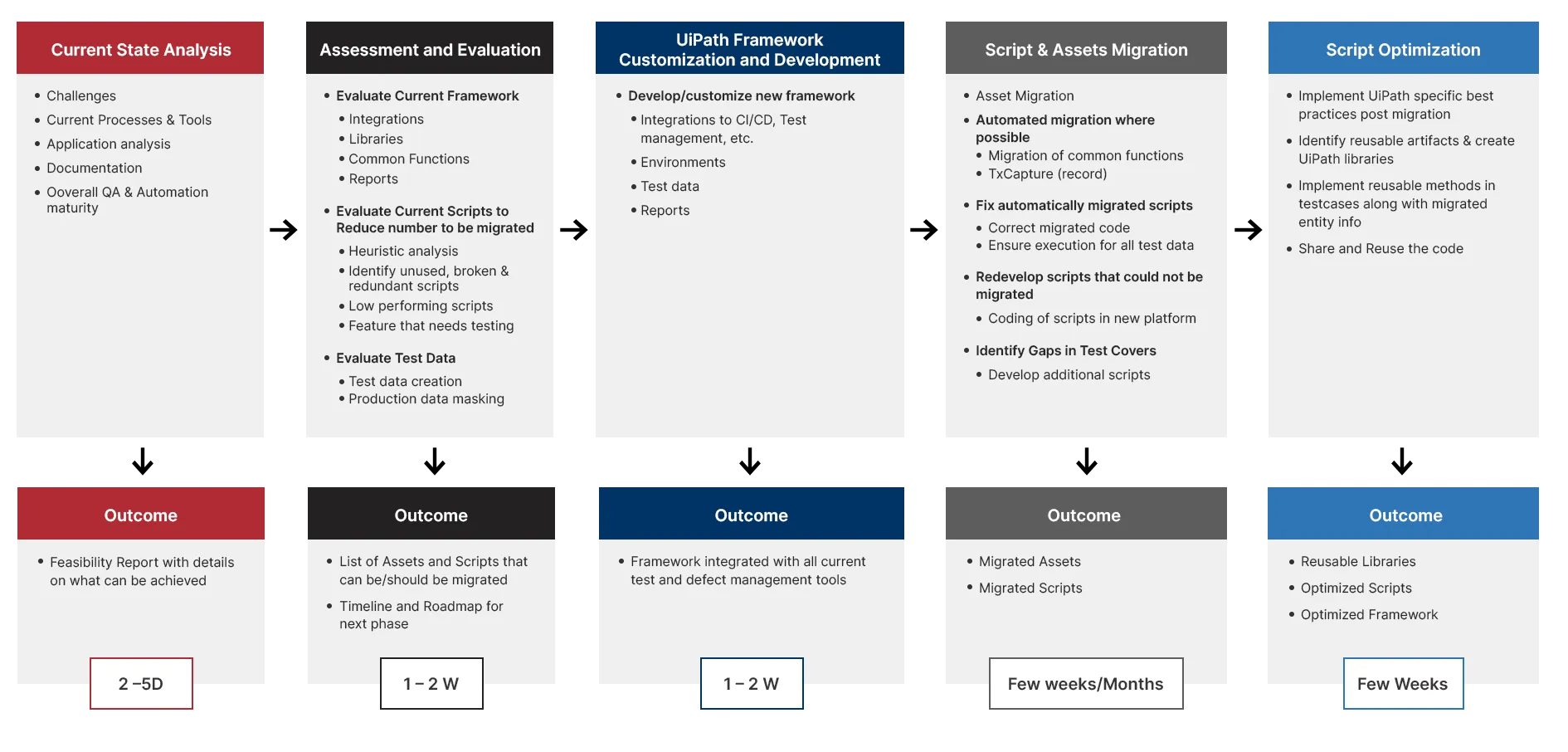

    Tx-Migrator Framework
    Tx-Migrator Framework

    A Leading Insurance Distribution Organization Accelerated QA Automation Excellence Through the UiPath Partnership Dots Image

    January 21, 2026

    QXcel Turned Automation Friction to Automation Excellence for a US Insurance Distribution Platform

    As a trusted partner of UiPath, TestingXperts expanded automation coverage, and strengthened release quality using QXcel, a Gen-AI Powered quality engineering platform and a scalable QA automation strategy.

    Read More

    Why Tx-Migrator

    Real Migration Results with Zero Disruption and Rework

    With Tx-Migrator, you can complete the migration of automation scripts in a fraction of the time that once took 12 months. It delivers value over a manual approach, with measurable results:

    check-icon
    35–40% reduction in migration effort across programs with 1,000+ scripts, compared to rewriting scripts by hand.

    check-icon
    25% productivity gain through Tx-Capture, TestingXperts' AI-assisted script generation module, used for supplementary automation during migration.

    check-icon
    10% reduction in migration scope by eliminating broken test cases before a single script moves.

    check-icon
    5% improvement in migration efficiency with shared and reusable UiPath libraries.


    Still evaluating automation migration options?

    Schedule a Consultation


    FAQs

    What challenges does Tx-Migrator solve in test automation migration?

    With Tx-Migrator, you can solve the following common challenges in test automation migration:


    • Eliminating manual script rewriting and reducing QA effort
    • Preserving existing test logic and business rules
    • Avoiding test coverage gaps
    • Reducing delays caused by tool fragmentation
    How does Tx-Migrator reduce risk during large-scale enterprise migration programs?

    Tx-Migrator reduces migration risk by bridging functional parity, preserving business logic, and eliminating broken or redundant test cases before migration.

    Can Tx-Migrator support cross-framework and cross-tool automation transformation?

    Yes, Tx-Migrator enables any-to-any test automation migration across tools and frameworks. You will be able to modernize your QA ecosystem by seamlessly converting test scripts, integrating with CI/CD pipelines, and ensuring compatibility across your target platforms.

    How does Tx-Migrator help standardize automation after migration?

    Tx-Migrator helps you standardize automation after automation with these techniques.


    • Enabling reusable test assets and consistent frameworks
    • Streamlining integration with your existing QA tools