Recommended Blogs

Workday Testing: The Smart Move for Scalable Business Growth

 Last Updated: May 5th, 2026
 Read Time: 6 minutes
Table of Content
- What is Workday Testing and Why is it Important?
- How Does Workday Testing Work?
- Step-by-Step Process of Workday Implementation Testing
- Key Areas to Test in Workday Implementations
- Business Benefits of Workday Testing
- Common Workday Testing Challenges and Their Solutions
- Why Partner with Tx for Workday Testing Solution?
- Summary
Share On


Workday is one of the widely used Human Capital Management (HCM) software in enterprises for managing HR, finance, and planning operations. According to a report, Workday revenue reached $7.3 billion, with subscription revenues at $6.6 billion. However, although it offers transformative business benefits, it comes with significant implementation and management challenges. According to Forrester, 35% of organizations struggle with testing enterprise cloud solutions due to the complexity of configurations and the fast-paced nature of release cycles. In this blog, we will discuss how Workday Testing can help overcome and handle the complexities of cloud solutions. It will help understand how enterprises can maximize the potential of their Workday solution capabilities while minimizing risks.
What is Workday Testing and Why is it Important?
Before getting into Workday testing, let’s understand what Workday is. It is a leading cloud-based HCM and finance management platform with multiple modules. Several leading institutions globally leverage this software to streamline their operations, like onboarding, payroll management, and financial accounting. Due to this, it is critical to pay extra focus to Workday implementation to empower the digital initiatives in an organization.
This is where Workday testing comes into the picture. It focuses on the Workday application’s functionality, performance, and reliability when integrated with an organization’s processes. This also helps to ensure that the system operates as expected, supports workforce management, and complies with industry regulations.
Workday is a core digital platform that facilitates the reliability of the operational routine within the organization. Testing the Workday platform ensures that the core digital operations operate as expected and improves efficiency by seamlessly integrating it from day one. It helps set the digital ecosystem for recruiting, onboarding, training, and nurturing employees. Businesses can ensure that the Workday platform syncs with their objectives, contribute to their overall RoI, and builds better loyalty among employees.
How Does Workday Testing Work?
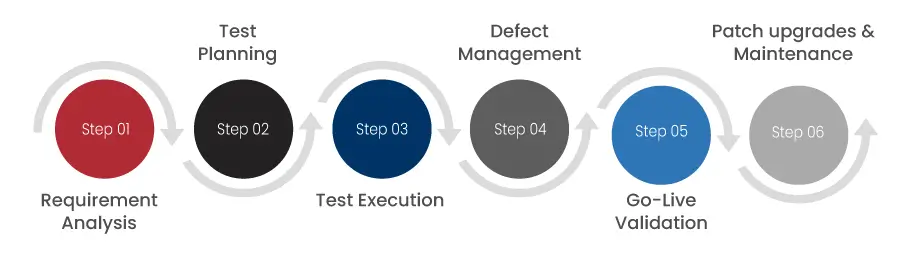
Workday testing involves a structured approach that validates system functionality, security, compliance, and integrations with existing systems. Here’s how it works:
Step 1: Requirement Analysis
Businesses must define their QA objectives, scope, and key stakeholders responsible for overlooking. It involves identifying business processes, configurations, and integrations that require testing.
Step 2: Test Planning
This stage involves establishing test cases, test data, and the expected outcomes they will deliver. One should develop a detailed test strategy covering functional, regression, UAT, security, and integration testing.
Step 3: Test Execution:
This step covers executing different testing types, such as Functional testing to validate core Workday modules, Integration testing to ensure sync between Workday and third-party applications, Regression testing to ensure existing functionality still works after any new change, Security testing to validate data access permissions/restrictions, and UAT to ensure the system meets business objectives before rollout.
Step 4: Defect Management
QA teams must re-test bug fixes to ensure proper functionality of the Workday system. They have to log, track, and retest issues identified during testing.
Step 5: Go-Live Validation
Conduct final checks before release. This will ensure system stability as teams perform smoke testing post-deployment.
Sep 6: Patch upgrades & Maintenance
The final step is regularly testing Workday updates and patches. This can be done by automating repetitive test cases for faster validation and efficiency.
Step-by-Step Process of Workday Implementation Testing
For a scalable Workday implementation testing approach, you should follow a continuous validation loop. The following are the steps which you should follow the process:
-
Requirement & Process Mapping
In this step, you align your requirements with HR, finance, and IT teams on business workflows.
-
Test Design & Data Preparation
In the next step, you must build or recreate real-world scenarios for running Workday functional testing and validating its workflows.
-
Execution Across Test Types
In this step, it is critical to execute across respective testing types, you should conduct the following tests in phased manner:
Functional and Workday system testing
Integration and UAT
Security and compliance validation
-
Defect Tracking & Revalidation
At this stage, you fix, retest, and refine scenarios continuously and consistently.
-
Go-Live Readiness Validation
In this step, you need to check if payroll, finance, and integrations are production-ready or not.
-
Continuous Testing for Updates
At the last step, you can validate every release, configuration change, and integration update.
Key Areas to Test in Workday Implementations
To ensure business continuity, organizations must focus on the most critical modules. We have noted all the important modules for you
HCM
- In this module, you validate the processes of hiring, onboarding, and compensation.
- It will increase the efficiency of the workforce.
Payroll
- With Workday payroll testing, you can validate if the processes of tax calculations and deductions are accurate.
- Hence, it will enhance your compliance and accuracy.
Finance
- With Workday finance testing, you can verify the ledger, reporting, and closing cycles.
- It will help you with faster and more rational decision making.
Time & Absence
- In this module, you can enhance leave tracking and approvals with Workday QA services.
- It will strengthen the operational continuity of your business.
Security Roles
- In this module, you can enhance your efficiency in RBAC and access controls.
- With Workday security role testing, it will be easier to protect your data.
Integrations
- With Workday system testing, you can validate how safe, stable and scalable your integrations in APIs and third-party systems are.
- It will help in verifying end-to-end workflows.
Business Benefits of Workday Testing

Workday testing is fundamental to ensure perfect implementation, updating, and enhancement of the Workday platform. It helps ensure reliable, user-friendly, and accurate HR and financial operations management. It offers the following business benefits:
Offer Better User Experience:
A thoroughly tested Workday system will help you deliver a seamless and intuitive experience for HR professionals, managers, and employees. Fixing usability issues early would ensure your employees can easily access the platform, leading to higher user adoption and satisfaction.
Improved Efficiency:
Workday testing ensures automated workflows and system integration function as expected, eliminating delays and bottlenecks. Businesses can process payrolls on time, manage workforce planning without obstacles, and onboard employees smoothly.
Decrease Compliance Risks:
Testing verifies compliance rules are correctly configured, ensuring that payroll deductions, benefits, and reporting requirements meet legal standards. This reduces the risk of fines, legal penalties, and reputational damage due to non-compliance.
Accurate Data Availability:
Workday testing ensures that this data is correctly entered, stored, and processed, preventing errors that could lead to payroll miscalculations, incorrect reporting, or compliance violations. Accurate data also improves decision-making by providing reliable insights.
Common Workday Testing Challenges and Their Solutions
| Challenge | Description |
Solution |
| Frequent Updates | Workday releases regular updates that can impact existing configurations and integrations. | Implement automated regression testing to validate system functionality after updates quickly. Maintain a structured update validation process. |
| Integration Complexities | Workday has to integrate with multiple third-party systems, making integration testing crucial. | Develop and execute comprehensive integration test cases. Use Workday’s APIs and integration testing tools to validate data flow. |
| Limited Test Data Availability | Workday testing requires real-world scenarios, but data privacy concerns limit access to actual employee and financial data. | Use masked data for testing. Create a test data management strategy to ensure realistic and diverse test scenarios. |
| Access Issues | Users need specific permissions; incorrect access settings can lead to security risks. | Conduct role-based testing to verify that users have the right permissions. Review security settings and audit access controls regularly. |
| Dependency on Business Users for UAT | Business teams are often busy, delaying User Acceptance Testing (UAT). | Plan UAT well in advance and provide clear test scripts to reduce effort. Automate repetitive tests to minimize dependency. |
| Test Automation Complexity | Workday’s frequent UI and workflow changes make automation challenging. | Use Workday-compatible automation tools like Selenium. Focus on script reusability and modular frameworks. |
| Lack of Testing Expertise | Workday’s unique architecture requires specialized testing knowledge. | Partner with Workday testing consultants and professionals for critical testing phases. |
| Issue Resolving Delays | Identifying and fixing defects can take time, impacting timelines. | Implement a robust defect-tracking system. Prioritize defects based on business impact and work closely with Workday support. |
Why Partner with Tx for Workday Testing Solution?
Our quality engineering solutions go beyond testing technical aspects to ensure intuitive UX delivery that can help you achieve higher ROI. Partnering with Tx for Workday testing services would give you access to your diverse portfolio of quality engineering services, which includes:
Customized Test Automation:
We integrate automation in every aspect of your test plan to minimize QA costs and accelerate the process. We leverage in-house AI-based next-gen accelerators like Tx-Automate and Tx-HyperAutomate to deliver maximum impact on your Workday testing initiatives.
E2E Testing:
Our experts test the complete technical flow between the Workday and your internal systems to ensure better alignment. We help you streamline the flow within your complex business landscape.
UX Testing:
We collaborate with clients to ensure their Workday platform meets all user requirements and functions seamlessly within different scenarios.
Risk-based Testing:
Our experts leverage top-of-line risk-based testing tools to identify and prioritize test cases based on risk level. We utilize AI, ML, and automation solutions to accelerate the processes.
AI-powered Testing:
We leverage AI-driven testing to enhance Workday testing accuracy and efficiency. By predicting defects and optimizing test coverage, our AI-powered approach reduces testing time, improves reliability, and lowers costs, making Workday implementations smoother and more resilient.
Reporting Validation:
Our approach ensures that financial, HR, and compliance reports generate precise and meaningful insights. We validate data accuracy, report formatting, and system-wide consistency, ensuring that dashboards reflect real-time, actionable information without dissimilarities.
Dashboard Testing:
We test Workday dashboards for functionality, data accuracy, and usability to ensure seamless user interaction. By verifying data integration, visualization consistency, and performance under different conditions, we help businesses confidently make informed decisions.
Summary
Workday testing ensures seamless implementation and functionality of the Workday platform, supporting HR, finance, and planning operations. It focuses on validating system performance, integration, and compliance with legal standards. Effective testing enhances UX, operational efficiency, and data accuracy while reducing compliance risks. Partnering with Tx will ensure you achieve seamless Workday integration through customized test automation, AI-powered testing, and comprehensive risk-based solutions for better business outcomes. To learn how Tx can assist you, contact our experts now.

VP, Delivery Quality Engineering
Manjeet Kumar, Vice President at TestingXperts, is a results-driven leader with 19 years of experience in Quality Engineering. Prior to TestingXperts, Manjeet worked with leading brands like HCL Technologies and BirlaSoft. He ensures clients receive best-in-class QA services by optimizing testing strategies, enhancing efficiency, and driving innovation. His passion for building high-performing teams and delivering value-driven solutions empowers businesses to achieve excellence in the evolving digital landscape.
FAQs
What is Workday testing, and what are its benefits for businesses?
Workday testing ensures critical HR, finance, and payroll functionalities perform seamlessly after new updates and patch releases. It helps businesses avoid disruptions, maintain compliance, and deliver accurate, secure experiences.
What testing methodologies are commonly used for Workday implementations?
Workday testing follows structured methodologies, including unit testing, integration testing, regression testing, UAT, and parallel testing.
What are the benefits of automated Workday Testing?
Automated Workday testing speeds up test cycles, enhances coverage, ensures consistency, and reduces human error. It helps keep up with frequent Workday releases while maintaining operational stability.
What are the common challenges in automated Workday Testing?
Complex integrations, dynamic UI elements, and frequent updates can hinder automation. Ensuring test data accuracy, maintaining reusable scripts, and aligning with business processes require specialized expertise and tools.
What is the future growth of Workday?
Workday rapidly evolves with AI-driven analytics, global compliance capabilities, and cloud scalability. Its rapid adoption makes testing even more critical to ensure seamless UX and system performance.
Discover more