Recommended Blogs

Salesforce Agentforce Testing: Turning AI Agents into Enterprise Assets

 Last Updated: May 28th, 2026
 Read Time: 2 minutes
Table of Content
- Why Salesforce Agentforce Testing Is a QA Priority?
- What Makes Testing Salesforce AI Agents Different from Traditional Salesforce QA?
- The Agentforce QA Strategy Enterprises Need Before Go-Live
- Modernizing Agentforce QA with Native Testing Center and DevOps QA
- Salesforce Agent Validation: The Executive Decision Framework
- How to Operationalize Agentic AI Testing in Salesforce DevOps?
- How Can TestingXperts Assist with Salesforce Agentforce Testing?
- Conslusion
Share On


Salesforce Agentforce agents are now handling customer service escalations, qualifying sales leads, and triggering backend workflows across enterprise systems. That scale of autonomy demands a testing model far more rigorous than what most Salesforce teams currently have in place.
Most QA programs for Agentforce deployments still rely on functional spot-checks and manual conversation reviews. That approach may be adequate for a pilot but not for production, where agent decisions carry legal, financial, and reputational weight.
According to Salesforce’s research, 64% of consumers already believe companies are being reckless with their data. An AI agent that hallucinates, leaks data, or ignores brand policy will accelerate that distrust. Salesforce Agentforce testing is not a technical nicety; it is a governance imperative.
Why Salesforce Agentforce Testing Is a QA Priority?
Agentforce agents do not just retrieve data. They reason, make decisions, invoke tools, and communicate directly with customers. A misconfigured agent is not a UI bug. It is a customer trust event, a potential compliance violation, and a brand incident rolled into one.
That’s why Salesforce Agentforce testing is important at the executive level. Business leaders are increasingly asking how they will know their AI agents behave safely in production. They need evidence that Agentforce agents can operate safely within business boundaries. The QA strategy should answer four questions:
- Can the agent protect customer and enterprise data?
- Can it act correctly across real customer scenarios?
- Can teams explain why the agent selected a topic or action?
- Can the business monitor performance after release?
The issue is not whether AI agents can improve productivity. The harder question is whether enterprises can trust them inside live Salesforce operations.
The Risk Categories That Demand Executive Attention

Hallucination Risk: Agents can produce incorrect responses, even with well-structured prompts. In regulated industries, a misstated policy detail or an incorrect benefit explanation can carry real liability.
Prompt Injection: Malicious users can draft inputs designed to manipulate agent behavior into revealing internal logic, sensitive records, or system details it was never meant to expose.
Brand and Policy Violations: Without continuous validation, agents drift. A response that passed review in UAT may violate updated brand guidelines or regulatory language by the time it reaches customers at scale.
Data Leakage: Agents with broad object access in Salesforce can inadvertently surface records outside a user’s permitted scope. Permission testing is non-negotiable.
What Makes Testing Salesforce AI Agents Different from Traditional Salesforce QA?
A standard Salesforce QA process follows a predictable model. Given input A, expect output B. If the test passes, the feature is done. That model breaks entirely when the system under test reasons dynamically and produces different responses to similar prompts.
The Determinism Problem
Agentforce agents are non-deterministic by design. Ask the same question twice, and the agent may respond with different phrasing, a different tone, or, occasionally, a different decision path. It reflects how large language models (LLMs) operate. But it makes traditional test scripts largely useless for coverage validation.
Salesforce’s guidance is direct on this point: non-determinism requires a fundamentally different validation model. You cannot write a test that asserts an exact string match and call it done.
From Screen Testing to Behavioral Testing
Traditional Salesforce QA asks: Does the screen work? Agentforce QA asks something more demanding.
- Does the agent understand what the customer actually meant?
- Does it select the right topic and action given the context?
- Does it recover gracefully when the conversation goes off-script?
- Does it refuse appropriately when a request falls outside its permitted scope?
These are judgment questions, not binary pass/fail checks. A contextual and adaptive behavior can change the entire QA model. Testers must design prompts that probe edge cases, simulate adversarial inputs, and evaluate agent reasoning.
Memory, Tools, and Multi-Turn Complexity
Agentforce agents can maintain context across conversation turns, call external APIs, query Salesforce data in real time, and chain multiple actions together. Each of those capabilities adds a new failure mode. Testing must account for the full agentic loop rather than just the first response.
The Agentforce QA Strategy Enterprises Need Before Go-Live
There is no single test type that validates an Agentforce agent. A credible go-live readiness posture requires layered coverage across multiple testing disciplines. What follows is a practical validation model for enterprise teams.
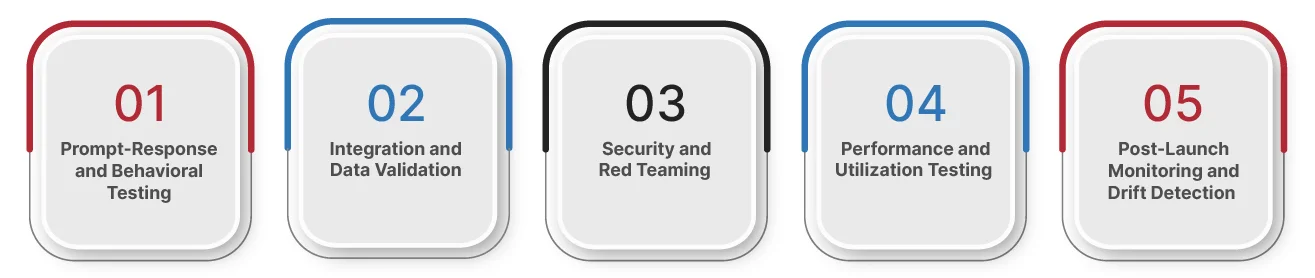
Prompt-Response and Behavioral Testing
Every agent topic and action requires dedicated test cases; test case volume, diversity, and quality all matter. A handful of happy-path prompts is not a test suite. Teams need cases that cover ambiguous intent, boundary scenarios, and adversarial inputs for every defined agent topic.
Integration and Data Validation
Agents that invoke Salesforce flows, retrieve records, or update objects must be tested across those integrations. Data returned by the agent must be validated for accuracy, completeness, and alignment with permissions. A grammatically correct response that draws from the wrong account record is still a failure.
Security and Red Teaming
- Prompt injection testing to verify the agent resists manipulation
- Permission and role-based access validation across different user personas
- Structured adversarial testing to probe for data leakage vectors
- Evaluation of what happens when the agent receives distorted or deliberately crafted inputs
Performance and Utilization Testing
Salesforce recommends explicit utilization and performance testing before production. Agents under concurrent load may behave differently than they do in isolated sandbox sessions. Latency, escalation rates, and token consumption should all be benchmarked.
Post-Launch Monitoring and Drift Detection
Agents do not stay static. Prompt changes, data updates, and model updates can all shift agent behavior over time. Monitoring for behavioral drift after deployment is as important as pre-launch testing. Without it, teams lose visibility into whether the agent that passed UAT is still the agent running in production.
Modernizing Agentforce QA with Native Testing Center and DevOps QA
Enterprises have multiple options for structuring their Agentforce testing practice. Each approach carries different capabilities and limitations worth understanding before committing to a model.
Agentforce Testing Center
The native Agentforce Testing Center supports batch test execution and prompt-level evaluation. The Testing Center improves visibility through metrics, conversation logs, and evaluation feedback, which is useful for early-stage prompt tuning and topic coverage analysis. However, the Testing Center covers single-turn interactions, which means multi-turn conversation flows, complex tool chains, and stateful agent behaviors require supplementary testing approaches. Human analysis of outputs remains necessary at scale.
Salesforce DevOps QA
For teams operating within a Salesforce DevOps lifecycle, testing must integrate with release pipelines, change governance, and regression suites. Agentforce changes should be subject to the same deployment gates as any other Salesforce configuration, with test results required before promotion across environments.
Copado and Pipeline Automation
Copado positions Salesforce testing around AI-powered test creation, parallel execution, end-to-end traceability, and DevOps pipeline visibility. For high-velocity teams managing frequent Agentforce changes, pipeline-integrated automation reduces manual testing bottlenecks and maintains coverage as agents evolve.
Salesforce Agent Validation: The Executive Decision Framework
Salesforce agent validation should not become a tool-selection debate. Enterprises need a decision framework that maps testing methods to business risk. Use native Agentforce testing when teams need fast feedback on prompts, topics, actions, and expected outcomes. This is especially useful during early build cycles and iterative prompt refinement.
Use Salesforce DevOps QA when agent changes affect release velocity and governance. This approach supports regression testing, change control, and deployment confidence.
When to Choose Which Approach
A clear decision framework prevents both overengineering and under-testing.
Choose the native Agentforce Testing Center when:
- The agent is still being shaped.
- Teams need batch testing for prompts.
- Topic and action coverage are the main concerns.
Choose DevOps-integrated testing when:
- Releases happen frequently across Salesforce clouds.
- Regression risk affects core business workflows.
- Teams need automated quality gates before deployment.
Choose Copado or a similar automation when:
- Continuous validation must scale across pipelines.
- Test traceability matters for release decisions.
- Regression suites must run with minimal manual effort.
The best model often blends these options. Tooling gives visibility, while experienced QA teams interpret risk.
How to Operationalize Agentic AI Testing in Salesforce DevOps?
Getting Agentforce testing into a CI/CD pipeline is an operational requirement, not just a technical configuration. Several practical considerations shape whether it works at scale.

Sandbox Strategy
Select the right sandbox type for the testing phase. Developer sandboxes support prompt and unit-level testing. Full sandbox environments are necessary for integration, performance, and regression testing that mirrors production complexity. Partial sandboxes work for mid-tier validation but introduce data completeness gaps that can mask real-world failures.
Test Data Management and Masking
Agents need realistic data to produce realistic behavior. But using production customer records in a sandbox violates data privacy. Enterprises must invest in proper data masking pipelines that preserve referential integrity while anonymizing personally identifiable information. An agent tested on realistic data behaves far more predictably in production than one tested on minimal seed data.
Release Gates and Promotion Criteria
Agentforce configuration changes (prompt updates, topic additions, action modifications) should require passing test results before promotion to the environment. Define explicit promotion gates that include behavioral test pass rates, security test sign-off, and performance benchmarks. This is the same change governance model that applies to Apex and metadata, applied to agent configuration.
Continuous Monitoring After Deployment
Testing does not end at go-live. Continue refinement after deployment based on real-world utilization data. Monitoring frameworks should capture agent performance metrics, escalation rates, and conversation outcomes over time, feeding findings back into the test suite as the agent evolves.
How Can TestingXperts Assist with Salesforce Agentforce Testing?
TestingXperts brings structured enterprise QA expertise to Agentforce deployments, covering the validation dimensions that native tooling leaves partially addressed.
- On the functional side, we design and execute behavioral test suites including adversarial prompt testing, multi-turn conversation validation, and topic and action coverage analysis.
- For security, our team conducts prompt injection testing, permission validation across user roles, and data exposure audits aligned to Salesforce’s own recommended security posture.
- TestingXperts validates agent behavior across Salesforce flows, external APIs, and connected enterprise systems, ensuring that data retrieved and decisions made are accurate end-to-end.
- Performance testing covers concurrent load scenarios, latency benchmarks, and utilization analysis that sandbox-only testing cannot replicate.
- For DevOps alignment, our experts embed Agentforce test execution within CI/CD pipelines, supporting sandbox-to-production promotion gates and regression coverage as agent configuration evolves. This means releases carry documented test evidence, and not just developer confidence.
- For enterprises operating in regulated industries or preparing for compliance reviews, TestingXperts provides independent validation to support audit documentation and executive-level risk reporting.
Do you also want to upscale your Salesforce Agentforce testing strategy? Contact TestingXperts now.
Conslusion
Salesforce Agentforce testing is the control layer that turns promising AI agents into enterprise assets. It gives leaders evidence that agents can answer, decide, and act within approved boundaries. The enterprises that scale Agentforce safely will treat QA as continuous governance. They will combine native testing, Salesforce DevOps QA, automation, monitoring, and independent validation.
Salesforce Agentforce testing should not slow your AI adoption. Partner with TestingXperts to adopt agentic AI more quickly, with greater confidence and accountability.

Director - Delivery
Dynamically dedicated and strategic leader with over 21 years of multicultural and diversified experience in leading Delivery Management, Program Management, and Project Management in Software Testing and Quality Control. Proven expertise in engaging with executive management and diverse teams at all levels, adept at developing IT roadmaps encompassing vision, strategy, and plans.
Discover more