Recommended Blogs

Salesforce CPQ Testing: Protecting Revenue Across Quote-to-Cash

 Last Updated: July 6th, 2026
 Read Time: 6 minutes
Table of Content
- What Is Salesforce CPQ Testing?
- Why CPQ Testing Is Critical for Revenue Protection
- Core Areas of Salesforce CPQ Validation
- Testing the Quote-to-Cash Ecosystem
- Building an Effective Salesforce CPQ Testing Strategy
- How Does TestingXperts Assist with Salesforce CPQ Testing?
- Conclusion
Share On


For global enterprises, Salesforce CPQ often sits between sales ambition and financial control. A broken rule, incorrect bundle, or missed approval can affect margins, billing accuracy, and customer trust.
Salesforce CPQ testing is not only a QA activity. It protects the revenue process from configuration errors, pricing gaps, approval failures, and quote-to-cash disruption.
Salesforce CPQ remains central to many enterprise revenue operations, while some organizations are also evolving toward broader Revenue Cloud and revenue lifecycle management models. The testing requirement remains the same: commercial rules, approvals, integrations, and downstream revenue workflows must work together accurately.
That is why CPQ testing must validate the full commercial workflow. It should cover product setup, pricing logic, quote output, approvals, integrations, performance, and regression risk.
A CPQ release is not ready simply because a quote can be created. It is ready when pricing, approvals, documents, orders, billing data, and revenue workflows remain accurate across the commercial scenarios the business depends on.
What Is Salesforce CPQ Testing?
Salesforce CPQ testing verifies that Configure, Price, Quote workflows function accurately across the entire sales lifecycle. It ensures users can configure products, calculate prices, apply discounts, generate quotes, trigger approvals, and transfer correct data to downstream systems.
This capability supports a wide range of commercial processes, including quote generation, approvals, subscriptions, amendments, renewals, assets, and order management. Each workflow introduces configuration dependencies, pricing logic, and approval rules that directly affect revenue outcomes.
The goal of Salesforce CPQ testing is not simply to confirm that the application works. It is to ensure the business can sell the right products, at the right price, with the right approvals, while maintaining billing accuracy and financial control across the quote-to-cash process.
Why CPQ Testing Is Critical for Revenue Protection
CPQ failures are expensive because they occur near the revenue line. Sales teams depend on correct pricing, finance teams depend on controlled discounting, and customers depend on accurate quote documents.
Grand View Research estimates the global CPQ software market at USD 3.9 billion in 2026 and projects it to reach USD 10.9 billion by 2033. This growth reflects the increasing enterprise need to manage complex configurations and pricing structures with greater accuracy.
As CPQ adoption grows, testing maturity must keep pace. A weak Salesforce CPQ testing model turns every product update, price change, and package release into a revenue control risk.
Core Areas of Salesforce CPQ Validation
Salesforce CPQ combines product configuration, pricing logic, business rules, and quote calculations to support complex selling scenarios. Testing must validate how these components interact to ensure accurate pricing, valid configurations, and consistent quote behavior across the sales lifecycle.
Testing Product Catalog Integrity
Product catalog testing ensures users can select the right products in the right combinations. This is critical for bundled products, required options, excluded options, regional catalogs, and compatibility constraints.
Test cases should cover:
- Valid and invalid bundle combinations
- Required and optional product selections
- Product dependencies and exclusions
- Quantity limits and configuration constraints
- Regional catalog visibility and permissions
Catalog integrity directly affects sales speed and quote accuracy. If sales teams can select invalid products, downstream billing and fulfillment risks increase.
Validating Pricing Rules and Discount Logic
Pricing is where CPQ testing becomes a revenue assurance discipline. Enterprises must validate list prices, partner pricing, contracted pricing, volume discounts, manual overrides, approvals, and subscription terms.
Testing should include quote-wide discounts, line-level discounts, ramp pricing, co-terming, renewal pricing, and usage-based pricing. Each scenario should confirm the expected net price, margin impact, and approval behavior.
Teams should test unauthorized discounts, expired price books, missing pricing data, conflicting price rules, and approval bypass scenarios.
Testing Quote Generation and Approval Workflows
A quote is more than a document. It is the customer-facing version of pricing, terms, product details, and commercial commitments.
Quote generation testing should validate document templates, merged fields, legal terms, currencies, taxes, signatures, and localized content. It should also confirm that approvals are triggered correctly before the final quote is output.
Salesforce CPQ supports quote document creation and advanced approvals, including approval conditions and approver sequencing. These workflows need business-led validation because small document errors can create contractual risk.
The quote itself is only one part of the revenue lifecycle. Enterprises must also validate how CPQ interacts with downstream systems and financial processes.
Testing the Quote-to-Cash Ecosystem
Salesforce CPQ operates within a broader quote-to-cash process involving ERP, billing, and revenue systems. Testing should therefore validate not only CPQ functionality but also the downstream workflows and integrations that support commercial operations.
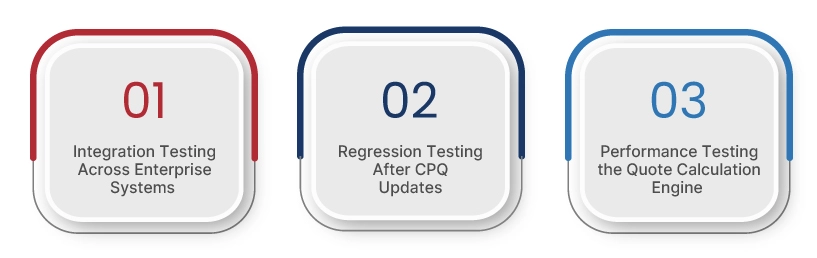
Integration Testing Across Enterprise Systems
CPQ rarely operates alone. It exchanges data with ERP, billing, tax, contract lifecycle management, revenue recognition, and data warehouse systems.
Integration testing must verify product IDs, account data, pricing fields, tax fields, contract terms, billing schedules, and order data. It should also test error handling when downstream systems reject incomplete or invalid data.
The highest-value scenarios are quote-to-order, quote-to-cash, amendment-to-billing, and renewal-to-revenue workflows. These flows show whether CPQ supports real business operations.
Regression Testing After CPQ Updates
Salesforce CPQ environments change often through configuration updates, new price rules, product changes, custom code, and managed package updates. Regression testing protects existing revenue workflows when those changes occur.
A strong regression pack should include critical products, common discounting scenarios, high-risk approvals, renewal quotes, amendment quotes, and integration handoffs.
Regression should not test everything equally. It should prioritize scenarios with the highest impact on revenue, compliance, sales productivity, and customer commitments.
Performance Testing the Quote Calculation Engine
CPQ performance affects sales execution. Slow calculations, timeout errors, and delayed quote saves can reduce sales productivity during peak periods.
Effective performance testing services should simulate large quotes, complex bundles, heavy discounting, approval triggers, and concurrent user activity. Teams should assess calculation time, page response time, quote-save performance, and integration latency. The goal is to build sales confidence as quote complexity increases.
Building an Effective Salesforce CPQ Testing Strategy
Successful Salesforce CPQ testing requires more than functional validation. Enterprises need a strategy that balances business risk, release speed, and long-term maintainability. This includes defining ownership, involving business stakeholders, prioritizing high-impact scenarios, and adopting the right mix of manual and automated testing approaches.
User Acceptance Testing with Sales and Finance Teams
User acceptance testing should involve sales, finance, operations, product owners, and revenue teams. Each group views CPQ risk differently.
Sales validates usability and quoting speed. Finance validates pricing control and discount governance. Operations validates order accuracy. Revenue teams validate downstream recognition and billing readiness.
UAT should use realistic deal scenarios rather than generic test data. The best test cases come from actual quote patterns, edge cases, and exception workflows.
Automation Approaches for Salesforce CPQ
Modern test automation services deliver the most value when CPQ scenarios are repeatable, high-risk, and stable enough for scripted validation. Regression testing is usually the strongest starting point.
Provar can support Salesforce-aligned automation. Copado can support DevOps and release governance. Custom Selenium frameworks may help when teams need flexibility across Salesforce and external systems.
The right approach depends on the level of customization, test data maturity, release frequency, and integration complexity. Automation should reduce regression effort without hiding business risk.
How Does TestingXperts Assist with Salesforce CPQ Testing?
With specialized Salesforce Testing Services, TestingXperts helps enterprises transform Salesforce CPQ testing into a business assurance function that protects revenue, accelerates releases, and improves commercial confidence across the quote-to-cash lifecycle.
We support Salesforce CPQ initiatives through:
Core CRM and Sales Cloud Testing
We validate opportunity management, account structures, approval workflows, custom Lightning components, and quote-to-cash processes to ensure CPQ configurations align with broader sales operations and CRM workflows.
Integration and Data Migration Testing
Our teams verify integrations across ERP, billing, taxation, revenue recognition, and middleware platforms while validating data mapping, transformation, and synchronization throughout the quote-to-cash journey.
Automation and Continuous Testing
TestingXperts implements Salesforce-focused automation frameworks that accelerate regression cycles, improve release confidence, and support continuous delivery across rapidly changing CPQ environments.
Performance and Scalability Validation
We assess quote calculation performance, large product bundles, concurrent user activity, and integration latency to ensure CPQ remains responsive during peak business periods and high-volume sales cycles.
AI-Led Quality Engineering
Our AI-led Quality Engineering approach improves test coverage, prioritizes business risk, and enables faster defect detection across complex pricing, configuration, and approval workflows.
Enterprise Release Assurance
TestingXperts helps organizations manage package upgrades, configuration changes, and release dependencies through risk-based regression strategies and proactive impact analysis.
By combining Salesforce domain expertise, AI-led Quality Engineering, and global delivery capabilities, TestingXperts enables enterprises to release CPQ changes with greater control, lower risk, and higher business confidence.
Conclusion
Salesforce CPQ testing services Protect the commercial engine of the enterprise by ensuring every quote reflects the right product, price, approval, document, and downstream transaction.
As CPQ environments become more complex, organizations need more than functional validation. They need enterprise application testing strategies that protect revenue workflows, reduce release risk, and maintain confidence across the quote-to-cash lifecycle.
TestingXperts helps enterprises strengthen Salesforce CPQ quality through risk-based testing, automation, integration validation, performance assurance, and AI-led Quality Engineering across quote-to-cash workflows. This enables organizations to deliver CPQ changes faster, with greater control, lower risk, and stronger business confidence.

Director - Delivery
Dynamically dedicated and strategic leader with over 21 years of multicultural and diversified experience in leading Delivery Management, Program Management, and Project Management in Software Testing and Quality Control. Proven expertise in engaging with executive management and diverse teams at all levels, adept at developing IT roadmaps encompassing vision, strategy, and plans.
FAQs
What should be included in Salesforce CPQ test cases?
Salesforce CPQ test cases should cover product configuration, pricing rules, discounts, approvals, quote generation, subscriptions, renewals, amendments, integrations, and downstream quote-to-cash workflows. Test scenarios should also include exceptions, edge cases, and invalid configurations.
What are common Salesforce CPQ testing challenges?
Common Salesforce CPQ testing challenges include complex pricing rules, product dependencies, approval workflows, frequent configuration changes, managed package upgrades, test data management, and validating integrations across ERP, billing, and revenue systems.
Why is software quality assurance important for Salesforce CPQ?
Software quality assurance services help organizations prevent pricing errors, invalid product configurations, approval failures, and downstream billing issues. It ensures Salesforce CPQ supports accurate transactions, revenue protection, regulatory compliance, and customer trust.
Discover more