Recommended Blogs

End-to-End Validation: From Release Checkpoint to Continuous Confidence

 Last Updated: July 17th, 2026
 Read Time: 6 minutes
Table of Content
- Why End-to-End Validation Must Move Beyond the Release Checkpoint
- Designing an End-to-End Testing Strategy for Digital Enterprises
- Scaling End-to-End Test Automation for Continuous Confidence
- Turning Test Evidence into Release Decisions
- How TestingXperts Helps Enterprises Strengthen End-to-End Validation
- Conclusion
Share On


End-to-end validation should no longer be treated as the last gate before production. Enterprise releases now flow through connected applications, APIs, data platforms, cloud services, and third-party dependencies. One component can pass its tests while the full business journey still fails. That gap can affect revenue, disrupt operations, erode customer trust, or expose compliance risk.
Digital businesses need a quality model that provides evidence throughout the delivery process. Critical business outcomes should be validated whenever code, data, configuration, or infrastructure changes. That is how end-to-end validation moves from a release checkpoint to a model for continuous confidence.
Continuous confidence means leaders have ongoing evidence that critical business journeys remain reliable, secure, scalable, and ready for release as systems change for continuous confidence.
Key Takeaways
- End-to-End validation should operate continuously, confirming that complete business journeys remain reliable across applications, integrations, data, infrastructure, and changing release conditions.
- Risk-based testing prioritizes critical workflows by operational, financial, customer, and compliance impact, ensuring effort focuses where failure would cause the greatest harm.
- Effective automation combines unit, API, integration, UI, and end-to-end checks, using each layer to balance speed, coverage, maintainability, and business confidence.
- Continuous confidence depends on representative test data, stable environments, production feedback, and decision dashboards that connect technical results with business risk.
Why End-to-End Validation Must Move Beyond the Release Checkpoint
Traditional release testing often asks whether the application is ready after development is largely complete. Modern end-to-end validation asks a stronger question throughout delivery: can the enterprise process still achieve its intended outcome?
Release Confidence Is a Business Control
End-to-End validation for release readiness connects technical evidence with business exposure. It checks whether high-value journeys remain reliable across systems, roles, data states, devices, regions, and integrations.
Tricentis’ 2026 Quality Transformation Report found that 60% of global organizations are shipping untested code as software development accelerates. That finding shows why release confidence cannot depend only on a final testing window or isolated pass rates.
Executives need evidence that a release protects revenue, service continuity, customer experience, and regulatory obligations. Quality leaders must therefore present risk by business process, not only by defect count.
The Enterprise System Is the Real Test Subject
End-to-end software testing must reflect how work actually moves across the organization. A customer order may cross a portal, a payment service, an inventory platform, an ERP, a warehouse application, and a notification engine.
Testing each component independently remains necessary, but it does not prove the complete journey works. The end-to-end layer validates handoffs, data integrity, business rules, access controls, and recovery behavior across the full chain.
This view changes the test design. Teams stop treating applications as separate products and start treating connected business flows as the primary assurance unit.
Designing an End-to-End Testing Strategy for Digital Enterprises
An End-to-End testing strategy for digital enterprises should begin with business risk, not a catalogue of screens. The strategy must identify where failure would cause the greatest operational, financial, customer, or compliance impact.
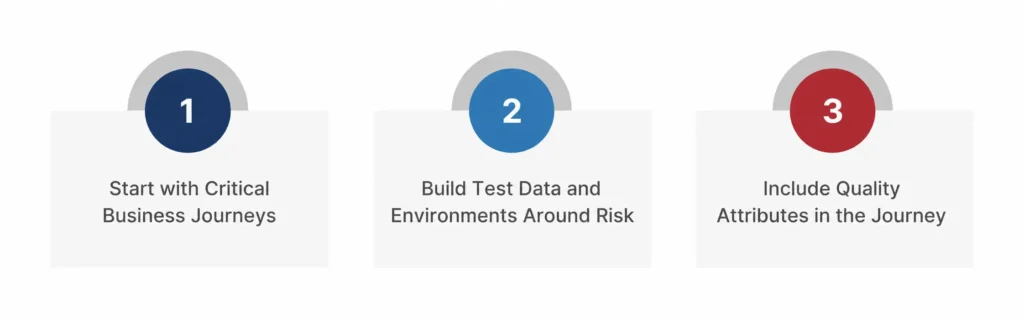
Start with Critical Business Journeys
Teams should map the processes that matter most to enterprise performance. Common examples include order-to-cash, claims processing, digital onboarding, policy servicing, patient scheduling, and financial close.
Each journey should have a defined owner, expected outcome, risk rating, and release criterion. Test coverage should follow the journey across every dependent system rather than stop at organizational boundaries.
A practical journey map should capture:
- Entry points, user roles, and approval paths
- Data created, transformed, stored, and exchanged
- Internal services and external dependencies
- Failure points, fallback behavior, and recovery needs
- Business controls, audit evidence, and regional rules
This approach helps leaders see which release risks are covered, and which remain exposed.
Build Test Data and Environments Around Risk
To test an enterprise application end-to-end, you need representative data and stable environments. If test data does not reflect production complexity, a passing test can become meaningless.
Teams need datasets that reflect valid, invalid, rare, and high-risk conditions. The data must also be governed through privacy controls, masking rules, refresh processes, and clear ownership.
Environment strategy is equally important. Service virtualization can help reduce dependency delays when external systems are not yet available or are too expensive to access. Controlled simulations also enable teams to validate failure conditions that are otherwise difficult to safely reproduce.
Include Quality Attributes in the Journey
Functional correctness is only one element of release confidence. A successful business journey can still stumble at the height of demand, expose sensitive data, or create an inaccessible user experience.
End-to-End validation should therefore incorporate performance, security, resilience, accessibility and data integrity checks as required by business risk. These controls should be coupled with the same critical journeys used for functional testing.
This leads to stronger evidence for the decision. Leaders can test if the journey works, scales, recovers, and protects users in real-world conditions.
Scaling End-to-End Test Automation for Continuous Confidence
End to End test automation is useful when it provides meaningful coverage and accelerates feedback. Its value diminishes when teams automate brittle scenarios, duplicate tests at a lower level, or maintain large test suites without clear business ownership.
Automate at the Right Layers
A balanced automation model uses unit, API, integration, UI, and end-to-end checks for different purposes. The lower layers offer faster feedback, and the end-to-end layer ensures critical business journeys are not broken.
The aim is not to automate every possible path through the interface.
End-to-end automation should focus on high-value journeys, cross-system risks, and release decisions that require full evidence.
Stable APIs should carry much of the validation burden. Target user critical interactions and workflows that cannot be proven elsewhere via UI automation.
Make Automation Adaptive and Maintainable
Enterprise applications change with code releases, configuration updates, platform upgrades, data changes, and vendor patches.
Automation must absorb that change without creating constant maintenance work.
Reusable components, controlled object models, version control, and clear test ownership contribute to sustainability. AI-powered test selection can help focus execution on journeys affected by recent changes.
Maintenance is product work. Teams need clear standards for retiring redundant tests, fixing unstable assets and reviewing coverage after architecture changes.
Turn Test Evidence into Release Decisions
Pass rates alone do not create ongoing confidence. Leaders need visibility into tested journeys, open business risk, dependency health, environment stability and production signals.
Good dashboards relate test results to scope of release and business criticality. They show what changed, what was validated, what failed, and what risk is still accepted.
Continuous feedback should continue after deployment as well. Observability of production, incident patterns, and customer behavior can reveal gaps that should improve future test design.
This creates a closed quality circle. Each release strengthens the case for the next release.
Turning Test Evidence into Release Decisions
Pass rates alone do not create ongoing confidence. Leaders need visibility into tested journeys, open business risk, dependency health, environment stability, and production signals.
Good dashboards connect test results to release scope and business criticality. They show what changed, what was validated, what failed, and what risk is being accepted.
Continuous feedback should continue after deployment as well. Production observability, incident patterns, and customer behavior can reveal gaps that should improve future test design.
This creates a closed quality loop. Each release strengthens the evidence base for the next release.
How TestingXperts Helps Enterprises Strengthen End-to-End Validation
TestingXperts helps enterprises shift end-to-end validation from a late release activity into an operating model for continuous confidence. Our approach focuses on business journeys, risk visibility, automation value, and measurable release readiness.
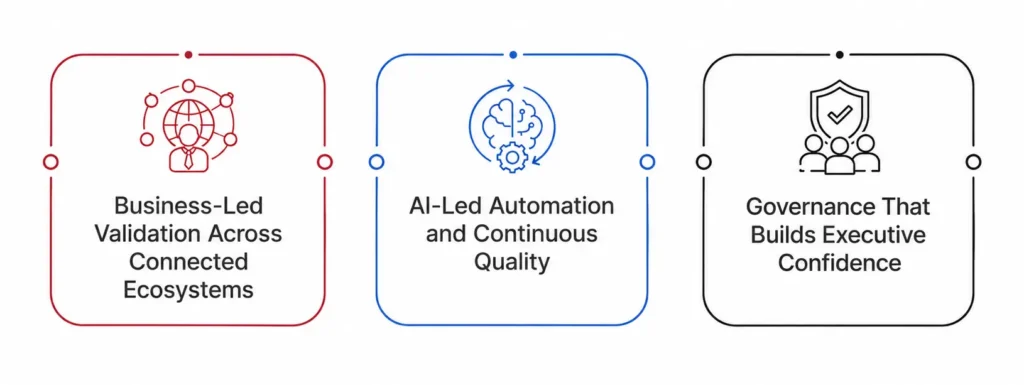
Business-Led Validation Across Connected Ecosystems
TestingXperts maps critical processes across ERP, CRM, web, mobile, APIs, cloud platforms, data services, and partner systems. This builds coverage around enterprise outcomes, not just isolated application behavior.
Risk-based design prioritizes journeys that protect revenue, compliance, operational resilience, and customer experience. Domain knowledge also supports realistic scenarios across regulated and high-volume industries.
AI-Led Automation and Continuous Quality
TestingXperts helps enterprises establish end-to-end testing services across automation engineering, service virtualization, test data management, and CI/CD quality controls.
AI-driven techniques can support test generation, impact analysis, asset maintenance, and execution prioritization. These capabilities help quality teams focus effort on the highest-risk changes and business journeys.
The purpose is practical: faster feedback, stronger coverage, and better release evidence without turning automation volume into another operational burden.
Governance That Builds Executive Confidence
TestingXperts helps define release criteria, ownership models, quality metrics, and decision dashboards. These controls give business and technology leaders a common view of release readiness.
This approach positions quality engineering as a capability for release confidence. It also supports enterprise scale by linking delivery teams, platforms, and business owners through consistent assurance standards.
Conclusion
End-to-end validation gives digital enterprises a clearer way to manage release risk across connected systems and critical business journeys. It moves quality beyond a final checkpoint and creates continuous evidence for faster, safer release decisions.
A mature model combines risk-based journey design, representative test data, layered automation, non-functional assurance, release dashboards, and production feedback. With this foundation, end-to-end validation becomes a business control rather than a testing phase.
For enterprises operating complex platforms and high-value digital journeys, TestingXperts helps build the end-to-end validation model needed to release with greater confidence.

Associate Vice President Delivery
Experienced Director- Quality Assurance with a demonstrated history of working in the information technology and services industry. Skilled in Requirements Analysis, Agile Methodologies, Test Automation, Mobile Applications, and Test Management. Strong quality assurance professional with a Bachelor of Engineering - BE focused in Electrical, Electronics and Communications Engineering from Model Institute of Engineering and Technology.
FAQs
What Is End-to-End Validation?
End-to-End validation confirms that a complete business journey works across applications, integrations, data flows, roles, and supporting infrastructure.
How Does End-to-End Test Automation Improve Release Readiness?
It provides repeatable evidence for critical journeys and shortens feedback cycles. Teams can identify cross-system failures before they affect production.
What Should Enterprises Automate First?
Enterprises should begin with stable, high-risk journeys that run frequently and affect revenue, compliance, operations, or customer experience.
Discover more