Recommended Blogs

Release Confidence in the AI Era: Why AI-Led Delivery Needs a New Model

 Last Updated: July 15th, 2026
 Read Time: 4 minutes
Table of Content
- Why Release Confidence Has Become a Boardroom Priority
- What Release Confidence Means in the AI Era
- Why AI-Led Delivery Increases Release Risk
- The New Release Confidence Model
- How Enterprises Should Measure Release Readiness
- Building Governance Into AI-Led Releases
- How TestingXperts Helps Enterprises Strengthen Release Confidence
- Conclusion
Share On


AI-assisted development, autonomous coding tools, and intelligent delivery pipelines are increasing the volume and pace of software change. That speed can improve innovation and responsiveness, but it also creates a new release-control challenge.
AI-generated code, complex integrations, frequent deployments, and evolving compliance requirements can create quality gaps that traditional testing approaches struggle to detect. As a result, enterprises can face a growing confidence gap between release velocity and production readiness.
The question is no longer whether teams can release faster. It is whether leaders have enough evidence to approve faster releases without turning speed into unmanaged business exposure.
Why Release Confidence Has Become a Boardroom Priority
Release confidence is now a business decision, not only a QA metric. Every digital release can affect revenue, customer experience, security, and operational continuity. For CIOs and CTOs, the issue is clear. Faster delivery creates value only when quality keeps pace. A failed release can disrupt transactions, damage user trust, and increase support costs.
In the AI era, the risk is bigger. AI-generated code, autonomous workflows, and complex integrations can introduce defects that are harder to detect through traditional testing.
That makes release confidence a shared responsibility across engineering, QA, security, compliance, product, and business leadership.
What Release Confidence Means in the AI Era
Release confidence means having evidence that a software release is ready for production. It goes beyond test completion reports or defect counts. Enterprises need confidence that critical business processes still work. They also need assurance that integrations, data flows, AI outputs, and user journeys behave as expected. In practical terms, release confidence answers three executive questions.
- Can we release now?
- What business risk remains?
- What evidence supports the decision?
Why AI-Led Delivery Increases Release Risk
AI-led speed changes the risk profile of software delivery. Agile, DevOps, and AI-assisted engineering compress release cycles. This reduces waiting time but increases pressure on validation. Traditional testing models often struggle in this environment. Late-stage testing creates bottlenecks. Manual regression slows delivery. Siloed QA creates blind spots across platforms and business workflows. The result is a confidence gap. Teams may move faster, but leaders lack clear evidence that releases are safe, compliant, and production ready.
The New Release Confidence Model
Modern release confidence requires an AI-led, risk-based, continuous quality model. Testing cannot remain a final checkpoint. It must become part of the delivery system. The new model is built around three shifts: testing moves earlier, validation becomes continuous, and release decisions are supported by risk evidence rather than activity reports.
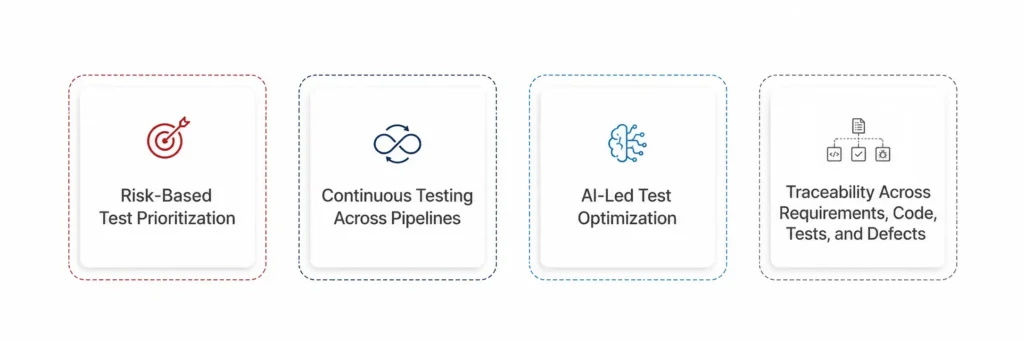
Risk-Based Test Prioritization
Not every feature carries the same business risk. Enterprises should identify the workflows that matter most to revenue, compliance, operations, and customer trust.
These workflows need deeper validation. Examples include payment journeys, claims processing, order management, identity and access management, financial reporting, and customer onboarding.
Risk-based testing helps teams focus their efforts where failure would hurt the business most.
Continuous Testing Across Pipelines
Continuous testing gives teams more feedback. It validates code, APIs, integrations, data, performance, and security across the delivery lifecycle.
This approach reduces late surprises. It also helps engineering, QA, and product teams make faster release decisions with shared evidence.
For enterprise leaders, the value is simple. Quality becomes visible before the release window, not after production issues appear.
AI-Led Test Optimization
AI-led quality engineering improves how testing is planned, executed, and maintained. It can support test selection, defect prediction, impact analysis, and automation maintenance.
This matters because enterprise systems change constantly. AI-led testing helps teams identify high-risk areas faster and reduce wasted effort on low-value execution.
The goal is not to replace QA judgment. The goal is to strengthen decision-making with better intelligence.
Traceability Across Requirements, Code, Tests, and Defects
AI-led delivery increases the need to connect every release decision back to evidence. Teams should be able to trace requirements, code changes, test results, defects, approvals, and production signals across the release lifecycle. Traceability helps leaders understand what changed, what was validated, what risk remains, and who approved the release decision.
How Enterprises Should Measure Release Readiness
Release confidence must be measurable. Leaders need dashboards that show business risk, not only test activity.
Useful release readiness indicators include:
- Regression pass rate for critical workflows
- Open high-severity defects
- Automation coverage for core journeys
- Test environment stability
- Production defect trends
- API and integration health
- Performance readiness under expected load
- Security and compliance validation status
- Change impact by application, workflow, and integration
- Traceability coverage from requirements to test evidence
These metrics should be tied to release decision criteria. A release should not move forward because testing is complete. It should move forward because the risk is understood and acceptable.
Building Governance Into AI-Led Releases
AI makes governance more important. Enterprises must know how AI-generated code is reviewed, tested, approved, and monitored. Governance should also define when human review is mandatory, which changes require additional validation, and how exceptions are recorded when teams accept residual risk.
Governance should define ownership across engineering, QA, security, compliance, and business teams. It should also define release criteria for AI-assisted features and AI-enabled workflows.
Strong governance includes human review for high-risk changes. It also requires traceability from requirements to test evidence, defect resolution, and production monitoring.
This creates a defensible release model. Leaders can approve releases with confidence because every decision is supported by evidence.
How TestingXperts Helps Enterprises Strengthen Release Confidence
TestingXperts helps enterprises build release confidence through AI-led Quality Engineering, continuous testing, and risk-based assurance.
Our approach connects business-critical workflow validation, automation maturity, platform risk, compliance expectations, and production readiness into one release confidence model.
TestingXperts supports enterprises through:
- AI-led test strategy and release assurance
- Continuous testing across DevOps pipelines
- Risk-based regression testing
- Test automation design and maintenance
- Enterprise application and ecosystem assurance
- Performance, security, and compliance validation
- Executive release readiness dashboards
The outcome is stronger release governance. Enterprises gain the evidence needed to make faster release decisions while reducing avoidable production, compliance, and operational risk.
Conclusion
Release confidence is becoming the operating standard for enterprise software delivery in the AI era. AI can accelerate engineering, but disciplined Quality Engineering is what helps protect the business from hidden release risk.
Enterprises that connect AI-led QE, continuous testing, automation, traceability, and governance can release with greater control. They can also make faster decisions without relying on optimism or incomplete evidence.
The strongest release models do not slow innovation. They give leaders the evidence to decide when speed is safe.

VP, AI & QE Transformation
Michael Giacometti is the Vice President of AI and QE Transformation at TestingXperts. With extensive experience in AI-driven quality engineering and partnerships, he leads strategic initiatives that help enterprises enhance software quality and automation. Before joining TestingXperts, Michael held leadership roles in partnerships, AI, and digital assurance, driving innovation and business transformation at organizations like Applause, Qualitest, Cognizant, and Capgemini.
FAQs
What is release confidence?
Release confidence is the evidence-based assurance that a software release is ready for production with an acceptable level of business risk.
Why is release confidence important in the AI era?
AI-assisted development increases delivery speed. It also creates new verification challenges that require stronger QA, governance, and risk controls.
How can enterprises improve release confidence?
Enterprises can improve release confidence through AI-led QE, continuous testing, risk-based prioritization, automation, and executive release dashboards.
How does TestingXperts support release confidence?
TestingXperts supports release confidence through AI-led quality engineering, continuous testing, automation, enterprise assurance, and release readiness governance.
Discover more