Recommended Blogs

Why AI-Accelerated Software Delivery is Creating a Release Confidence Gap

 Last Updated: July 8th, 2026
 Read Time: 5 minutes
Table of Content
- Why Faster Software Delivery Is Creating a Release Confidence Gap
- The Bottleneck Has Shifted from Writing Code to Trusting It
- Why Traditional Release Gates Are Losing Relevance
- What Release Confidence Means in an AI-Accelerated Enterprise
- Closing the Release Confidence Gap Without Slowing Delivery
- Conclusion
Share On


Imagine a release review three years ago. The CTO asks how much code is going out this quarter, and the number is manageable. Now picture the same review today: AI coding assistants have multiplied output, half the code was machine-generated, and nobody in the room can say with certainty which half. The release ships on schedule. But whether it was actually safe to ship (secure, stable, and fully validated) is a question no one in the room can answer with evidence, because the code arrived faster than anyone could verify it.
That gap between how fast enterprises can ship and how well they can trust what they ship is the defining delivery problem of the AI coding era. Code creation has accelerated, but release control has not kept pace. The release confidence gap appears when delivery teams can generate change faster than the enterprise can validate, trace, govern, and approve it with evidence. This blog examines why that imbalance has become a business liability and how to fix it without sacrificing speed.
Why Faster Software Delivery Is Creating a Release Confidence Gap
AI-assisted development has changed the front end of software delivery. GitLab’s 2026 AI Accountability research found that 78% of respondents say developers are writing and committing code faster since adopting AI tools, while 79% agree that overall software delivery has not accelerated at the same pace. The result is an AI paradox: code output is increasing, but review, validation, governance, and release readiness are becoming harder to scale.
Why? Because everything downstream of code generation, like review, validation, security checks, regression, and sign-off, was built for human-speed output. Assurance capacity hasn’t grown with code volume, so risk accumulates in the gap. The same research found that 82% of organizations believe AI-generated code risks creating a new form of technical debt they are not prepared to manage. The risk is that AI increases the volume of change faster than the organization can validate it. That creates pressure across the delivery chain:
- More code to review
- More dependencies to assess
- More regression risk
- More security and compliance questions
- More release decisions that need evidence
In the AI coding era, speed is only valuable when the release process can keep up.
The Bottleneck Has Shifted from Writing Code to Trusting It
For years, software leaders treated coding speed as a major delivery constraint. AI has weakened that constraint, and now, the new constraint is trust. In the same GitLab research, 85% of respondents agree that the bottleneck has shifted from writing code to reviewing and validating it. This matters because AI-assisted change creates a different type of management problem. The enterprise must know:
- Are the changes secure, or did an AI assistant reproduce a vulnerable pattern at scale?
- Is it stable under production load?
- Is the code compliant, and can we prove that to an auditor?
- Who is accountable for it once it’s live?
The trust problem is compounded by a visibility problem, as you cannot govern what you cannot identify. And there’s also a confidence gap. While 87% of leaders felt sure their teams could determine within 24 hours whether AI-generated code contributed to a production incident, a third of organizations that actually had an incident couldn’t make that determination. Confidence, it turns out, is not the same as confidence with evidence.
Why Traditional Release Gates Are Losing Relevance
Traditional release gates were built for a slower delivery world. They often rely on manual review meetings, late regression cycles, disconnected signoffs, and a final go/no-go discussion close to deployment. Against AI-driven velocity, each traditional gate starts to strain. Against AI-driven velocity, each traditional gate is straining:
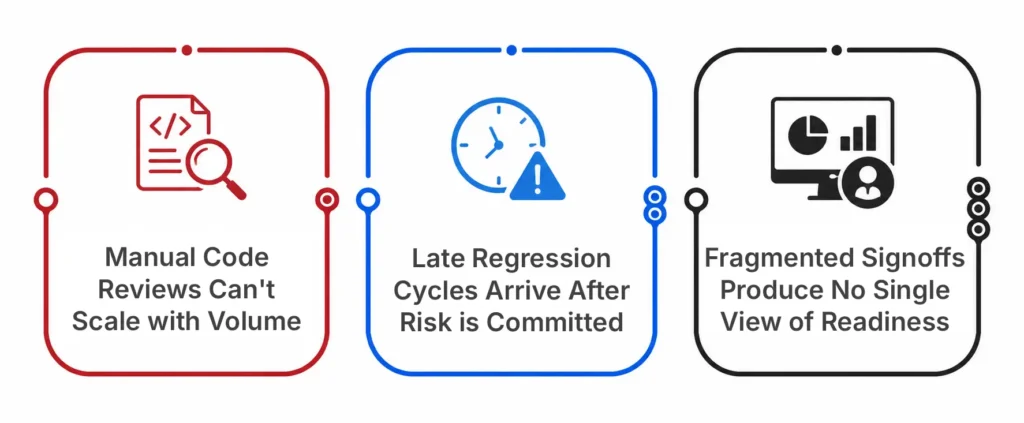
- Manual Code Reviews Can’t Scale with Volume: When AI multiplies output, human reviewers become the queue. Reviews either slow everything down or get rubber-stamped; both defeat the purpose.
- Late Regression Cycles Arrive After Risk is Committed: A suite that runs days before release tests an accumulation of changes, making it slow to run and nearly useless for pinpointing which change caused a problem.
- Fragmented Signoffs Produce No Single View of Readiness: Security approves in one tool, QA in another, compliance over email. Nobody owns the consolidated answer to “is this release safe?”, so the decision defaults to schedule pressure.
A traditional gate might ask, “Did testing pass?” However, a modern release confidence model asks better questions:
- What has changed since the last release?
- Which business critical workflows are affected?
- Which regression tests run automatically?
- Which risks were accepted and by whom?
- Can the release decision be reconstructed after an incident?
- Is confidence established continuously or only at the end?
This is the difference between process and control. Enterprises do not need more meetings at the end of delivery. They need stronger evidence throughout delivery.
What Release Confidence Means in an AI-Accelerated Enterprise
Release confidence is the ability to make a go-live decision backed by evidence rather than optimism. In practice, it rests on six capabilities, each answering a question leadership should be able to ask before any deployment:
| Capability | The leadership question it answers |
|---|---|
| Risk-based validation | Are we testing hardest where failure costs the most? |
| Automated regression | Can we re-verify critical functionality on every change, not just before releases? |
| Impact analysis | Do we know which specific change this touches before it ships? |
| Release evidence | Can we show, not just claim, that this release was validated? |
| Traceability | Can we trace any line of code (human or AI-written) back to its origin and approval? |
| Business-critical workflow assurance | Do the journeys that carry revenue and trust still work end to end? |
This table is a decision system that converts delivery activity into a signal a leader can act on, at the speed AI-assisted development actually moves.
Closing the Release Confidence Gap Without Slowing Delivery
AI will continue to increase delivery velocity as more teams adopt AI coding assistants. Which means more code will enter enterprise systems faster, and more releases will include changes that are partially or fully AI-assisted.
Slowing down surrenders the competitive gains that justified AI adoption, while accelerating blindly will convert those gains into incident costs, audit findings, and technical debt. The organizations that will win do neither. They build control that operates at the speed of their delivery. This is where Release Confidence must become an operating model, not a final approval meeting. At TestingXperts, our Release Confidence approach helps enterprises connect validation, automation, risk visibility, and governance into a clearer release decision process. Our Release Confidence model provides:
- A release readiness view before production.
- Visibility into QA bottlenecks, coverage gaps, and regression risks.
- An automation opportunity map for repetitive QA effort.
- A risk-based roadmap focused on the highest exposure areas.
- An auditable decision artifact that supports post-release scrutiny.
The outcome is a governed, auditable release decision before deployment rather than a reconstruction after something breaks. TestingXperts helps enterprises identify QA bottlenecks, coverage gaps, regression risks, and automation opportunities across the delivery cycle, then prioritize improvements based on where business exposure is highest.
Conclusion
AI coding is increasing software delivery speed, but speed alone is not a business advantage. Without control, it can lead to technical debt, security risks, compliance exposure, and poor release decisions. Release confidence is now the control layer that connects AI-assisted development with enterprise trust. Four questions will tell you:
- Can we identify which code in our next release was AI-generated, and does it matter to our approval process?
- When we approve a release, is the decision based on evidence we could present to a regulator, or on the absence of bad news?
- If a severity-1 incident happened tomorrow, how long would it take to trace the responsible change to its origin?
- Is our release decision repeatable across teams, or does it depend on who is in the room?
The enterprises that win will not be the ones that generate code fastest. They will be the ones that combine AI-driven speed with evidence-based release control. A Release Readiness Assessment can help identify where validation, traceability, automation, and governance need to improve before AI-driven delivery speed turns into unmanaged release risk.

VP, AI & QE Transformation
Michael Giacometti is the Vice President of AI and QE Transformation at TestingXperts. With extensive experience in AI-driven quality engineering and partnerships, he leads strategic initiatives that help enterprises enhance software quality and automation. Before joining TestingXperts, Michael held leadership roles in partnerships, AI, and digital assurance, driving innovation and business transformation at organizations like Applause, Qualitest, Cognizant, and Capgemini.
Discover more