Recommended Blogs

Automation Testing Beyond Script Coverage: Building Release Intelligence

 Last Updated: July 13th, 2026
 Read Time: 6 minutes
Table of Content
- Why Automation Testing Must Move Beyond Script Coverage
- What Release Intelligence Means for Enterprise QA
- How to Build an Automation Testing Strategy That Reflects Risk
- Where AI-Led Automation Testing Changes the Model
- Selecting the Right Test Automation Framework
- What Enterprise Automation Testing Should Measure Now
- How TestingXperts Helps Enterprises Build Release Intelligence Through Automation
- Conclusion
Share On


Key Takeaways
- Automation testing should focus on release confidence, not just script coverage, by validating business-critical workflows and providing meaningful insights into production readiness and risk.
- Release intelligence combines test results, defect trends, risk scores, and production signals to help engineering and business leaders make informed release decisions.
- AI-led automation testing improves test prioritization, maintenance, and failure analysis, delivering greater efficiency when supported by a strong automation strategy and governance.
- A successful automation strategy aligns testing with business outcomes through risk-based coverage, scalable frameworks, CI/CD integration, and metrics that measure release readiness.
Most automation programs are not failing because teams lack scripts. They struggle because scripts do not always explain release risk.
Automation Testing has helped enterprises reduce repetitive effort and shorten regression cycles. Yet many leaders still lack a clear answer before release approval. They know how many tests passed. They do not always know whether the business is safe to release.
Why Automation Testing Must Move Beyond Script Coverage
Script coverage was a good milestone for early QA automation programs. It showed that repeated checks could be done more quickly and with fewer manual steps. That model is no longer enough for modern enterprise systems. Use cases span APIs, cloud services, mobile channels, packaged platforms, and data pipelines.
A script can pass while a business process remains exposed. A checkout flow might work on screen but not in payment reconciliation. A customer onboarding journey might pass functional checks and fail identity verification. These are release risks, not just testing gaps.
The Coverage Trap
The coverage trap begins when quantity starts to replace judgment. Dashboards make higher percentages look good, so teams automate more cases. Over time, suites become larger, slower, harder to maintain, and less connected to actual business risk.
Automation Testing is not script inventory management. It should be a more accurate way to understand release readiness.
What Release Intelligence Means for Enterprise QA
Release intelligence connects QA automation signals to release decisions. It turns test execution into evidence of release confidence. This evidence may include test results, defect trends, risk scores, environment stability, and production feedback. The value is in the combination of these signals.
An experienced automation testing company helps enterprises unify these quality signals, enabling teams to make informed release decisions based on business risk rather than test execution alone.
- Which critical journeys are ready for production?
- Which defects carry customer or revenue impact?
- Which integrations still show repeated instability?
- Which releases need added controls before approval?
- Which areas need deeper testing next cycle?
This is where QA automation becomes more strategic. It stops reporting only test activity and starts describing delivery risk. That distinction matters for a mixed audience. Engineering teams want technical precision. Business leaders want decision clarity.
How to Build an Automation Testing Strategy That Reflects Risk
An effective automation testing strategy begins with business exposure. Tool selection should come later. Teams should first identify the workflows where failure would cause operational, financial, regulatory, or customer impact. Those flows deserve deeper automation coverage.
Examples include payments, claims, billing, inventory updates, account access, policy changes, and order management. Each industry will define risk differently.
Start With Business-Critical Journeys
A practical automation testing strategy should map automated tests to business outcomes. This helps teams avoid wasting effort on low-value scenarios.
The core strategy should include these elements.
- Risk-based prioritization for critical workflows
- API, UI, data, and integration validation
- Stable test data aligned with real usage patterns
- CI/CD integration for faster feedback
- Defect scoring based on business impact
- Dashboards focused on release readiness
- Regular pruning of low-value automation assets
This approach protects the value of enterprise automation testing. It also prevents automation suites from becoming expensive legacy assets.
Where AI-Led Automation Testing Changes the Model
AI-powered automation testing is not a magic layer on top of bad QA practices. It works best when the foundation of automation is already well-disciplined.
It is most valuable in test selection, maintenance, failure analysis, and coverage optimization. These areas often delay the maturation of automation programs.
The World Quality Report 2025–26 shows that many organizations are experimenting with GenAI in Quality Engineering, but enterprise-wide scaling remains limited. The implication is clear: AI-led automation can improve efficiency, but only when the underlying automation strategy, governance, and operating model are strong.
Smarter Maintenance
AI can help to reduce failures caused by routine application changes. This is important because brittle scripts consume engineering and QA effort. The self-healing ability can detect changes to objects and suggest updates. Teams still need governance to adopt those changes.
Better Test Prioritization
AI can also prioritize tests based on change impact, usage data, and defect history. This helps teams shorten regression cycles while keeping attention on the areas most likely to affect the release. The goal is not to run fewer tests blindly. The goal is to run the right tests sooner.
Faster Failure Interpretation
Another interesting use case is failure analysis. AI can group similar failures and suggest likely causes. This lets teams spend less time reading logs. It also helps engineers focus on the most important defects.
Selecting the Right Test Automation Framework
The test automation framework should be aligned with the enterprise architecture and the release model. It cannot be just a favorite tool. A strong framework supports different layers of validation. UI testing checks user journeys. API testing checks service behavior.
Data validation helps confirm consistency between systems. Integration testing verifies whether connected platforms exchange information correctly across workflows.
What the Framework Must Support
A practical framework must answer several enterprise questions.
- Can it support web, mobile, API, cloud, and packaged applications?
- Can it connect with DevOps pipelines and test management systems?
- Can it support risk-based execution across releases?
- Can it handle test data and environment complexity?
- Can teams reuse assets across regions and products?
- Can AI capabilities be governed rather than unquestioningly accepted?
Design of the framework also impacts scale. The reusability of components, naming standards, reporting rules, and version control increase the sustainability of automation. Test automation becomes fragile without these basics. It may run fast, but it still will not support release intelligence.
What Enterprise Automation Testing Should Measure Now
Many QA automation programs still measure activity more than outcomes. Test case count and execution volume are useful, but limited. Enterprise automation testing should measure confidence, stability, and changes in risk. These metrics help leaders make better release decisions.
Metrics That Matter
Useful automation metrics include the following.
- Business process coverage
- Critical journey pass rate
- Defect leakage risk
- Regression stability
- Automation maintenance effort
- Test data readiness
- Environment availability
- Defect aging by business impact
- Release readiness by product area
These metrics help teams see whether automation is improving delivery confidence. They also show where investment is still underperforming. The strongest QA automation programs connect test data with production signals. Incidents, customer behavior, and defect leakage should shape future coverage. The feedback loop makes automation smarter over time. It also keeps test suites aligned with how users actually experience software.
How TestingXperts Helps Enterprises Build Release Intelligence Through Automation
TestingXperts helps enterprises move beyond siloed QA automation toward automation programs that support release intelligence. The focus is clear: protect business-critical journeys, reduce release risk, and give leaders stronger evidence before production decisions.
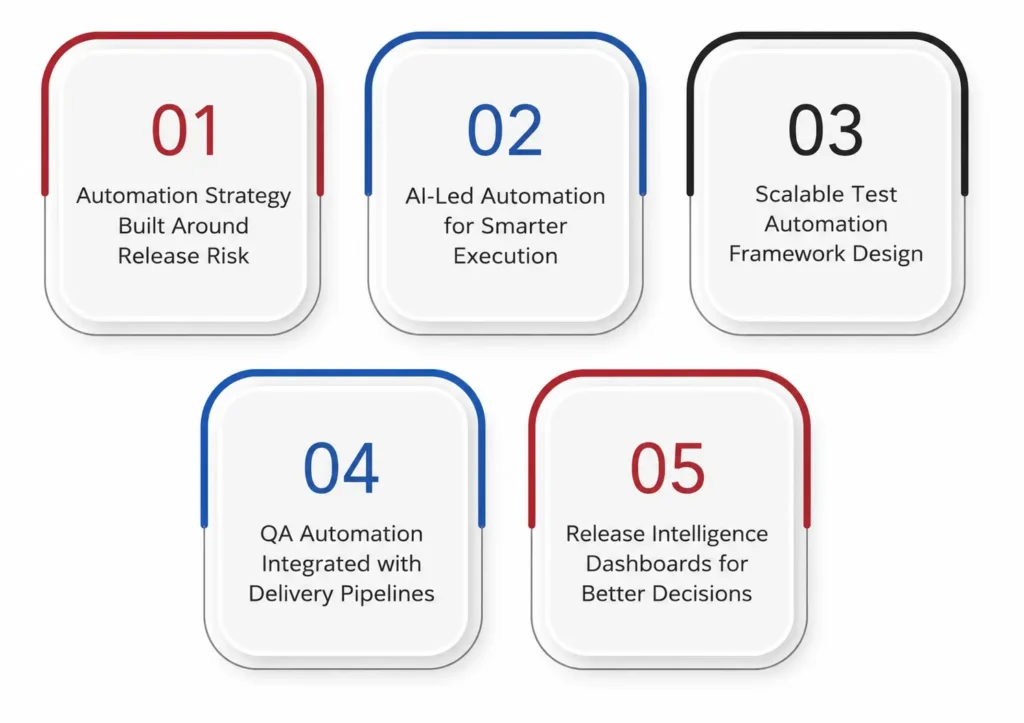
Automation Strategy Built Around Release Risk
TestingXperts starts with the business processes that carry the highest release exposure. Our teams evaluate current automation maturity, coverage gaps, and maintenance effort, then design a strategy that connects QA automation to release confidence.
AI-Led Automation for Smarter Execution
TestingXperts applies AI-led automation to improve test selection, maintenance, prioritization, and failure analysis. This helps teams reduce regression noise, shorten feedback cycles, and focus on defects with real business impact.
Scalable Test Automation Framework Design
TestingXperts develops automation frameworks for web, mobile, API, ERP, cloud, and integration-intensive systems. These frameworks are designed for reusability, governance, maintainability, and scale across products, regions, teams, and release pipelines.
QA Automation Integrated with Delivery Pipelines
TestingXperts integrates automated testing into CI/CD pipelines so teams receive earlier quality signals. This gives engineering and QA teams visibility into risk before it becomes release pressure and gives leadership better insight into readiness, stability, and unresolved business impact.
Release Intelligence Dashboards for Better Decisions
TestingXperts builds automation dashboards that go beyond pass rates. They connect defect trends, critical journey status, test stability, and release risk, helping enterprises decide whether to approve, pause, or strengthen a release.
Managed Automation Testing Services at Enterprise Scale
Managed Automation Testing Services for enterprises needing speed, consistency, and global delivery maturity. TestingXperts. Our teams support the ongoing design, execution, maintenance, and reporting of automation. This enables organizations to realize value from automation across multiple releases.
Conclusion
Automation Testing has moved beyond the goal of increasing script coverage. The next standard is release intelligence.
Enterprises need automation that explains risk, protects critical journeys, and supports confident release decisions. AI-led automation can make that shift faster when the strategy, governance, and framework design are strong.
The strongest automation programs do not simply run more tests. They help leaders understand whether the release is ready, where risk remains, and what needs attention before production.

VP, Delivery Quality Engineering
Manjeet Kumar, Vice President at TestingXperts, is a results-driven leader with 19 years of experience in Quality Engineering. Prior to TestingXperts, Manjeet worked with leading brands like HCL Technologies and BirlaSoft. He ensures clients receive best-in-class QA services by optimizing testing strategies, enhancing efficiency, and driving innovation. His passion for building high-performing teams and delivering value-driven solutions empowers businesses to achieve excellence in the evolving digital landscape.
FAQs
What is Automation Testing?
Automation Testing uses tools, frameworks, and scripts to validate software behavior. It reduces repetitive manual effort and improves test consistency.
Why is Automation Testing moving toward release intelligence?
Enterprises need more than pass and fail results. They need visibility into business risk, release readiness, and customer impact.
What is AI-led automation testing?
AI-led automation testing applies AI to test selection, maintenance, prioritization, and failure analysis. It helps teams improve automation value.
What makes a strong test automation framework?
A strong test automation framework is scalable, reusable, governed, and integrated with delivery pipelines. It supports multiple testing layers.
Why choose TestingXperts for automation testing services?
TestingXperts helps enterprises connect automation with release confidence, business risk, and AI-led quality engineering. The focus is measurable enterprise value.
Discover more