Recommended Blogs

UiPath Test Manager: Aligning Business Intent with Automated Execution

 Last Updated: May 21st, 2026
 Read Time: 10 minutes
Table of Content
- Why UiPath Test Manager Must Be the Control Layer for Business-Led Automation
- Where Automation Programs Drift Away from Business Intent
- UiPath Test Manager: Mapping Requirements to Test Cases with Measurable Accountability
- Requirements Traceability in Test Automation: Turning Coverage into Release Confidence
- The Three Traceability Connections That Define Release Confidence
- Defect Traceability in QA Automation: Connecting Failed Tests to Business Risk
- How TestingXperts Turns UiPath Test Manager into Release Confidence
- Unified Automation QA Architecture Across Studio, Orchestrator, and Test Manager
- TestingXperts + UiPath Test Manager: Capability Summary
- Conclusion
Share On


The most dangerous automation failure is not a broken script. It is a passing test that validates the wrong business expectations.
The 2026 State of Testing Report signals a clear shift: 76.8% of teams now use AI in testing. Faster execution is no longer the constraint. Proof of coverage is. AI can help teams create, run, and maintain tests at scale, yet that speed means little when no one can demonstrate which business requirement was protected.
UiPath Test Manager closes that proof gap. By connecting requirements, test cases, execution results, and defects in one traceable flow, it transforms automated testing from a velocity metric into release evidence.
As a UiPath Certified Partner, TestingXperts has deployed Test Manager at enterprise scale across financial services, healthcare, retail, and logistics. This blog explains how the platform works and how our proven methodologies make it deliver measurable release confidence, not just faster test runs.
Partnership Credential
TestingXperts is a UiPath Certified Partner with hands-on delivery experience across UiPath Studio, Orchestrator, Test Manager, and Autopilot for Testing. Our teams are accredited in UiPath RPA and testing disciplines, enabling joint implementation engagements and co-validated quality architectures.
Why UiPath Test Manager Must Be the Control Layer for Business-Led Automation
As business-led automation expands, quality ownership is no longer limited to QA teams. Product owners, operations leaders, and citizen developers now build and influence workflows that must be reliably validated before release. Without a governance layer, automation scales faster than assurance.
UiPath Test Manager must act as the control layer that connects business intent, automated execution, and release governance across the enterprise. Here is how each capability serves that purpose.

Bridging Business Ideas and Technical Execution
Direct requirement mapping: Requirements traceability with live execution linkage
Every test case is mapped to the business requirement it validates. Execution results feed back to that requirement record automatically, giving product and QA teams a shared view of what is covered and what remains exposed.
AI-assisted test creation: Autopilot for Testing; structured AI-assisted test generation
UiPath’s Autopilot for Testing allows teams to generate test cases from process documentation, acceptance criteria, and workflow definitions. Unlike generic AI test tools, Autopilot operates within the Test Manager requirement context, so generated cases inherit the business traceability chain from creation.
End-to-end validation scope: Native RPA and application test integration
UiPath Test Manager is uniquely positioned to validate both RPA robots and business applications in the same governance layer. Teams testing SAP, Salesforce, or custom UIs alongside attended and unattended bots can track all results under one traceability model.
Enforcing Enterprise Governance
Policy control: Centralized test case ownership, execution records, and defect linkage
Test Manager provides centralized management of test sets, schedules, results, and defects. Ownership is tracked, approvals are logged, and every release cycle has an auditable quality record.
Release readiness reporting: Impact visibility across requirements, results, and defects
Leaders can view which business outcomes passed, which failed, and which were never covered before a deployment decision is made. This replaces pass-rate dashboards with business-outcome dashboards.
Governance at deployment velocity: CI/CD pipeline integration
Test Manager integrates natively with Jenkins, Azure DevOps, and other CI/CD pipelines via the UiPath Testing Activities Pack. This embeds traceability checks into automated release gates, not just manual review cycles.
Scaling Through Orchestration
Business-led automation risks becoming fragmented with siloed scripts, local test data, and disconnected release processes. UiPath Test Manager works with Studio and Orchestrator to connect design, execution, reporting, and traceability across the full automation lifecycle.
This architecture matters when enterprises are simultaneously testing APIs, web UIs, packaged applications, and RPA workflows. Test Manager gives every execution a business reference point, so automation scales with control, not just complexity.
Where Automation Programs Drift Away from Business Intent
Automation programs drift when business reality changes faster than validation logic. A workflow can still execute cleanly while serving an outdated, incorrect, or superseded requirement. That gap widens as teams add more scripts, agents, and release cycles, and it is rarely visible in a standard execution report.
This is where automated testing alignment with business goals becomes a leadership concern. These are the five most common failure patterns TestingXperts observes in enterprise automation programs:
Drift Pattern 1: Legacy logic remains active after policy change
Automation reflects the business model that existed when scripts were first written. When pricing rules, approval thresholds, or customer policies change, old test logic may keep passing, validating yesterday’s behavior, not today’s requirement.
Drift Pattern 2: Broken manual processes get automated without redesign
Teams sometimes automate a flawed manual process before questioning whether it should change. This amplifies defects, increases rework, and accelerates operational friction at scale.
Drift Pattern 3: Technical pass rates replace business value measurement
Automation programs can become internally focused, measuring execution counts, pass rates, and coverage percentages while business impact remains unvalidated. A workflow that runs cleanly is not the same as a workflow that protects a business outcome.
Drift Pattern 4: Static requirements meet continuously shifting business goals
Early-stage requirements quickly become outdated as markets, regulations, and product priorities evolve. AI agents and automation scripts may then optimize for the original interpretation and not the current intent.
Drift Pattern 5: Defects are logged without a business risk context
A defect logged against a failed test step tells teams what broke technically. It does not tell them which business requirement is now exposed, which release decision is affected, or who owns the risk. That gap slows triage and weakens the release of governance.
UiPath Test Manager directly addresses each of these failure patterns by keeping requirements, test cases, execution evidence, and defects connected in a single traceable flow.
UiPath Test Manager: Mapping Requirements to Test Cases with Measurable Accountability
Mapping requirements to test cases in UiPath Test Manager creates end-to-end accountability. Every requirement has a defined validation path, an execution record, and a measurable quality signal. This gives development, QA, and business stakeholders a shared, auditable view of release readiness.
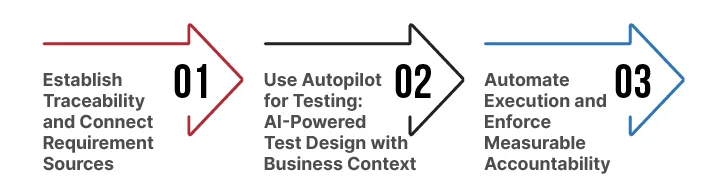
Step 1: Establish Traceability and Connect Requirement Sources
Import from ALM or planning tools: Approved requirements can be brought into Test Manager from external tools such as Jira, Azure DevOps, or other ALM platforms. Business intent is captured before test design begins.
Create requirements natively: Teams can define and manage requirements directly within Test Manager when external integration is not needed, keeping smaller programs structured without additional tooling overhead.
Map test cases to requirements: Each test case is assigned to the requirement it validates. This creates the core traceability chain from business outcome to test case, to execution result, to defect record.
Step 2: Use Autopilot for Testing: AI-Powered Test Design with Business Context
UiPath Autopilot for Testing generates structured test cases from process documentation and acceptance criteria within the Test Manager environment. Unlike standalone AI test generation tools, Autopilot preserves the requirement context throughout, so every generated case stays connected to the business outcome it was designed to protect.
- Review and confirm the requirement context before initiating test generation.
- Validate expected results and edge cases before adding generated cases to test suites.
- Apply human review gates on high-risk, regulated, and business-critical workflows.
Step 3: Automate Execution and Enforce Measurable Accountability
Automate with Studio and link to Test Manager: Repeatable validation flows are built in UiPath Studio and linked to Test Manager test cases. Execution results map automatically back to the originating requirement.
Monitor release readiness dashboards: Coverage completeness, execution failures, and defect counts are aggregated against requirement records, giving leaders a business-outcome view of release readiness before deployment.
Track defect impact against requirements: Failed executions are linked to defect records, which connect back to affected requirements. This creates a clean audit trail for triage, ownership assignment, and risk sign-off.
Integrate into CI/CD pipelines: Via the UiPath Testing Activities Pack, Test Manager connects to Jenkins and Azure DevOps, embedding traceability checks directly into automated deployment gates.
The discipline of precise requirement mapping matters as much as the tooling. Strong mapping creates auditable evidence. Weak mapping creates noise. UiPath Test Manager provides the structure to prove what was tested, why it mattered, and where risk remains before every release.
Requirements Traceability in Test Automation: Turning Coverage into Release Confidence
Requirements traceability in test automation is the discipline of maintaining a live, navigable chain from business requirement to test case, from test case to execution result, and from execution result to defect record. It transforms test coverage from a raw execution count into evidence that a release is ready.
Why Traceability Matters More Than Coverage Volume
Running a large automated suite means little if the tests do not validate the current business intent. Traceability connects validation logic to business value and creates three critical outcomes:
Requirement visibility: Teams can identify, at any point in a release cycle, which requirements have test coverage and which remain unvalidated.
Change impact analysis: When a requirement changes, teams can immediately identify which test cases need to be updated, retired, or rebuilt, without manual cross-referencing.
Release confidence evidence: Stakeholders can review a structured record of what passed, what failed, and what was not covered, even before a deployment decision is made.
The Three Traceability Connections That Define Release Confidence
Connection 1: Requirement to Test Case
Every business requirement of material risk should have at least one mapped test case. A login requirement maps to an authentication validation test. A payment approval rule maps to a transaction boundary test. Without this connection, execution volume cannot be interpreted as business assurance.
Connection 2: Test Case to Execution Status
Execution results must aggregate against mapped requirements, not just against test suites. UiPath Test Manager surfaces requirement-level pass, fail, and blocked status, making it possible for a QA lead to answer, ‘which business requirements passed this cycle?’ rather than only ‘how many tests ran?’
Connection 3: Defect Back to Requirement
When an automated test fails, the defect record must connect back to the originating requirement. This gives product, QA, and development teams immediate business context during triage, reducing the time from defect identification to risk-based prioritization.
This three-connection model is how coverage becomes release confidence. Teams stop measuring how many tests are executed and start answering which business outcomes are protected and which risks still require action before release.
Defect Traceability in QA Automation: Connecting Failed Tests to Business Risk
A failed test matters most when teams know which requirement failed, which business workflow is affected, and who must respond. Defect traceability in QA automation should deliver that context automatically, not as a post-incident manual exercise.
How Strong Defect Traceability Improves Triage Quality
UiPath Test Manager connects execution results, defects, and requirement records in a single traceability chain. When a test fails, the defect is automatically associated with the affected test case and its mapped requirement. Triage teams review the failed step, the related test case, and the affected business outcome together, reducing triage cycles and improving prioritization accuracy.
Traceability also prevents low-impact defects from displacing high-risk ones. A minor display rendering defect should not compete with a failed payment approval rule during sprint triage. Connecting defects to their originating requirements allows teams to rank by business consequence, not only technical severity.
Defect Traceability as a Governance Signal
For enterprises running audit-bound or compliance-sensitive workflows like financial controls, healthcare processing, and regulated data handling, defect traceability is not just a QA efficiency gain. It is a governance requirement. UiPath Test Manager provides the structured defect-to-requirement evidence trail that supports release sign-off, audit review, and post-incident analysis.
The strongest QA programs treat each defect as a business signal. They connect every failure to requirement impact, release readiness status, and operational exposure, making defect management a strategic input to release decisions, not a reactive logging exercise.
How TestingXperts Turns UiPath Test Manager into Release Confidence
Partner Credential
TestingXperts is a UiPath Certified Partner with accredited practitioners across UiPath Studio, Orchestrator, Test Manager, and Autopilot for Testing. Our teams have delivered enterprise Test Manager implementations across financial services, healthcare, retail, and logistics — joint engagements backed by UiPath-validated methodologies.
TestingXperts does not implement UiPath Test Manager as a standalone tool. We deploy it as a governed by quality architecture, one that connects business requirements, automated execution, defect intelligence, and release decisions into a single accountable system.
Our approach is structured around three proprietary frameworks that have been refined across enterprise deployments:
Tx Business-to-Test Blueprint Framework
Before automation scale, we map business requirements to critical workflows across manual, automated, and AI-assisted validation paths. This prevents teams from automating low-value cases while missing higher-risk business paths. Every Test Manager deployment begins with a requirement coverage architecture, not just a test plan.
- Identify which requirements need automated validation, exploratory review, or expanded data coverage.
- Prioritize test design effort against business risk exposure, not execution volume.
- Establish the requirement to test traceability before the first test case is created.
Tx AI-Governed Test Design Protocol
For organizations adopting UiPath Autopilot for Testing, we apply a structured governance protocol that ensures AI-generated test cases retain clear business intent. This includes requirement context validation before generation, human review gates on regulated and high-risk workflows, and traceability verification before test cases enter execution cycles.
The result: AI testing at scale without sacrificing the quality of the traceability chain. Teams gain faster test creation without losing the evidence base needed for release governance.
Tx Risk-Tiered Triage Model
We design defect workflows in Test Manager that connect every failure to a business risk tier. Defects are categorized by their originating requirement’s business impact, separating display-level issues from workflow-critical failures at the point of logging. This shortens triage cycles, improves sprint prioritization, and produces the defect-to-requirement evidence trail needed for compliance and release sign-off.
Unified Automation QA Architecture Across Studio, Orchestrator, and Test Manager
Our teams design and implement across the full UiPath testing stack, like traceable test cases, reusable test sets, defect workflows, release readiness dashboards, and governance models aligned to enterprise CI/CD and release cycles. For organizations testing both RPA robots and business applications, we deliver a unified quality architecture that validates the entire automation portfolio under one traceability model.
Every automated execution in a TestingXperts-governed Test Manager deployment points back to a measurable business outcome. That is the standard we hold ourselves to as a UiPath Certified Partner.
TestingXperts + UiPath Test Manager: Capability Summary
| Challenge | UiPath Test Manager Capability | Tx Accelerator / Methodology |
| Requirements drift from business intent | Requirements traceability matrix with live execution linkage | Tx Business-to-Test Blueprint Framework |
| AI testing speed without coverage proof | Autopilot for Testing + structured test case generation | Tx AI-Governed Test Design Protocol |
| Defects lack a business risk context | Defect-to-requirement linkage with impact reporting | Tx Risk-Tiered Triage Model |
| No release readiness visibility | Real-time dashboards across Studio, Orchestrator & Test Manager | Tx Release Confidence Scorecard |
| Siloed validation across RPA & apps | Unified testing across RPA robots, APIs, and UI workflows | Tx Unified Automation QA Architecture |
Conclusion
UiPath Test Manager gives enterprises the structure to connect automation execution with the business intent behind every requirement. That connection becomes the foundation of release confidence, especially as Autopilot for Testing and AI-driven execution increase the speed and volume of test cycles.
The strongest QA programs will not be measured by automation coverage alone. They will be measured by traceability depth, defect clarity, and the quality of release evidence they can produce. UiPath Test Manager, deployed with the right requirement mapping discipline, AI governance protocol, and defect traceability model, makes that standard achievable.
TestingXperts, as a UiPath Certified Partner, makes that standard achievable at enterprise scale. Our frameworks, like the Business-to-Test Blueprint, the AI-Governed Test Design Protocol, and the Risk-Tiered Triage Model, are built to turn Test Manager from a capable platform into a proven release governance layer.
Ready to build release confidence into your automation program?
Connect with TestingXperts to explore how our UiPath-certified teams can implement traceable, governed, and AI-powered testing at enterprise scale. Visit www.testingxperts.com or reach out to your UiPath account team for a joint engagement conversation.

VP, AI & QE Transformation
Michael Giacometti is the Vice President of AI and QE Transformation at TestingXperts. With extensive experience in AI-driven quality engineering and partnerships, he leads strategic initiatives that help enterprises enhance software quality and automation. Before joining TestingXperts, Michael held leadership roles in partnerships, AI, and digital assurance, driving innovation and business transformation at organizations like Applause, Qualitest, Cognizant, and Capgemini.
Discover more