Data analytics in insurance is no longer a reporting function inside the CIO’s office. It now shapes underwriting appetite, claims decisions, fraud controls, customer engagement, and product profitability. McKinsey estimates that analytics represents €1.2 trillion of realized and potential global insurance value.
That value does not come solely from dashboards. It comes from faster decisions, cleaner data, governed models, and accountable business workflows. Many insurers still make critical decisions based on legacy reports, spreadsheet extracts, and disconnected operational systems.
The problem is not that insurers lack data. The problem is that too much of it arrives late, lacks context, or cannot be trusted.
Why Data Analytics in Insurance Needs a Modern Decision Backbone?
Insurance has always been a data business, even before digital became the default channel. Actuarial tables, loss histories, policy records, claims files, and broker inputs shaped decisions for decades. What has changed is the speed and complexity of those decisions.
A carrier may need to price risk using telematics, weather data, medical data, claims history, and customer behavior. Claims teams may need to identify leakage while improving settlement speed. Distribution leaders may need early signals of churn across agent, digital, and contact center channels.
Legacy Reporting Cannot Carry This Load
Traditional reporting often explains what happened after the business impact is already visible. That works for quarterly performance review, but not for live underwriting decisions or fraud triage. Data analytics in insurance industry operations requires near real-time context and traceable data flows.
McKinsey argues that the value of digital and analytics depends heavily on last-mile execution. For every dollar invested in digital and analytics, insurers may need another dollar or more for talent, operating model changes, deployment, and change management.
Analytics modernization is not only a platform upgrade. It also requires decision ownership, data quality assurance, workflow redesign, and model governance.
The Role of Analytics in the Insurance Sector Today
The role of analytics in the insurance sector now supports decisions across the policy lifecycle, from acquisition to renewal. Leading insurers use analytics to connect risk signals, operational behavior, and customer intent.
Core Insurance Use Cases
Insurers typically apply analytics across several high-value areas.
Underwriting teams assess risk with structured and external data sources.
Claims teams prioritize cases, detect leakage, and route complex claims.
Fraud teams identify suspicious patterns across claims and policy activity.
Marketing teams personalize offers and improve retention campaigns.
Operations teams monitor cycle times, workload, and exception patterns.
The strongest programs focus on decisions that materially change outcomes. They avoid analytics projects that yield interesting insights but lack operational adoption.
Analytics Must Connect with Workflows
Analytics tools for insurance companies only matter when teams act on their outputs. A fraud score should influence claims routing. A churn signal should trigger a retention action. A pricing insight should reach product, underwriting, and distribution leaders.
That connection between insight and action is often where programs stall. Business teams’ distrust unclear models, while technology teams struggle with fragmented legacy data. Successful analytics programs treat adoption as a design requirement, not a training issue.
From Legacy BI to Intelligent Insurance Analytics Solutions
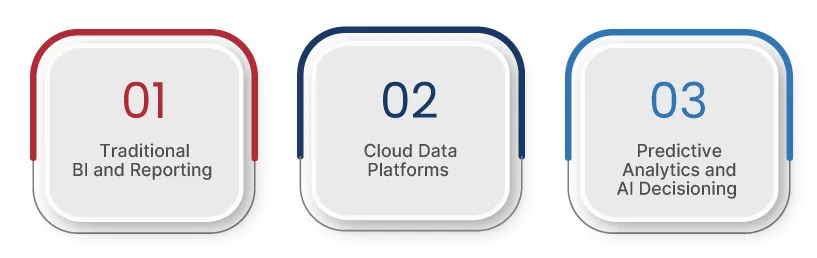
Modernization does not mean replacing every reporting tool at once. Insurers usually operate across multiple maturity levels simultaneously. The practical question is which approach fits the decision being modernized.
Traditional BI and Reporting
Business intelligence remains useful for statutory reporting, performance dashboards, and management visibility. It gives enterprises a shared view of historical patterns. However, it rarely supports predictive decisions without deeper data engineering and model integration.
Cloud Data Platforms
Cloud data platforms create scalable foundations for integrated insurance analytics solutions. They help consolidate policy, claims, billing, CRM, broker, and external data sources. TestingXperts describes cloud data engineering as the work of architects and managers to build and maintain secure data infrastructure to enable actionable insights.
Predictive Analytics and AI Decisioning
Predictive models help insurers estimate risk, claim severity, fraud probability, and customer churn. AI-enabled decisioning can improve speed, but it also increases governance needs. Model outputs must be explainable, monitored, and validated against business rules.
Where Business Analytics in Insurance Creates Measurable Value
Business analytics in insurance should connect directly to business metrics. Executives rarely fund analytics because dashboards look modern. They fund it because decisions become faster, more consistent, and financially measurable.
Profitability and Loss Ratio Discipline
Analytics helps underwriting leaders detect underpriced segments, emerging exposures, and portfolio drifts. It can also reveal where product rules or manual overrides weaken pricing discipline. These insights support stronger risk selection and better portfolio steering.
Claims analytics help detect leakage, identify avoidable delays, and improve reserve accuracy. Fraud analytics adds another layer by flagging suspicious behavior before claims payments accelerate. Together, these capabilities support better loss performance and expense control.
Customer Retention and Operating Efficiency
Improving insurance efficiency with analytic capabilities also means reducing avoidable friction. Claims handlers can receive prioritized worklists based on severity, complexity, and customer risk. Contact centers can identify vulnerable renewal accounts before they lapse.
Retention analytics becomes more valuable when it explains why customers may leave. Price sensitivity, poor service history, claim dissatisfaction, and channel behavior may all matter. A useful model gives business teams enough context to act responsibly.
The most effective analytics investments combine financial metrics with operational metrics. Leaders should track cycle time, referral rates, model adoption, exception volume, and decision accuracy. That mix shows whether analytics are changing behavior or merely producing reports.
Choosing the Right Analytics Modernization Path
Not every insurer should start with advanced AI. Some need stronger data foundations before predictive models can produce dependable results. Others already have good data pipelines but lack embedded analytics inside business workflows.
A Practical Decision Framework
Use business readiness and data maturity to select the right path.
Choose data foundation modernization when source data is fragmented or unreliable.
Enhance BI when leaders lack consistent enterprise visibility and trusted metrics.
Deploy predictive analytics when historical data supports repeatable decision patterns.
Adopt AI-enabled analytics when speed, scale, and complexity justify automation.
The right approach depends on risk appetite, regulatory expectations, legacy complexity, and operating discipline. Speed matters, but uncontrolled modernization can create new decision risk. Analytics leaders need a roadmap that balances ambition with validation.
Building Trustworthy Analytics for Regulated Insurance Environments
Insurance analytics must be trusted by customers, regulators, auditors, and business users. A model that improves speed but cannot be explained may create unacceptable risk. Governance must therefore sit inside the analytics lifecycle.
Data Quality as a Control Layer
Data quality affects underwriting decisions, claims outcomes, and customer treatment. Incorrect policy attributes can distort risk models. Missing claims notes can weaken fraud detection. Duplicate customer records can damage personalization and service history.
TestingXperts positions data quality management around automated lineage, validation checks, compliance monitoring, data annotation, threat detection, and validation services. These controls are especially relevant when insurers train AI models on operational data.
Governance and Accountability
Trustworthy analytics needs more than technical controls. It needs accountable owners for data definitions, model changes, exception handling, and decision escalation. Business leaders should know where models influence decisions and where humans remain responsible.
Key governance practices include model validation, audit trails, explainability reviews, and security testing. Data pipelines should also preserve lineage across ingestion, transformation, and consumption. TestingXperts highlights lineage tracking, observability, version control, and governance within ETL and data warehouse services.
Regulated analytics succeeds when quality engineering, data engineering, compliance, and business teams work together. That collaboration turns analytics from a black box into a controlled decision capability.
How Can TestingXperts Assist with Data Analytics Strategies for the Insurance Industry?
TestingXperts supports insurers where analytics programs often break down, which is data trust and execution quality. Our data and analytics capabilities span:
TestingXperts’ insurance practice leverages domain experience, AI accelerators, and RPA-based automation frameworks to deliver scalable insurance products. We help:
Validate data transformations
Test AI-driven workflows
Assess integration quality
Strengthen data reliability
Our data validation capabilities focus on accuracy, completeness, reliability, and ETL testing across business-critical processes. We connect engineering execution with insurance domain needs, QA discipline, and decision accountability.
Conclusion
Data analytics in insurance must move beyond dashboards and isolated experiments. The real opportunity lies in modernizing decisions across underwriting, claims, pricing, risk, and service. Insurers that invest in trusted data, governed models, and embedded workflows can scale decisions with greater confidence.
The next phase of data analytics in insurance will benefit streamlined execution over technology confidence. Enterprises should focus on measurable outcomes, accountable ownership, and analytics capabilities that improve enterprise decisions. To know how TestingXperts can assist, contact our experts now.
Yuvraj Singh is an accomplished Associate Director of Delivery, renowned for leading strategic quality assurance initiatives that consistently deliver outstanding software outcomes across global markets. With deep expertise in both Property & Casualty (P&C) and Life & Annuities (L&A) insurance domains, Yuvraj excels at bridging the gap between complex business objectives and flawless execution.