Recommended Blogs

Struggling With QA Delays? Build a Scalable Guidewire Testing Framework

 Last Updated: May 22nd, 2026
 Read Time: 2 minutes
Table of Content
- Why Guidewire Testing Becomes a Bottleneck for Enterprises
- How a Guidewire Test Automation Framework Solves It
- Architecture Behind a Scalable Guidewire Testing Framework
- Key Components That Make Guidewire Automation Work
- Benefits of Automation Testing for Guidewire Programs
- Why Choose TestingXperts for Guidewire Testing
- Conclusion
Share On


Companies building digital insurance platforms can’t afford to skip test automation anymore. More than 46% of teams have already automated at least half of their QA practices, and 60% say that automation has made their testing more accurate and thorough. But Guidewire applications still struggle with extended regression cycles, unstable settings, and tests that are becoming more difficult.
The outcome is slower releases and higher QA costs. In plain terms, this suggests that automation alone isn’t enough. Companies require a well-organized Guidewire test automation framework that aligns with their business processes, integrates with CI/CD, and scales with the product without making maintenance more difficult.
Why Guidewire Testing Becomes a Bottleneck for Enterprises
There are many moving parts in the guidewire ecosystem. They include PolicyCenter, BillingCenter, ClaimCenter, integrations, and business rules that have been extensively changed. Over time, that complexity gets worse.
This is where the bottleneck happens:
- Frequent UI and configuration changes break scripts and increase maintenance effort
- Complex business logic makes reusable automation difficult
- Integration dependencies slow down end-to-end validation
- Test data challenges delay execution cycles
In a lot of cases, regression cycles last for days. This means leaders have to choose between speed and quality of release. In a world of continuous supply, that trade-off is no longer acceptable.
How a Guidewire Test Automation Framework Solves It
A structured Guidewire test automation framework shifts testing from reactive to planned.
It adds:
- Standardized test design aligned with business processes
- Reusable components across UI, API, and integration layers
- Automated execution integrated into CI/CD pipelines
- Intelligent test selection for faster regression cycles
The fundamental change is that testing becomes more reliable. Teams go from putting out fires to making sure quality stays high.
This is especially important in Guidewire because modifications affect many modules at once. A clear structure ensures that those dependencies are checked without slowing down releases.
Architecture Behind a Scalable Guidewire Testing Framework
The architecture of a scalable Guidewire Testing Framework is modular by design. It divides problems to make upkeep easier and change easier.
At a high level, it has:
- Test Layer: Business-driven test scenarios using BDD (Cucumber/Karate)
- Execution Layer: Works with CI/CD pipelines to run automatically
- Data Layer: Managing test data and controlling the environment from one place
- Integration Layer: Checking APIs and services at the system level
- Reporting Layer: Dashboards that bring together quality insights
The native Guidewire framework supports BDD-based testing and integrates with CI/CD pipelines, enabling teams to launch automated test suites and enforce quality gates.
This basically means the team’s size is no longer tied to scalability. It becomes a part of architecture.
Key Components That Make Guidewire Automation Work
Businesses need more than just tools to make automation last. They need the appropriate parts to work together.
Businesses need more than just tools to make automation sustainable. They need the right components working together in a structured Guidewire test automation framework.
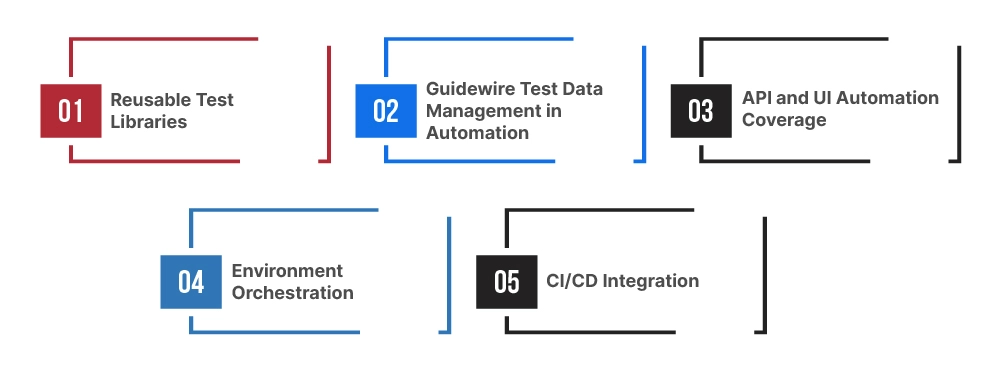
1. Reusable Test Libraries
Reusable test libraries standardize automation across Guidewire modules by creating modular, business-aligned components. This reduces duplication, speeds up script development, and simplifies maintenance. As a result, teams can scale automation faster without increasing effort.
2. Guidewire Test Data Management in Automation
Test data is often the biggest bottleneck in Guidewire testing. A strong Guidewire test data management in automation strategy ensures consistent, production-like datasets across environments. This improves test accuracy and eliminates delays caused by data dependencies.
3. API and UI Automation Coverage
Guidewire automation must cover both UI and API layers for complete validation. UI testing ensures smooth user journeys, while API testing validates backend logic and integrations. Together, they enable faster feedback and stronger test coverage.
4. Environment Orchestration
Reliable automation depends on stable and well-managed environments. Environment orchestration ensures consistent setup, availability, and alignment with testing needs. This reduces false positives and improves overall execution reliability.
5. CI/CD Integration
Automation must be embedded into CI/CD pipelines to deliver real value. Running tests in every build cycle helps detect defects early and enforce quality gates. This ensures continuous validation without slowing down releases.
Without these parts, automation is weak. It becomes a growth enabler when you add them.
Benefits of Automation Testing for Guidewire Programs
In Guidewire systems, automation does more than just speed up execution. It has a direct effect on release confidence, operational efficiency, and long-term cost control. The benefits are both immediate and scalable when built on a structured Guidewire test automation architecture.
Some of the main benefits are:
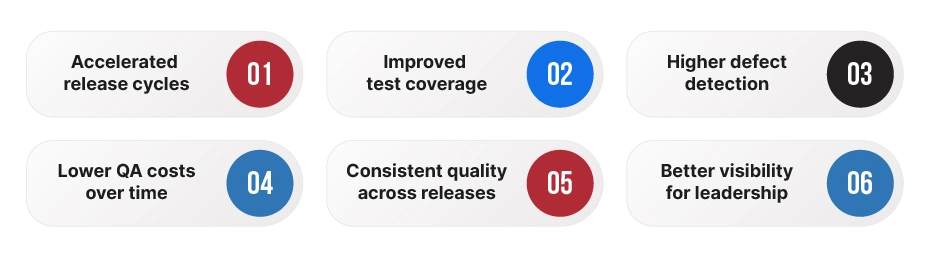
Accelerated release cycles:
Automation significantly reduces regression testing time from days to hours by executing large test suites in parallel. This enables faster, more predictable releases and helps teams meet tight delivery timelines without compromising quality.
Improved test coverage:
Automation ensures comprehensive validation of complex Guidewire workflows across PolicyCenter, BillingCenter, and ClaimCenter. It allows teams to cover more scenarios, edge cases, and integrations that are often missed in manual testing.
Higher defect detection:
By integrating automated tests into CI/CD pipelines, defects are identified early in the development cycle. This reduces the cost of fixing issues later and improves overall product stability before production deployment.
Lower QA costs over time:
Automation reduces dependency on repetitive manual testing efforts, leading to long-term cost savings. It also minimizes rework and maintenance overhead, allowing QA teams to focus on higher-value testing activities.
Consistent quality across releases:
Standardized automation ensures tests are executed the same way every time, regardless of changes. This consistency improves reliability, reduces human error, and maintains stable quality across frequent and complex releases.
Better visibility for leadership:
Automation tools provide real-time dashboards and detailed reports on test execution, defects, and coverage. This enables leadership to make informed go/no-go decisions based on accurate, data-driven quality insights.
This means innovation will happen faster without harming system stability or the consumer experience.
Why Choose TestingXperts for Guidewire Testing
To test Guidewire, you need to know about Guidewire well, have scalable frameworks, and be disciplined in how you do things. TestingXperts has all three, which helps businesses go from having separate QA teams to a mature, automation-led testing strategy.
What makes TestingXperts different:
Proven Guidewire expertise:
Deep, hands-on experience across Guidewire implementations, upgrades, and large-scale transformations enables teams to handle complex workflows, integrations, and customizations while ensuring stable, high-quality testing outcomes.
Accelerated framework setup:
Pre-built accelerators and reusable assets speed up the deployment of a Guidewire test automation framework, reducing setup time and enabling faster transition from manual to automated testing without disrupting ongoing delivery cycles.
Strong architecture capabilities:
Expertise in designing scalable Guidewire Testing Framework architecture ensures seamless integration with enterprise CI/CD ecosystems, enabling continuous testing, faster feedback loops, and long-term sustainability of automation initiatives.
Focused test data management:
A structured approach to Guidewire test data management in automation ensures consistent, production-like datasets across environments, reducing execution delays, improving accuracy, and eliminating dependencies that often slow down testing cycles.
AI-led optimization:
AI-driven techniques enhance automation by improving test coverage, identifying redundant scripts, and reducing maintenance efforts. This helps teams optimize execution efficiency while keeping automation aligned with evolving application changes.
End-to-end QA support:
Comprehensive QA support spans strategy, framework design, execution, and continuous improvement. This ensures alignment with business goals while enabling enterprises to scale testing capabilities as systems and requirements evolve.
The result is a Guidewire testing program that is faster, more dependable, and able to grow with the business.
Conclusion
Tools are rarely the cause of delays in guidewire testing. They are caused by automation tactics that don’t work together and architecture that can’t grow. A well-designed Guidewire test automation framework that changes ensure testing aligns with how the business operates and how things are delivered. For businesses, it’s not only about speed; it’s also about ensuring every release is right. With the right Guidewire testing services, organizations can modernize QA processes and eliminate bottlenecks. TestingXperts can help you design and scale a Guidewire testing strategy that is ready for the future, enabling you to update your QA processes and eliminate bottlenecks.

Associate Director
Yuvraj Singh is an accomplished Associate Director of Delivery, renowned for leading strategic quality assurance initiatives that consistently deliver outstanding software outcomes across global markets. With deep expertise in both Property & Casualty (P&C) and Life & Annuities (L&A) insurance domains, Yuvraj excels at bridging the gap between complex business objectives and flawless execution.
FAQs
What does a scalable Guidewire Testing Framework architecture typically include?
A scalable Guidewire Testing Framework architecture includes modular layers such as test design, execution, data management, integration validation, and reporting. This layered approach improves maintainability, enables parallel execution, and ensures the framework adapts to evolving Guidewire implementations.
How does Guidewire Testing Framework architecture support UI, API, and integration testing?
The architecture separates testing layers to handle UI, API, and integrations independently yet cohesively. UI tests validate user journeys, API tests ensure backend logic, and integration tests verify system interactions, enabling comprehensive and faster validation cycles.
What business outcomes can enterprises expect from a mature Guidewire test automation framework?
A mature Guidewire test automation framework drives faster releases, improved defect detection, reduced QA costs, and higher test coverage. It also enhances release confidence, enabling enterprises to innovate quickly while maintaining system stability and compliance.
How do you choose the right Guidewire test automation framework for a large insurance enterprise?
The right framework should align with business workflows, support scalability, and integrate seamlessly with CI/CD pipelines. It must offer strong test data management, reusable components, and flexibility to adapt to frequent Guidewire updates and customizations.
What are the measurable benefits of automation testing for Guidewire transformation programs?
- Reduced regression cycles and faster release timelines
- Improved defect detection and lower production risks
- Increased test coverage across complex workflows
- Reduced long-term QA costs and manual effort
- Better visibility through real-time reporting and analytics
How does Guidewire test data management in automation reduce test execution bottlenecks?
Effective Guidewire test data management in automation ensures consistent, production-like datasets are readily available. This eliminates delays caused by data dependencies, improves test accuracy, and enables parallel execution across environments, accelerating overall testing cycles.
What implementation challenges should teams expect with a Guidewire test automation framework?
Enterprises often face challenges like high initial setup effort, test data complexity, and maintaining scripts during frequent changes. With TestingXperts, these challenges are addressed through proven accelerators, scalable architecture design, and optimized automation strategies for Guidewire environments.
Discover more