Recommended Blogs

Enterprise Software Quality Risks: Why Testing Still Misses Critical Defects

 Last Updated: June 8th, 2026
 Read Time: 2 minutes
Table of Content
- The Nature of Enterprise QA Risks
- Why Enterprise Software Testing Still Misses Critical Defects
- The Cost of Production Failures in Enterprise Systems
- The Hidden Layer: Systemic Risk
- Rethinking QA Testing for Enterprise Applications
- Why Critical Defects Still Slip Through
- The Way Forward
- Strengthening Enterprise QA with the Right Partner
Share On


Enterprise defects rarely come from a single broken feature. They emerge from integrations, data flows, concurrency, and non-functional limits, then surface in production as payment failures, reconciliation drift, or compliance gaps. Traditional QA validates requirements; it often undertests systemic risk.
Enterprise QA risks continue to arise in production despite established processes, automated testing suites, and specialized QA teams. The effects can be seen in issues such as data inconsistencies, and compliance violations. IBM’s 2025 Cost of a Data Breach Report puts the global average cost of data breach at about $4.44M, with improvements largely tied to faster detection and containment. But many incidents still originate in preventable gaps like misconfigurations, broken authorization logic, validation errors, and unsafe defaults, that pre-release testing didn’t expose.
Here’s the uncomfortable truth: typical testing of corporate software often checks whether it works but doesn’t look for systemic risks.
The Nature of Enterprise QA Risks
Enterprise applications are not tools that work on their own. They are ecosystems. CRM systems and ERP platforms work together. APIs connect to third-party vendors. Cloud services synchronize data in real time.
Enterprise QA risks come from:
- Deep integrations across systems
- High transaction volumes
- Multi-user concurrency
- Regulatory and compliance obligations
- Legacy-modern hybrid architectures
When QA testing for enterprise applications focuses only on feature validation, it often overlooks integration fragility, data flow inconsistencies, or performance bottlenecks under real-world load.
That’s where software testing finds hidden bugs.
Why Enterprise Software Testing Still Misses Critical Defects
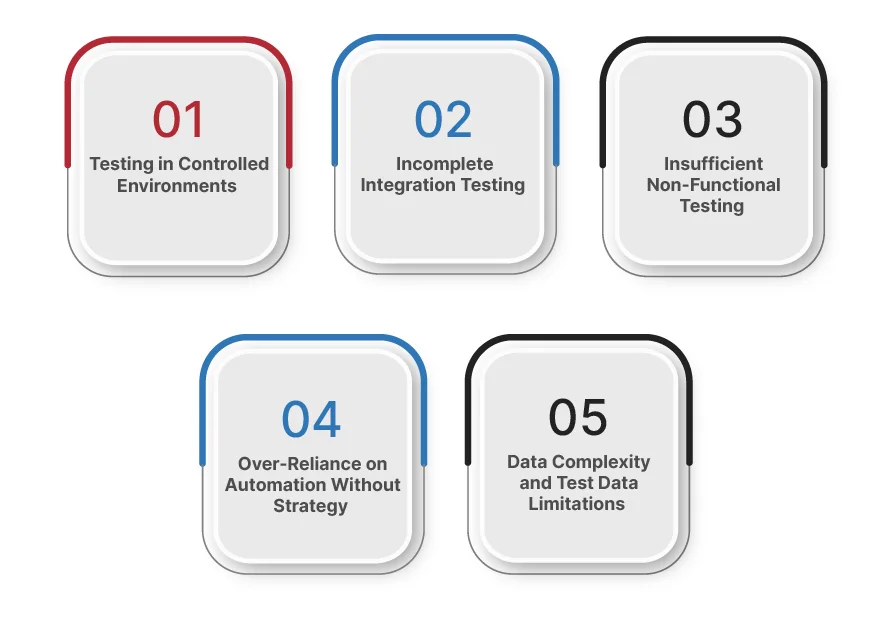
1. Testing in Controlled Environments
Most testing of enterprise software takes place in staging environments that don’t seem like real-world situations.
Test environments typically have smaller datasets; fewer integrations enabled, services virtualized, lower concurrency, and simplified network latency.
In other words, the system has been tested in the best possible settings. However, production environment is not always perfect.
Enterprise apps often have production problems because of:
- Unexpected user behavior
- Sudden traffic spikes
- Data anomalies
- Latency between distributed systems
If performance and resilience testing are not aligned with real usage patterns, critical vulnerabilities remain invisible.
2. Incomplete Integration Testing
APIs and middleware are very important for enterprise systems. A small modification to a schema in one service can have a big effect on the whole ecosystem.
But integration testing is often only done on secure paths.
Software testing often finds hidden bugs during:
- Timeout handling
- Error propagation across services
- Partial transaction failures
- Data synchronization issues
These flaws might not show up during isolated functional testing, but they might cause production problems in business systems when real-world interactions happen.
3. Insufficient Non-Functional Testing
Enterprise stakeholders often prioritize release dates and feature delivery over other priorities. Because of this, non-functional testing may get skipped.
But this is where the risks of business QA grow.
Some common non-functional gaps are:
- Performance under peak load
- Scalability validation
- Security vulnerability assessments
- Failover and disaster recovery simulations
Systems look stable until they are tested at scale, at which point their flaws become apparent.
4. Over-Reliance on Automation Without Strategy
Automation is very important. But if you automate without risk-based prioritizing, you could miss things.
Many QA testing methodologies for enterprise apps automate regression suites that focus on UI flows. That might improves things, but it doesn’t immediately reduce the risks of software testing.
Automation should only answer one question: Are we taking the safest business routes?
Automation can speed things up, but it can’t make them safe if important financial operations, regulatory checkpoints, or data transformations aren’t thoroughly checked.
5. Data Complexity and Test Data Limitations
Enterprise apps handle large amounts of data. Records of customers, financial transactions, operational logs, and regulatory documentation.
Testing with small or cleaned datasets typically does not show:
- Data truncation errors
- Encoding issues
- Edge-case calculations
- Performance degradation at scale
Enterprise apps often have production bugs because QA never tested edge cases involving data.
The Cost of Production Failures in Enterprise Systems
Let’s talk about what happens if failures are not addresses before reaching to production stage:
Enterprise systems can fail to produce:
- Revenue loss during downtime
- Regulatory penalties
- Brand damage
- Customer churn
- Operational disruption
According to the 2025 Observability Forecast from New Relic, high-impact IT outages now cost businesses a median of about $2 million for every hour systems are down, which works out to approximately $33,333 per minute of downtime.
And the actual impact typically goes beyond just losing money right away. It can take a long time to get back trust when it has been broken.
This is why testing enterprise software needs to change from “Does it work?” to “What could break, and how badly it can impact?”
The Hidden Layer: Systemic Risk
Systemic risks refer to failures caused by interactions across systems, data pipelines, and infrastructure rather than a single application defect. These risks typically surface only under real workloads, making them difficult to detect in traditional test environments.
Most business QA hazards are systemic, not isolated.
For example:
- A billing system miscalculation may affect thousands of accounts before it is detected.
- A failed integration can silently corrupt data across modules.
- A performance issue may degrade gradually before triggering alerts
These bugs aren’t easy to see. There are flaws in the structure.
When traditional QA methods focus on validating requirements, they typically miss systemic risk because they only test parts of the ecosystem, not how they work together.
Rethinking QA Testing for Enterprise Applications
The way businesses test software needs to change if they want to reduce risk.
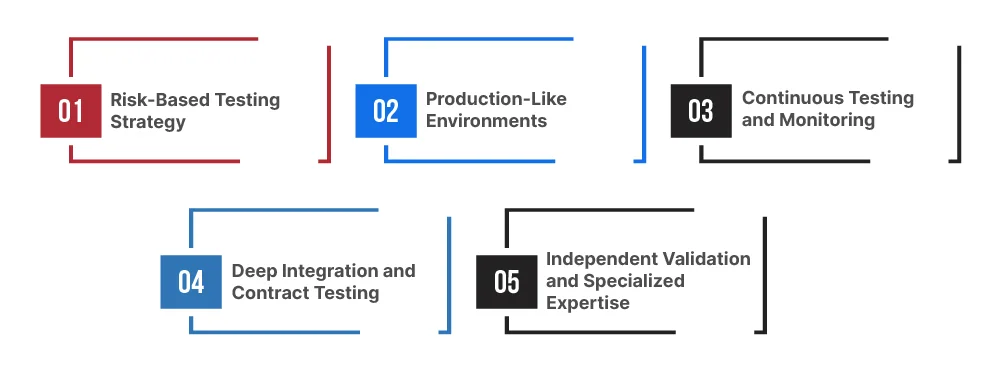
Risk-Based Testing Strategy
Don’t just look at the scope of the features when deciding what to test first; also consider how they will affect the business.
Important revenue flows, compliance modules, and data-sensitive components should undergo additional validation, such as stress testing, negative testing, and failure simulations.
Production-Like Environments
Put money into realistic staging areas.
This includes:
- Representative datasets
- Simulated peak loads
- Real API dependencies
- Multi-region deployment validation
Testing that mimics the production environment reduces the risk of problems in enterprise applications.
Continuous Testing and Monitoring
Testing shouldn’t stop after the product is released.
Shift-left practices help catch defects early. But equally important is shift-right validation:
- Real-time monitoring
- Observability integration
- Synthetic transaction monitoring
- Automated rollback mechanisms
This makes the impact window smaller if faults do get through.
Deep Integration and Contract Testing
Enterprise ecosystems need strong checks for API contract validation and legacy compatibility.
Contract testing ensures that modifications to one service don’t accidentally break systems that depend on it.
This is very important for companies that use microservices and distributed systems.
Independent Validation and Specialized Expertise
It’s not just about tools when it comes to enterprise software testing. It requires knowledge of the domain and architecture, as well as the ability to model risks.
This is where managed testing services for enterprise QA come in handy. Independent QA teams can give you:
- Objective risk assessments
- Cross-system validation
- Compliance-aligned testing frameworks
- Advanced performance and security testing
Why Critical Defects Still Slip Through
Enterprise QA concerns persist because businesses generally focus on defect counts rather than risk exposure to gauge how well they’re doing.
A low number of defects does not mean little risk. It could mean that the tests were not very deep.
Most of the time, critical faults aren’t clear syntax issues. There are minor data errors, timing conflicts, race conditions, or scalability constraints that only surface when things get tough.
There is still considerable risk without holistic validation across functional, non-functional, integration, and data aspects.
The Way Forward
Testing enterprise software has to shift from validation-based to risk-based.
That means:
- Aligning QA with business impact
- Testing ecosystems, not modules
- Validating under real world conditions
- Integrating security and performance testing deeply
- Continuously monitoring post-release
You can’t rely solely on surface-level validation for enterprise systems.
Strengthening Enterprise QA with the Right Partner
Quality risks in enterprise software are not necessarily a sign of failure. They often reflect the inherent complexity of large, interconnected systems.
The difference between robust and vulnerable businesses lies in how proactively they address software testing risks before they become production problems in their enterprise systems.
A disciplined, risk-driven strategy is necessary if your company wants to find and fix hidden bugs in software testing and develop trust across complicated ecosystems.
TestingXperts offers specialized software testing services to businesses. These include corporate software testing, performance resilience, integration validation, and risk-based QA techniques geared to systems vital to the company.
Now is the moment to rethink your testing approach with the right people on board if you’re looking to strengthen QA testing for business apps and reduce enterprise QA risks.

VP, Delivery Quality Engineering
Manjeet Kumar, Vice President at TestingXperts, is a results-driven leader with 19 years of experience in Quality Engineering. Prior to TestingXperts, Manjeet worked with leading brands like HCL Technologies and BirlaSoft. He ensures clients receive best-in-class QA services by optimizing testing strategies, enhancing efficiency, and driving innovation. His passion for building high-performing teams and delivering value-driven solutions empowers businesses to achieve excellence in the evolving digital landscape.
FAQs
How can we reduce enterprise QA risks before production release?
Reduce enterprise QA risks by shifting from feature-based to risk-based testing. Focus on critical business flows, simulate real-world environments, validate integrations deeply, and include performance, security, and data quality testing. Continuous monitoring and early risk identification are key to preventing production failures.
What are the most effective strategies for enterprise software testing in complex ecosystems?
- Risk-based testing aligned with business impact
- End-to-end integration and contract testing
- Production-like test environments
- Performance and scalability validation
- Continuous testing with observability integration
- Realistic test data and edge-case coverage
What types of defects are commonly missed in enterprise QA testing?
Enterprise QA often misses systemic defects like data inconsistencies, race conditions, API contract mismatches, and performance bottlenecks. These issues typically surface under real-world load, complex integrations, or large datasets rather than during controlled functional testing.
How do software testing services for enterprises help prevent production failures?
Enterprise testing services bring independent validation, advanced tools, and domain expertise. They focus on integration risks, non-functional testing, and real-world simulations, helping uncover hidden defects early and reducing the chances of costly production outages.
How do enterprise software testing services support compliance with industry regulations?
Enterprise testing services ensure compliance by validating security controls, data integrity, and regulatory workflows. They align testing with standards like data protection and financial regulations, helping businesses avoid penalties, ensure audit readiness, and maintain trust.
What are the key benefits of outsourcing software testing services for enterprises?
Outsourcing to providers like TestingXperts enables access to specialized QA expertise, scalable resources, and advanced testing frameworks. It improves test coverage, accelerates releases, reduces operational costs, and strengthens risk-based validation across complex enterprise systems.
Discover more