Recommended Blogs

Mobile App Testing for QSR Platforms to Prevent Downtime

 Last Updated: May 25th, 2026
 Read Time: 2 minutes
Table of Content
- Why Peak-Hour Failures Now Define QSR Digital Performance
- Where Costly Errors Begin in Restaurant Digital Ordering QA
- POS Integration Testing Is the Backbone of QSR Order Accuracy
- Modernization Choices. Patch, Replatform, or Build Quality into the Pipeline
- When to Choose Which QA Strategy for QSR Digital Ordering
- How Food Delivery App Testing Services Reduce Peak-Hour Revenue Leakage
- How Can TestingXperts Assist with Digital Ordering Software Testing?
- Conclusion
Share On


A QSR app rarely fails quietly during lunch, dinner, or promotional surges. It fails where customers notice first, inside payment flows, cart updates, loyalty balances, and pickup promises.
That is why mobile app testing for QSR platforms now sits closer to revenue protection than release validation. NCR Voyix research cited by Restaurant Dive found that 58% of customers prefer ordering delivery directly through a restaurant app or website.
For CIOs and CTOs, the risk is not just downtime. The larger problem is inaccurate orders, broken integrations, delayed kitchens, failed payments, and lost customer trust.
Why Peak-Hour Failures Now Define QSR Digital Performance
Peak hours expose weak digital ordering systems faster than any planned test window. A mobile app may perform well at 10 AM but fail during lunch traffic.
QSR digital performance depends on many connected systems working together under pressure. Mobile apps, web ordering, POS, KDS, loyalty programs, payment gateways, delivery partners, and inventory platforms must stay in sync.
The Real Failure Is Operational
A failed app transaction creates more than one customer complaint. It can also trigger duplicate orders, delayed preparation, refunds, store-level confusion, and loyalty disputes.
Restaurant teams usually experience these failures as operational noise. Technology leaders should view them as preventable quality gaps across the digital ordering stack.
Strong mobile app testing for QSR platforms validates behavior under realistic pressure. That includes traffic spikes, limited menu windows, item substitutions, and high payment concurrency.
Testing should also reflect store-level realities across regions and franchise models. A promotion that works in one market can fail badly in another.
Where Costly Errors Begin in Restaurant Digital Ordering QA
Many digital ordering defects start with business rules rather than broken screens. The interface may look fine while the pricing, fulfillment, or loyalty logic fails.
This is where restaurant digital ordering QA needs domain context. Generic mobile testing rarely catches errors tied to combos, modifiers, taxes, coupons, refunds, and delivery promises.
Common Risk Areas
QSR apps need targeted validation across several recurring failure points.
- Menu availability by time, location, and store capability
- Cart rules for substitutions, modifiers, bundles, and upsells
- Payment behavior across wallets, cards, refunds, and retries
- Loyalty points, offers, redemptions, and account synchronization
- Delivery fees, service charges, taxes, and final receipt accuracy
- Pickup timing, kitchen routing, throttling, and order status updates
Each area looks small until it fails during a busy service window. A missing modifier can become a remake. A failed payment retry can become abandonment.
Quality teams should test ordering journeys as revenue journeys. That mindset changes the test design, the environment, and the release criteria.
POS Integration Testing Is the Backbone of QSR Order Accuracy
A QSR mobile order is only successful when the store receives it correctly. That makes POS integration testing central to the reliability of digital ordering.
POS systems connect customer-facing orders to store operations. They influence pricing, tax, payment capture, kitchen routing, receipts, inventory, and reporting.
Test The Transaction, Not The Component
Many teams test the mobile app and POS separately. That misses defects that only appear during handoffs between systems.
A practical POS integration testing strategy should validate these flows.
- Mobile order submission into the correct store POS
- Item mapping between the app menu and the POS catalog
- Modifier translation into kitchen display systems
- Payment authorization, capture, void, and refund behavior
- Loyalty and CRM updates after order completion
- Receipt accuracy across digital and in-store channels
Online ordering POS integration reduces manual re-entry and connects digital orders into restaurant systems. SumUp describes this integration to route online orders into the POS environment.
That connection creates value only when QA repeatedly proves it. Integration defects can appear after menu updates, POS patches, payment changes, or franchise configuration updates.
Modernization Choices. Patch, Replatform, or Build Quality into the Pipeline
QSR technology leaders rarely modernize from a clean slate. They manage legacy POS estates, franchise variation, vendor dependencies, and aggressive release calendars.
The modernization question is not only technical. It is also operational, financial, and risk driven.

Option One. Patch The Existing Platform
Patching works when defects are narrow, and business continuity matters most. It can stabilize urgent issues without delaying scheduled releases.
The tradeoff is a technical debt. Too many patches create fragile regression zones across menus, payments, and integrations.
Option Two. Replatform The Ordering Stack
Replatforming helps when architecture blocks scale, observability, or omnichannel growth. It can improve long-term control across apps, web, kiosk, and delivery channels.
The tradeoff is at transition risk. Legacy data, POS dependencies, and franchise rollout schedules can complicate migration.
Option Three. Build Quality into The Pipeline
Continuous quality provides teams with faster feedback before production defects occur. It combines automation, regression testing, API validation, performance testing, and release risk scoring.
IBM notes that post-release defects can cost 15 times as much to fix as those resolved earlier.
For QSRs, that cost includes more than engineering effort. It also includes refunds, lost baskets, store disruption, and brand damage.
When to Choose Which QA Strategy for QSR Digital Ordering
A single testing method cannot protect the entire ordering journey. IT leaders need a decision framework based on release risk and operational exposure.
The right QA mix depends on what has changed. A UI refresh needs different coverage than a POS upgrade or payment gateway migration.
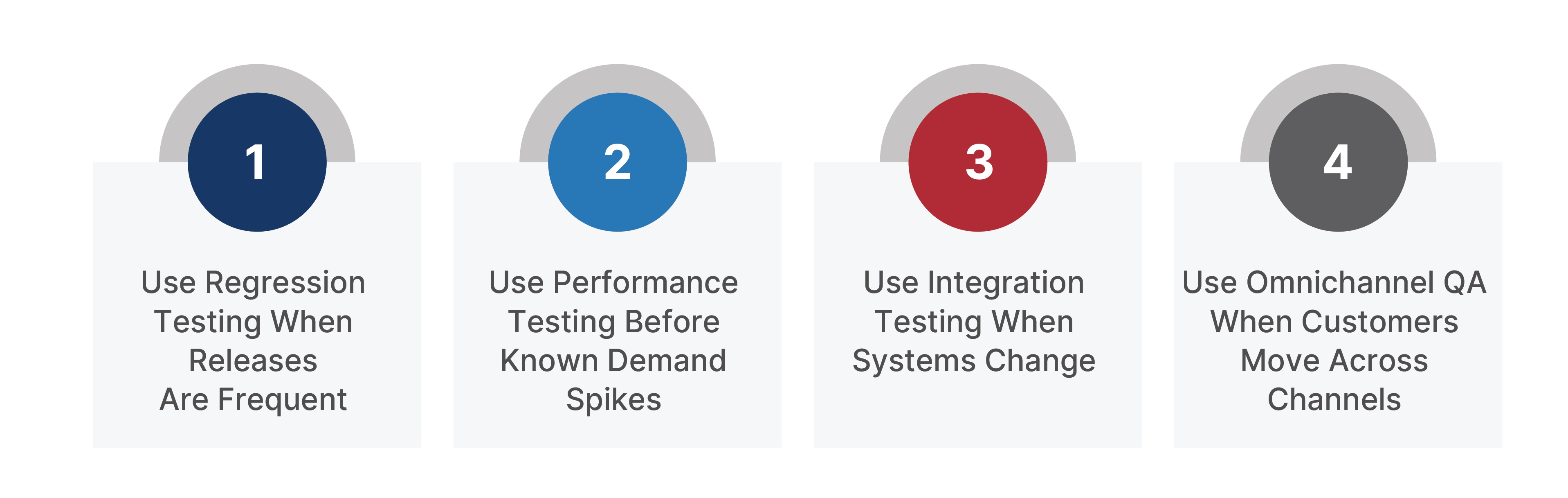
Use Regression Testing When Releases Are Frequent
Choose mobile ordering regression testing when teams ship offers, menus, screens, or loyalty features. Automation should cover core journeys that directly affect revenue.
These journeys include account login, reorder, cart updates, payment confirmation, refund, and order tracking. They should run across priority devices and operating systems.
Use Performance Testing Before Known Demand Spikes
Choose performance testing before campaigns, sporting events, holidays, and national promotions. The goal is not only higher traffic tolerance, but also better performance.
Teams must also validate response time, queue behavior, payment retries, API degradation, and graceful failure patterns.
Use Integration Testing When Systems Change
Choose integration testing when POS, loyalty, CRM, delivery, tax, or payment systems change. These releases carry hidden risk across downstream operations.
Use Omnichannel QA When Customers Move Across Channels
Choose omnichannel QSR QA when customers start in one channel and finish in another. The experience must stay consistent across app, web, kiosk, drive-thru, and delivery marketplaces.
How Food Delivery App Testing Services Reduce Peak-Hour Revenue Leakage
Revenue leakage often hides inside small digital failures. A customer abandons a cart, switches to an aggregator, requests a refund, or stops using the app.
Specialized food delivery app testing services focus on the full ordering path. They validate what happens before, during, and after the transaction.
What Peak-hour Testing Should Include
Peak-hour QA should simulate real customer and store behavior. Scripted happy paths alone cannot reveal production risk.
Key coverage areas include these scenarios.
- API performance under concurrent ordering traffic
- Cart persistence across app restarts and network changes
- Payment gateway failover and retry handling
- Store availability updates during temporary closures
- Delivery radius, address validation, and geolocation accuracy
- Loyalty offer redemption during high transaction volumes
- Order throttling when kitchen capacity becomes constrained
This type of testing helps teams find bottlenecks before customers do. It also gives operations teams clearer confidence before campaign launches.
For enterprise QSR brands, QA should also include observability validation. Logs, alerts, dashboards, and incident triggers must accurately reflect real ordering failures.
How Can TestingXperts Assist with Digital Ordering Software Testing?
TestingXperts supports QSR brands with digital assurance capabilities built around real ordering complexity. Its QSR practice covers mobile apps, loyalty platforms, digital ordering platforms, and connected restaurant systems.
For digital ordering software testing, TestingXperts can validate customer journeys across mobile, web, POS, payment, loyalty, and fulfillment layers. Teams can combine services like, functional testing, test automation, API testing, performance testing, accessibility testing, and usability testing.
The value comes from testing the complete restaurant workflow, not isolated screens. That includes menu configuration, order placement, payment processing, kitchen routing, refund handling, and loyalty updates.
TestingXperts also provides accelerators, reusable templates, and domain-specific QA methods to accelerate coverage. Its QSR POS modernization case study reported a 150% increase in deployment efficiency and a 20-store rollout within 12 months.
For IT leaders, that means fewer blind spots before releases reach stores. It also means stronger governance across franchise rollouts and high-volume ordering periods.
Conclusion
Downtime is only the most visible symptom of poor QSR mobile quality. The deeper issue is breaking trust across ordering, payment, fulfillment, and loyalty experiences.
Mobile app testing for QSR platforms helps leaders protect revenue when demand is highest. It also improves release confidence across POS integration, digital ordering, and omnichannel QSR QA.
QSR brands that treat quality as a revenue infrastructure will move faster with fewer service disruptions. The next competitive advantage may be an ordering experience that works under pressure.

VP, Delivery Quality Engineering
Manjeet Kumar, Vice President at TestingXperts, is a results-driven leader with 19 years of experience in Quality Engineering. Prior to TestingXperts, Manjeet worked with leading brands like HCL Technologies and BirlaSoft. He ensures clients receive best-in-class QA services by optimizing testing strategies, enhancing efficiency, and driving innovation. His passion for building high-performing teams and delivering value-driven solutions empowers businesses to achieve excellence in the evolving digital landscape.
Discover more