Recommended Blogs

Guidewire Testing Challenges that Slow Insurance Programs and How Enterprises Can Solve Them

 Last Updated: June 2nd, 2026
 Read Time: 2 minutes
Table of Content
- Why Guidewire Testing Is Complex for Insurance Enterprises
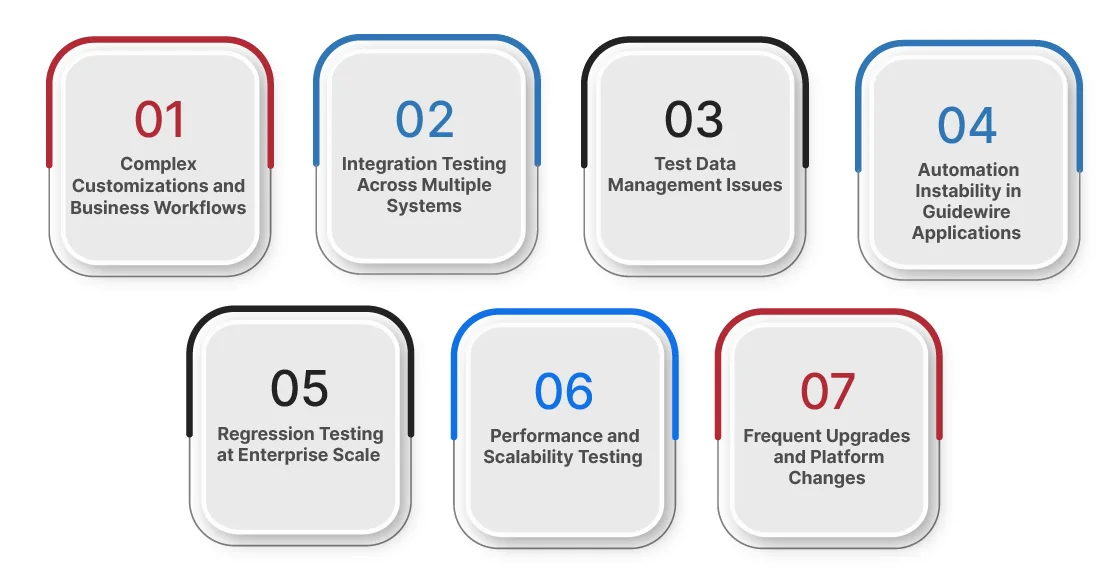
- Common Guidewire Testing Challenges and Solutions
- Best Practices to Overcome Guidewire Testing Challenges
- How Does TestingXperts Help Enterprises Overcome Guidewire Testing Challenges?
- Conclusion
Share On


Guidewire and other platforms are very important to insurance businesses for managing policy administration, billing, and claims processes. Even a tiny problem with these systems can throw off underwriting, claims processing, or billing cycles when they run essential business processes.
That’s why testing Guidewire is such an important part of big transformation efforts. But many businesses struggle with guidewire testing issues, especially when they have to deal with large installations, integrations, and frequent system changes.
Guidewire platforms are highly configurable and integrate with many enterprise systems. Because of this complexity, QA teams often face delays, unstable automation, and incomplete test coverage if testing strategies are not well planned.
Why Guidewire Testing Is Complex for Insurance Enterprises
Guidewire platforms like PolicyCenter, BillingCenter, and ClaimCenter can handle complex insurance operations, but they require significant setup and integration with other business systems. When you test these systems, you verify that the business rules, integrations, APIs, processes, and security controls are functioning.
The complexity increases in enterprise environments where Guidewire connects with CRM systems, payment gateways, document management platforms, and legacy insurance applications. This challenge is growing as more insurers adopt cloud-based core platforms. In fact, over 570 insurers across more than 40 countries rely on Guidewire solutions, reflecting the scale and complexity of modern implementations.
Because of this, companies usually have issues with Guidewire implementation testing, especially when you upgrade platforms or undergo digital transformation.
Common Guidewire Testing Challenges and Solutions
1. Complex Customizations and Business Workflows
Handling multiple changes is one of the hardest parts of guidewire testing for insurance companies. Insurance businesses often set up their business rules, rating engines, and processes to fit the products they sell. These changes bring new dependencies and increase the likelihood of bugs during upgrades or new feature releases.
It takes a lot of effort to test every workflow manually, and it often doesn’t complete.
Solution
Use risk-based testing and model-based automation to focus on the most important insurance workflows. Automated checks of important tasks, including issuing policies, processing claims, and calculating bills, help maintain high quality while reducing manual testing.
2. Integration Testing Across Multiple Systems
Guidewire doesn’t perform well on its own. It integrate with payment systems, CRM platforms, third-party tools, and external data suppliers. Integration problems can stop important insurance activities from working.
Many teams struggle with Guidewire QA issues when validating asynchronous APIs, message queues, and responses from other systems.
Solution
Set up a framework for integration testing that involves testing APIs, virtualizing services, and simulating environments. When third-party systems are unavailable, QA teams cannot perform full end-to-end integration testing. Instead, they validate their side using mock APIs or service virtualization to simulate responses. Full integration testing is completed once the external systems become available.
3. Test Data Management Issues
Insurance systems depend heavily on customer, policy, and claims data. It can be hard to get actual test data while still following the rules, though. Poor test data leads to incorrect test findings and issues being missed.
Industry guidelines say that bad test data and mismatched environments are major problems that come up while implementing Guidewire.
Solution
Test data management helps QA teams create, manage, and provision reliable datasets for testing. Instead of simply generating fake data, teams often extract subsets of production data and apply masking or anonymization to protect sensitive information such as customer details.
4. Automation Instability in Guidewire Applications
Automation is necessary for large insurance operations. However, many companies struggle with test scripts that don’t work. Automation frameworks typically break when the UI changes, the platform is updated, or the workflow changes.
One of the hardest things about Guidewire testing at scale is automation instability.
Solution
If you’re wondering how to reduce automation failures in guidewire testing, the answer lies in designing resilient frameworks.
Best practices include:
- Implementing modular automation frameworks
- Using API-level automation instead of only UI testing
- Incorporating self-healing automation tools
- Maintaining reusable test components
5. Regression Testing at Enterprise Scale
Every change in Guidewire configurations or integrations can impact multiple modules because insurance workflows are closely connected. Even a small update may affect policy, billing, or claims processes, making regression testing more complex.
When done manually, regression cycles become slow and resource intensive. This often delays releases and increases project costs, especially in large Guidewire implementations.
Solution
Companies get around this by using DevOps environments to set up continuous testing pipelines. Automated regression suites run in CI/CD pipelines help find problems sooner and speed up the release cycle.
6. Performance and Scalability Testing
Guidewire solutions need to be able to handle thousands of users at once, such as agents, brokers, claims handlers, and policy administrators. However, performance testing is typically missed during implementation.
The native Guidewire testing framework is primarily for functional validation. Therefore, you usually need other tools for performance testing.
Solution
Companies perform performance testing using solutions such as load-testing frameworks and cloud-based testing environments. This ensures the platform can handle peak loads during claims events, insurance renewals, or disasters.
7. Frequent Upgrades and Platform Changes
Guidewire regularly provides updates that add new features and make the software more secure. Changes to APIs, workflows, or data models are common in upgrades. This breaks test scripts and makes QA’s job harder.
QA teams have to put in a lot of work to make sure everything works together.
Solution
Businesses may quickly find the regions that are affected after each upgrade by using impact analysis and automated regression testing.
This strategy reduces the number of tests needed while keeping key business operations robust.
Best Practices to Overcome Guidewire Testing Challenges
Organizations that successfully overcome common guidewire testing challenges and solutions typically follow a few key practices.
- Use automation early in the project life cycle
- Focus on insurance workflows that are important to your business
- Reduce UI dependence via testing APIs
- Keep your test data management processes strong.
- Add testing to CI/CD workflows
- Use risk-based regression strategies to speed up releases
When companies use these tactics together, they can significantly improve testing efficiency and reduce manufacturing risks.
How Does TestingXperts Help Enterprises Overcome Guidewire Testing Challenges?
Large Guidewire programs require strong domain knowledge, scalable automation, and structured testing practices. TestingXperts supports insurance enterprises by addressing common guidewire testing challenges with proven quality engineering approaches.
- Specialized Guidewire testing services covering PolicyCenter, BillingCenter, and ClaimCenter implementations
- Experience supporting guidewire testing for large scale implementations across complex insurance ecosystems
- Automation frameworks designed to reduce automation failures in Guidewire testing and improve test stability
- Strong capabilities in integration testing, API validation, and data quality testing for Guidewire environments
- Risk-based regression strategies to manage major challenges in Guidewire implementation testing
- Continuous testing approaches aligned with DevOps to accelerate enterprise release cycles
Conclusion
Guidewire testing is critical to the success of insurance transformation programs, but it often becomes challenging because of customizations, integrations, data dependencies, and frequent platform changes. Insurers need a structured approach that combines risk-based testing, stable automation, strong integration validation, and effective test data management. With the right quality engineering strategy, organizations can reduce release risk and improve delivery speed. TestingXperts helps insurers strengthen Guidewire testing and ensure reliable business-critical operations.

Associate Director
Yuvraj Singh is an accomplished Associate Director of Delivery, renowned for leading strategic quality assurance initiatives that consistently deliver outstanding software outcomes across global markets. With deep expertise in both Property & Casualty (P&C) and Life & Annuities (L&A) insurance domains, Yuvraj excels at bridging the gap between complex business objectives and flawless execution.
FAQs
How can enterprises overcome common Guidewire testing challenges effectively?
Enterprises can overcome Guidewire testing challenges by adopting risk-based testing, strengthening test data management, and using API-first automation. Integrating testing into CI/CD pipelines also helps identify defects early and ensures stable, faster releases.
What makes a Guidewire testing solution effective for large insurance organizations?
An effective solution combines domain expertise, scalable automation, and strong integration testing. It should support complex workflows, handle large datasets, and ensure consistent validation across PolicyCenter, BillingCenter, and ClaimCenter environments.
How can businesses accelerate release cycles in large-scale Guidewire programs?
Businesses can accelerate releases by implementing continuous testing, automating regression suites, and reducing UI dependency with API testing. Early defect detection and streamlined test environments help minimize delays in large-scale Guidewire implementations.
What are the best practices for scaling Guidewire testing in enterprise environments?
- Focus on business-critical workflows
- Use API and automation-first testing approaches
- Implement strong test data management
- Integrate testing into CI/CD pipelines
- Apply risk-based regression strategies for faster execution
What testing strategy helps insurers validate business-critical Guidewire workflows faster?
A combination of risk-based testing and automation works best. By prioritizing high-impact workflows like claims and policy processing, and automating them, insurers can validate critical functions faster while maintaining accuracy and reducing manual effort.
How does TestingXperts help enterprises solve Guidewire testing challenges?
TestingXperts helps insurers tackle Guidewire testing challenges through domain-led QA, robust automation frameworks, and integration testing expertise. Their approach improves test coverage, reduces automation failures, and enables faster, more reliable releases for large insurance programs.
Discover more