

Recommended Blogs

Post
The Integrity Deficit Undermining Salesforce Data Migration Success
Table of Content
- The Hidden Integrity Gaps Derailing Salesforce Data Migration
- Why Transformation Fails at the Data Layer, Not the Salesforce Layer
- Integrity-by-Design: A Modern Blueprint for Salesforce Readiness
- High-Value Tests That Shield Salesforce from Data Failure
- Scaling Data Integrity Across Multi-Cloud Salesforce Landscapes
- Why TestingXperts: Your Partner for Integrity-Driven Salesforce Success
- Conclusion
Share On


Salesforce is one of the powerful cloud-based technologies for enterprise CRM operations. Yet, many Salesforce data migration challenges stall the transformation initiatives. Lack of operational quality, trust, and structure are some of the leading factors derailing Salesforce program implementation. According to Gartner research, poor data quality costs businesses an average of $12.9 million per year. And the impact doubles when they plan for data migration without an adequate CRM data migration strategy.
The Hidden Integrity Gaps Derailing Salesforce Data Migration
Enterprises often prioritize investments in workflows, automation, and configuration, while data is given the least attention. Based on the trend that has unfolded since the advent of the AI era, data is becoming the core aspect of all operations. There’s a saying prevalent in the business era: “If your data is correct, you are going to lead the revolution.” The undermined data foundation results in a migration program that’s complete, yet it doesn’t produce any results.
Duplicate accounts, incomplete histories, compliance gaps, and invalid relationships are some of the integrity gaps that affect the Salesforce programs. These gaps are carried forward from legacy systems into the new CRM environment. That’s why enterprises need strong Salesforce migration best practices to ensure transparency in data integrity.
Why Transformation Fails at the Data Layer, Not the Salesforce Layer
Enterprises need Salesforce to improve visibility, modernize engagements, and accelerate operations. But its impact depends on the trustworthiness of the data. When it comes to data layer failures, traditional IT practices often show less concern for data readiness. Let’s take a look at some Salesforce data migration challenges and solutions:

Unable to Comprehend Legacy Data:
Organizations frequently underestimate the level of fragmentation in their existing systems. Multiple CRMs, billing platforms, marketing tools, and homegrown applications hold conflicting customer details. Without a thorough data quality assessment for Salesforce migrations, inconsistencies remain hidden until late in the program.
Weak Salesforce Data Mapping:
Salesforce data mapping is more than a field-to-field conversation. It requires a business-aligned interpretation of relationships, hierarchies, and historical attributes. When mapping relies solely on technical documentation rather than operational rules, critical relationships break after migration.
Limited Data Cleaning and Validation:
Most teams focus heavily on Salesforce configuration and far less on data cleansing in Salesforce workloads. This leads to outcomes where transformed data meets the technical format but not the business standards required for accuracy.
Close to No Governance:
Data governance Salesforce programs often mature slowly. Without ownership models, approval workflows, and data quality thresholds, project teams lack clarity on what “good” looks like. That creates inconsistent decisions on which records to merge, transform, or retire.
Inadequate Data Quality:
Salesforce sandbox testing often focuses on functionality, not data integrity. As a result, teams validate screen behavior but do not confirm whether account hierarchies, contact associations, and opportunity histories maintain integrity after the migration.
Integrity-by-Design: A Modern Blueprint for Salesforce Readiness
To achieve reliable Salesforce migration outcomes, enterprises should adopt an integrity-first strategy. Let’s take a close look at the blueprint to ensure compliance for Salesforce data migration:
Establish Current Data Baseline:
Start by profiling legacy sources for accuracy, duplication levels, compliance exposure, and completeness. It will give a quantifiable view of the practices needed to meet Salesforce standards.
Convert Business Logic into Salesforce Structure:
Data mapping requires agreement between business operations and Salesforce objects and relationships. This step reduces post-migration rework and protects data relationships for reporting and forecasting.
Clean and Standardize Data:
The next step is to clean the data by performing activities such as deduplication, enrichment, and formatting corrections. It will help protect the quality of the migrated data.
Govern Migration Process:
Define ownership for rules approval, quality metrics review, and exception validation. It will support the decision-making structure and keep migration activities in sync with business objectives.
Apply Validation:
Validation is not a one-time activity. Test for data accuracy at extraction, transformation, load, and post-migration data audits in Salesforce. It will ensure the completeness of migrated data and reduce the chances of issues after go-live.
Continuous Monitoring:
Teams should monitor trends continuously to identify quality drifts. It will help preserve integrity during the program and support reliable analytics.
High-Value Tests That Shield Salesforce from Data Failure
The accuracy of your Salesforce data depends on the validation activities that you perform. The following are the testing best practices for Salesforce data migration that an enterprise should include:
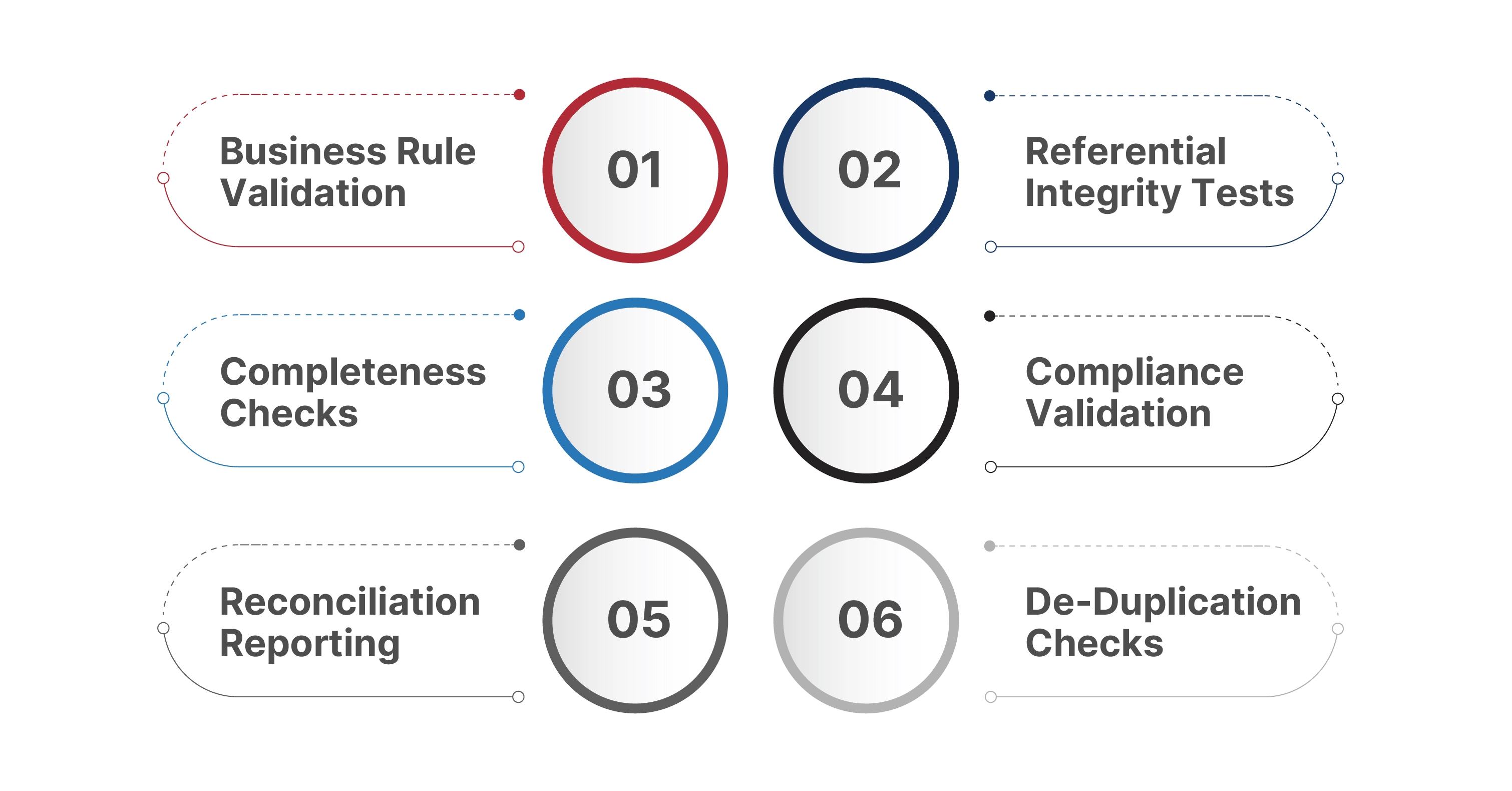
Business Rule Validation:
Make sure your data aligns with operational policies. For example, validate whether opportunities have preserved past data, and all contacts are associated with active accounts.
Referential Integrity Tests:
Address data relationship validation issues after Salesforce migration. It will help verify parent-child relationships between datasets, along with account hierarchies and lookup values.
Completeness Checks:
Ensure the complete migration of all records. It will prevent customer data loss, incomplete service cases, or partial opportunity data.
Compliance Validation:
Fulfill regulatory requirements related to data retention and secure handling of sensitive attributes. It is a must-have activity for Salesforce data migration across various industries, including insurance, healthcare, and banking.
Reconciliation Reporting:
The final data must match the extracted, transformed, and loaded data. This will protect your enterprise from silent data loss.
De-Duplication Checks:
Avoid redundancy in customer records to prevent sales productivity loss and facilitate reporting accuracy.
Scaling Data Integrity Across Multi-Cloud Salesforce Landscapes
Companies operating across multiple clouds, including Sales Cloud, Service Cloud, Marketing Cloud, Experience Cloud, and Industry Clouds, are facing a whole new level of complexity. With more systems interacting, you’ve got a whole lot more to keep track of when it comes to data dependencies. So, how do you maintain your integrity across all these different clouds? Here are some key areas to focus on:
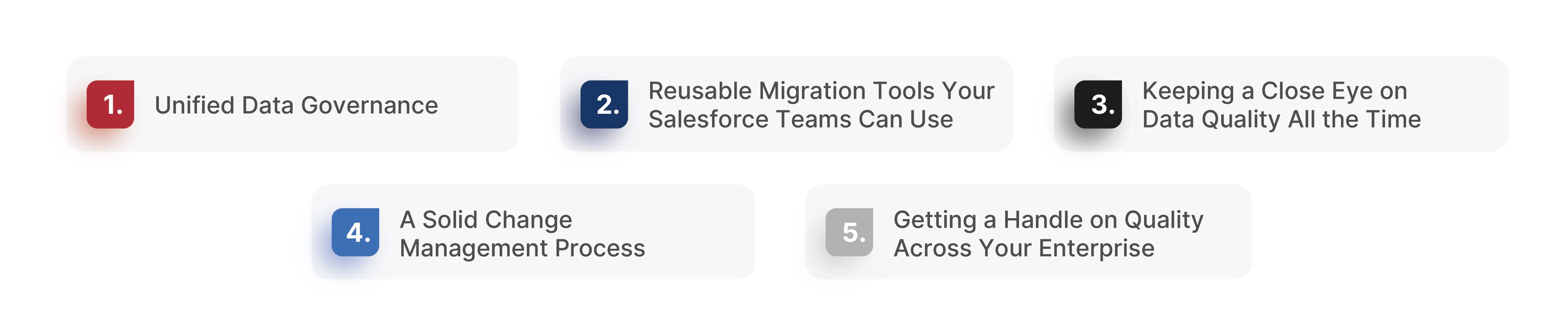
Unified Data Governance:
Build shared rules that define how your data should be formatted, what quality it needs to meet, and who’s responsible for ensuring it is maintained. That way, you avoid having standards that are inconsistent across different clouds.
Reusable Migration Tools Your Salesforce Teams Can Use:
Using the same ETL pipelines to migrate data across clouds makes a whole lot of sense. Not only does it speed up future migrations, but it also means you can expect the same results every single time. No more starting from scratch for every single deployment.
Keeping a Close Eye on Data Quality All the Time:
Conducting regular audits on the data after migration can help identify any quality issues that may arise. Having regular scorecards to track this kind of information helps ensure that everyone knows where they stand and prevents issues from escalating over time.
A Solid Change Management Process:
When things change rapidly in a multi-cloud environment, you need a system in place to determine the impact of any new field, integration, or automation on your data. That way, you can avoid mucking up your existing data relationships in the process.
Getting a Handle on Quality Across Your Enterprise:
By assigning a quality score to each of your domains, you gain a clear understanding of your biggest risks and can ensure you’re focusing on the most critical areas first.
Why TestingXperts: Your Partner for Integrity-Driven Salesforce Success
TestingXperts, one of the leading transformation experts, helps enterprises avoid pitfalls encountered during Salesforce data migration. We follow an integrity-driven approach to uncover and correct issues in the data layer and the CRM environment. Our approach involves identifying defects, gaps, and inconsistencies in the lifecycle. We help clients understand their legacy data before initiating the migration process.
Our data validation rules include referential integrity testing, business rule assessments, and reconciliation checks. Whether adopting a single cloud or multi-cloud portfolio, TestingXperts ensures consistent data integrity at the enterprise level.
Conclusion
Businesses that treat data integrity as an afterthought would face consequences in the long run. Considering mapping legacy data to Salesforce as a strategic priority would result in stronger adoption, cleaner reporting, and better ROI on Salesforce investments. TestingXperts, one of the leading Salesforce solutions experts, offers data migration and integration expertise, frameworks, and Salesforce ETL tools to help you move with confidence.

Manjeet Kumar
VP, Delivery Quality Engineering
Manjeet Kumar, Vice President at TestingXperts, is a results-driven leader with 19 years of experience in Quality Engineering. Prior to TestingXperts, Manjeet worked with leading brands like HCL Technologies and BirlaSoft. He ensures clients receive best-in-class QA services by optimizing testing strategies, enhancing efficiency, and driving innovation. His passion for building high-performing teams and delivering value-driven solutions empowers businesses to achieve excellence in the evolving digital landscape.
FAQs
How can enterprises ensure data integrity during Salesforce data migration?
Enterprises ensure data integrity by profiling source data, cleansing duplicates, validating mappings, enforcing transformation rules, and reconciling migrated records against the source systems before go-live.
What challenges arise when performing Salesforce data migration across multiple clouds?
Challenges include inconsistent data models, synchronization issues, data duplication, security policy conflicts, latency, and maintaining consistent data ownership across cloud environments.
How do data integrity gaps from legacy systems affect Salesforce data migration success?
Legacy data issues, such as duplicates, missing fields, outdated formats, and inaccurate relationships, are transferred into Salesforce, reducing data reliability and impacting reporting, automation, and user trust.
How can organizations detect hidden data risks before migrating to Salesforce?
Organizations detect hidden data risks through data audits, profiling tools, dependency analysis, validation rules, and identifying anomalies in structure, completeness, accuracy, and historical consistency.
What Salesforce data integrity risks are typically inherited from legacy CRM systems?
Common inherited risks include duplicate records, inconsistent field values, broken relationships, incomplete histories, invalid formats, and outdated business rules embedded in legacy CRM data.
Discover more