Recommended Blogs

The Importance of Salesforce Testing for Business Success

 Last Updated: December 18th, 2025
 Read Time: 3 minutes
Table of Content
- What is Salesforce Testing?
- 7 Types of Salesforce Testing
- Salesforce Testing Requirements
- How Salesforce Testing Benefits to Businesses?
- How Do Functional and Integration Testing Improve Salesforce CRM Reliability?
- Automation Strategies for Salesforce Testing
- Performance and Security Testing for Salesforce Environments
- Summary
- Why Choose Tx for Salesforce Testing?
Share On


How does a business ensure the optimal performance of its customer relationship management (CRM) systems under varying conditions, such as high traffic volumes, data migrations, system configuration changes, software updates, etc.? In the data-driven business world, maintaining the functionality and integrity of CRM systems is crucial for survival and success.
Salesforce, a leading CRM platform implemented by various businesses, handles everything from customer service and sales to automating marketing strategies. But, just like any powerful tool, it must ensure it performs seamlessly and securely. That’s where Salesforce testing enters.
It helps to confirm each module functions as expected, and that new integrations or updates do not impact existing functionalities. Despite its important role, businesses often overlook this step. Doing so, they risk their operational efficiency and customer satisfaction. Businesses that conduct regular Salesforce testing experience increased user satisfaction and reduced downtime related to CRM issues.
What is Salesforce Testing?
Salesforce is a popular cloud-based CRM platform that allows businesses to connect with customers, streamline processes, manage sales, improve customer services, and more. Launched in 1999 by Marc Benioff and Parker Harris, Salesforce started as a SaaS for CRM. Now, it offers multiple software solutions like app development, analytics, automation, sales, and marketing. It’s also widely used beyond the business world — nonprofits can leverage Salesforce for donor management, fundraising performance tracking, and supporter engagement.
Salesforce also offers tools to track customer activity, market to customers, automate customer service, and support businesses to make informed decisions based on real-time data. Sometimes, it is also known as SFDC (SalesforceDotCom, reflecting company’s original domain name), and its testing is referred to as SFDC testing. Its wide array of functionalities and frequent updates present unique challenges that require thorough testing. The following are the reasons why to conduct Salesforce testing:
Testing Salesforce ensures the complex system meets every business requirement without hampering the existing processes. Its wide array of functionalities and frequent updates present unique.
• Businesses usually customize Salesforce to align it with their operations. Testing Salesforce ensures the customizations work correctly even after changes are made in the underlying system.
• Salesforce handles a vast amount of sensitive customer data, making testing a crucial step to ensure security measures are implemented to maintain data integrity. This helps prevent data breaches and maintain user trust.
• It helps to ensure the user interface is error-free and meets the user’s requirements. This increases efficiency and satisfaction among teams using the system daily.
• Regular updates and features require seamless integration with existing systems. Testing helps identify and resolve any issues related to updates or new integrations, ensuring continued work without disruptions.
• It helps ensure Salesforce implementations comply with legal standards to avoid potential fines and regulatory issues.
7 Types of Salesforce Testing
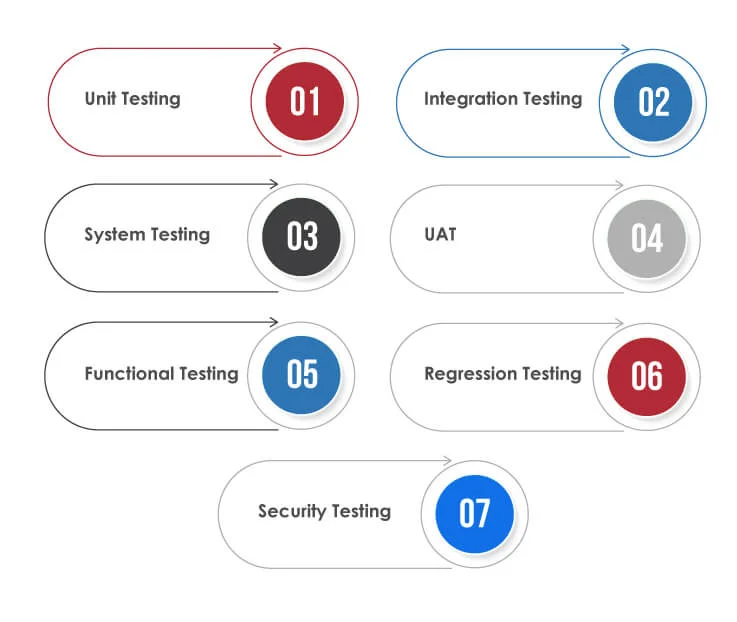 Depending on the project requirements, businesses may need several types of Salesforce testing. A targeted approach helps identify issues affecting day-to-day business operations and ensure the components work effectively. The following are key Salesforce testing types:
Unit Testing
Unit testing involves testing individual modules or components of the Salesforce application to ensure they function correctly. QA and dev teams perform unit testing during the development phase to catch and fix bugs early in the lifecycle. Businesses should test 75% of their code with unit testing before deploying it into a test environment.
Integration Testing
Businesses generally integrate their Salesforce application with other systems, such as marketing automation tools and ERP systems, making integration testing essential. When third-party modules are added to the system integration testing helps identify issues. It ensures Salesforce interacts seamlessly with other systems and data flows in the right order between them without corruption or loss.
System Testing
System testing involves analyzing the Salesforce software to verify whether it meets the business requirements. It is performed after unit and in parrel with integration testing to identify defects affecting the system. It ensures that all components within the Salesforce ecosystem work seamlessly and that the system functions as expected in the environment, mimicking production settings. The process covers stress testing and scenario testing as well.
UAT
In this type of testing, a small portion of end-users validate the Salesforce system’s functionality and usability before moving it to the production phase. They verify that the system does what it’s made for based on the business requirements. Successful UAT is crucial for gaining stakeholder approval before the Salesforce system goes live.
Functional Testing
This type of Salesforce testing examines each software function by providing input and analyzing output against functional requirements. Functional testing ensures the Salesforce application functions as expected and that all features work based on specified requirements. It verifies workflows, captures, and executes user interactions accurately.
Regression Testing
Regression testing is performed whenever new changes or updates are made to Salesforce. It ensures that the new modifications do not severely affect the existing functionalities, maintaining system stability and user trust post-updates. Manual and automation testing can be used to do this.
Security Testing
Security testing is necessary to understand the critical nature of Salesforce data. It helps check vulnerabilities, ensures the system adequately protects data and follows regulations like GDPR, HIPAA, etc.
Salesforce Testing Requirements
Businesses must fulfill certain requirements to ensure the effectiveness of Salesforce testing. This will ensure the thoroughness of the testing process, covering all necessary aspects of the Salesforce environment and supporting business strategic goals. Following are some of the key testing requirements for Salesforce:
• Create a comprehensive test plan that outlines the testing scope, including the processes and functionalities to be tested, the test schedule, and team members’ responsibilities. This plan will ensure all critical components are covered, and testing processes are managed efficiently.
• Set up a testing environment replicating the production environment but isolated from the actual production environment. This is necessary to prevent disruption to daily operations while QA teams can accurately simulate real-world scenarios.
• Salesforce testing requires realistic test data that reflects the actual data handled by Salesforce systems. To protect sensitive information, comply with data protection regulations.
• QA team should understand Salesforce functionalities and the configurations used in that environment. They must have technical expertise and an understanding of business processes to conduct effective testing.
• Use tools that support both manual and automation testing. It will save time and increase the testing coverage. Utilize performance testing tools to assess system behavior under various loads.
• Salesforce frequently receives updates, so it’s important for QA teams to stay informed about the changes. Conduct training sessions to update teams on new releases and best practices in Salesforce testing.
How Salesforce Testing Benefits to Businesses?
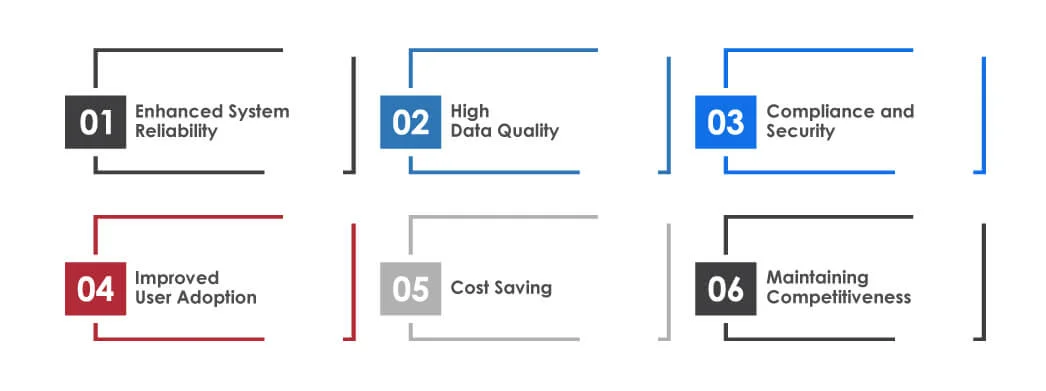
Implementing Salesforce testing is a technical necessity and a strategic business investment. Businesses that rigorously test their Salesforce environment will experience overall efficiency improvement and better customer relationship management. The following are several key business benefits of conducting thorough Salesforce testing:
Enhanced System Reliability
Testing the Salesforce platform ensures all features and functions perform reliably and correctly. This level of reliability is necessary for maintaining uninterrupted business operations and avoiding costly downtimes that may affect sales processes and customer interactions.
High Data Quality
Effective testing maintains the accuracy and integrity of Salesforce data. High-quality data is crucial for making informed business decisions and enhancing the CRM strategy’s effectiveness.
Compliance and Security
It ensures that the Salesforce system complies with relevant laws and regulations, especially data protection. By ensuring the security of user data, businesses can avoid legal penalties and protect their reputations.
Improved User Adoption
Users are likelier to adapt and effectively use a bug-free, thoroughly tested platform. An efficient and smooth system enhances user satisfaction and productivity, impacting overall organization performance.
Cost Saving
Identifying and resolving issues early in the development or deployment phase reduces the need for costly bug fixing later. This proactive testing approach will allow businesses to save substantial money over time and minimize the financial impact of critical bug failures.
Maintaining Competitiveness
A well-structured and error-free functioning Salesforce system will provide businesses with a competitive edge. It will facilitate faster and more accurate responses to market changes and customer needs. This, in turn, will lead to better customer service and improved loyalty.
How Do Functional and Integration Testing Improve Salesforce CRM Reliability?
Functional and integration testing ensure that all of Salesforce’s business processes function as intended across modules, third-party systems, and custom settings. This is very important for businesses that use Salesforce CRM to track sales, service, and customer data.
Functional testing checks that business logic, workflows, and role-based access are correct. Integration testing ensures that data flows smoothly between Salesforce and other platforms linked to it, such as ERP systems, marketing automation systems, and payment systems.
Key focus areas include:
- Validating custom objects, workflows, and triggers in the Salesforce application testing.
- Making sure that APIs and middleware integrations work as they should.
- Checking user paths like lead-to-cash and case resolution.
- Testing across multiple clouds, such as Sales, Service, and Marketing.
An organized approach to Salesforce quality assurance reduces the likelihood of system failures, improves accuracy, and builds trust in the company’s CRM procedures.
Automation Strategies for Salesforce Testing
Automation is a big part of boosting the ROI of Salesforce testing services because it reduces manual work and speeds up releases. Businesses that use Salesforce implementation and upgrade testing need automation that can be reused and grow with them.
Common automation strategies include:
- Regression automation for frequent Salesforce release testing cycles.
- CI/CD pipeline integration to support continuous delivery.
- API and UI automation to improve test coverage.
- Test data automation for large enterprise environments.
Selection criteria for automation tools:
- Compatibility with Salesforce updates.
- Support for low-code or script-based testing.
- Scalability for enterprise Salesforce environments.
A balanced approach to automation boosts productivity and speeds up corporate change.
Performance and Security Testing for Salesforce Environments
Performance and security testing ensure that Salesforce systems can manage a large number of users, a large volume of data, and new cyber threats. Businesses that don’t undertake thorough validation of risk slowdowns, downtime, and noncompliance.
Best practices include:
- Load and stress testing for peak business events.
- API performance validation for connected ecosystems.
- Data encryption and access control testing.
- Compliance validation for GDPR, HIPAA, and other regulations.
These methods improve Salesforce CRM testing, speed up response times, and protect private customer information.
Summary
Salesforce testing is necessary to ensure the optimal performance of CRM systems under varying conditions, such as high traffic volumes, system updates, etc. It is also necessary to ensure operational efficiency and higher customer satisfaction. The process involves various testing types: unit, integration, system UAT, functional, regression, performance, and security testing.
It helps maintain system integrity, enhance user adoption, and ensure data security. Salesforce testing will become a strategic business investment with detailed planning and skilled execution, thus enhancing overall business operations and CRM strategies.
Why Choose Tx for Salesforce Testing?
Partnering with the right Salesforce testing provider can significantly enhance the effectiveness of your CRM system, improving overall business efficiency and customer satisfaction. Tx is one of the leading Salesforce testing providers due to its deep expertise in the Salesforce system, proven methodologies, and client-centric approach.
Partnering with Tx will ensure your Salesforce systems are robust, secure, and perfectly aligned with your operational needs and business goals. Following are the reasons to choose Tx for Salesforce testing:
• Automated regression test suits to ensure applications are developed rapidly while maintaining high quality.
• Conducting Role-based testing to ensure compatibility with your organizational policies.
• Ensure adherence to strict quality standards and follow best practices for data security to ensure the effectiveness of the Salesforce environment.
• Using our in-house test automation framework (Tx-Automate) and other latest tools and technologies to conduct thorough and efficient testing, ensuring high coverage and accuracy while reducing testing time and costs.
• Tx offers a complete range of Salesforce testing services, from unit testing to user acceptance testing, including regression testing, performance testing, security and integration testing, etc.
• Specialization in HTTP-based REST APIs, SOAP connectivity, and other enterprise integrations.
• Experience in the Salesforce cloud platform and various middleware APIs and plugins.
• To know more, contact our QA experts now.

Associate Vice President Delivery
Experienced Director- Quality Assurance with a demonstrated history of working in the information technology and services industry. Skilled in Requirements Analysis, Agile Methodologies, Test Automation, Mobile Applications, and Test Management. Strong quality assurance professional with a Bachelor of Engineering - BE focused in Electrical, Electronics and Communications Engineering from Model Institute of Engineering and Technology.
FAQs
How can Salesforce testing reduce post-deployment defects?
Testing Salesforce applications early finds problems with workflows, connectors, and customizations. This stops production failures, reduces downtime, and makes users feel better about releases.
Which automation approaches optimize Salesforce testing ROI?
The best return on investment comes from test automation focused on high-risk areas. Some important ways to do this are:
- Regression automation
- API automation
- CI/CD integration
- Test data automation
How do we validate data integrity during Salesforce migrations?
Data validation frameworks, reconciliation testing, and automated tests ensure that Salesforce upgrade testing and migrations are correct. These strategies stop data from being lost, duplicated, or put at risk of not following the rules.
How can performance testing prevent slowdowns in enterprise Salesforce instances?
Load, stress, and scalability testing mimic how things are really used. This helps find bottlenecks early on and ensures performance remain stable when there are a lot of transactions.
What metrics track overall Salesforce testing effectiveness?
Key indications are defect leakage, automation coverage, test cycle time, MTTR, and release stability. TestingXperts employs these Salesforce quality assurance indicators to make things more reliable and get a better return on investment.
Discover more