Recommended Blogs

Healthcare Legacy System Migration Testing: A QA Framework for Cloud EHR Modernization

 Last Updated: July 3rd, 2026
 Read Time: 5 minutes
Table of Content
- Why EHR Cloud Migration Is a Clinical Continuity Challenge
- The Five Areas That Must Be Validated Before Go-Live
- A Risk-Weighted EHR Migration QA Model
- What Healthcare Leaders Should See Before Approving Go-Live
- How Does TestingXperts Supports EHR Cloud Migration Assurance?
- A Practical QA Checklist for On-Premise to Cloud Healthcare Testing
- Conclusion
Share On


Moving a healthcare system to the cloud is not simply a hosting decision. It is a clinical continuity, data integrity, interoperability, and release-readiness challenge. When an EHR migration fails, the impact rarely stops with IT operations. It can affect medication histories, lab results, patient access, billing processes, and the confidence clinicians place in the new environment.
Healthcare organizations therefore need migration assurance that validates data, workflows, integrations, coexistence, and cutover readiness before go-live.
Why EHR Cloud Migration Is a Clinical Continuity Challenge
Cloud EHR migration is a clinical continuity initiative as much as a technology modernization program. Legacy healthcare platforms contain years of patient histories, business rules, custom workflows, integrations, access models, and reporting logic that support daily care delivery.
When these systems move to cloud environments, hidden dependencies become visible. A field mapping issue can affect medication history. An access control defect can prevent clinicians from viewing records. A failed interface can delay lab results, pharmacy updates, or billing transactions.
Migration risk therefore extends far beyond infrastructure readiness. Healthcare organizations require assurance that the target environment preserves trusted data, functioning workflows, and connected care journeys. Success should not be measured by system availability alone. It should be measured by confidence that clinicians can continue delivering care without disruption after go-live.
The Five Areas That Must Be Validated Before Go-Live
Successful EHR modernization programs require evidence across five critical validation areas before production cutover. Weakness in any one area can introduce operational disruption, workflow failures, data inconsistencies, or delayed patient care.
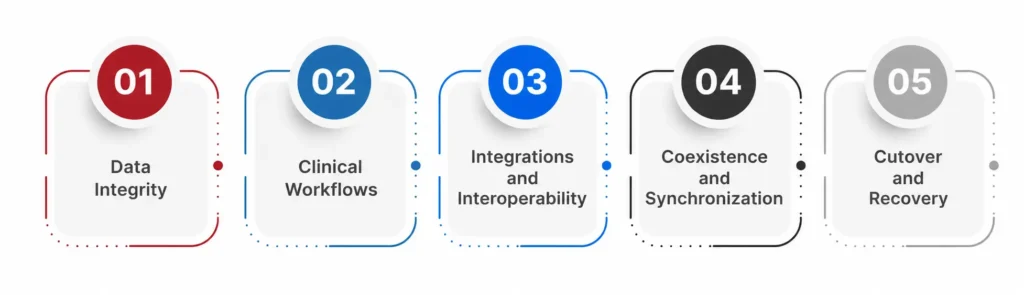
-
Data Integrity
Data integrity validation begins before migration starts. Teams should profile source data, identify duplicates, review code sets, and confirm transformation rules before extraction occurs.
During migration, QA teams must validate record counts, field mappings, and exception handling processes. Following migration, they should reconcile records against source systems to verify completeness and accuracy. Particular attention should be given to high-risk clinical data elements such as allergies, medications, diagnoses, immunizations, lab results, referrals, and care plans.
Security and privacy controls also require validation throughout the migration process. Access controls, audit logging, authentication, authorization, encryption, and data masking should be tested to support healthcare privacy and security requirements.
-
Clinical Workflows
Healthcare workflows rarely operate in isolation. A physician order may trigger lab activity, pharmacy actions, nursing tasks, billing events, and patient notifications. Migration testing must therefore validate end-to-end journeys rather than isolated screens or transactions. Critical workflows include patient intake, diagnosis entry, medication reconciliation, discharge planning, claims processing, and patient communication.
Organizations should also prioritize regression testing for customized workflows that have evolved over years of EHR usage. The objective is not to preserve every historical behavior, but to identify which processes remain essential to care delivery and operational continuity.
-
Integrations and Interoperability
Modern healthcare ecosystems depend on interoperability between EHR systems and connected applications. Validation should cover laboratories, pharmacies, imaging platforms, patient portals, identity services, analytics tools, claims systems, and external partners. HL7 messages, FHIR APIs, batch feeds, and real-time interfaces all require functional and negative testing scenarios.
For example, an order may appear successfully created inside the EHR while the downstream process fails because a laboratory system rejects the HL7 message, a pharmacy interface does not acknowledge the medication request, or a billing platform receives incomplete encounter data.
Migration assurance must confirm not only that information moves, but that it arrives correctly, is acknowledged properly, and supports the next step in the care journey.
-
Coexistence and Synchronization
Many healthcare organizations operate legacy and cloud environments in parallel during migration. This coexistence period introduces risks related to synchronization delays, duplicate records, failed updates, reconciliation gaps, and conflicting transactions between systems.
Parallel-run testing helps organizations verify whether old and new environments remain aligned while teams continue delivering care across both platforms. Synchronization issues can affect more than clinicians and administrators. They may also create patient portal discrepancies, appointment scheduling failures, delayed notifications, telehealth handoff problems, or eligibility verification issues.
Without coexistence assurance, organizations may approve cutover while hidden inconsistencies continue accumulating across systems.
-
Cutover and Recovery
Cutover testing represents the final readiness gate before production transition. Healthcare organizations should conduct migration rehearsals that simulate the actual migration window, including extraction, loading, validation, approvals, communication, and sign-off activities.
Rollback procedures require equal attention. Leadership teams should understand what triggers rollback, who approves it, how systems return to a safe state, and how transactions created during the failed window are managed. Performance, security, and user acceptance testing should also reflect real healthcare conditions such as appointment peaks, portal activity, reporting cycles, and high interface traffic.
A Risk-Weighted EHR Migration QA Model
Successful cloud EHR modernization programs treat migration assurance as a staged process rather than a collection of isolated testing activities. A risk-weighted QA framework helps healthcare organizations focus validation efforts on areas with the greatest impact on patient experience, operational continuity, and release readiness.
| Stage | Primary Focus |
|---|---|
| Assess | Source data profiling, workflow inventory, interface discovery, dependency mapping, and risk ranking |
| Validate | Data reconciliation, transformation validation, access controls, regression testing, and interoperability assurance |
| Coexist | Parallel-run validation, synchronization monitoring, duplicate detection, and exception management |
| Cut Over | Dress rehearsals, rollback validation, downtime procedures, performance testing, and go-live approvals |
| Stabilize | Production monitoring, reconciliation, defect triage, optimization, and post-migration assurance |
This model allows healthcare leaders to move beyond defect counts and focus on evidence that supports confident release decisions.
What Healthcare Leaders Should See Before Approving Go-Live
Before approving production cutover, healthcare leadership teams should have clear visibility into migration readiness indicators rather than relying solely on test execution metrics. Decision-ready evidence should include:
- Percentage of critical clinical data elements successfully reconciled.
- Pass status for high-risk workflows such as medication ordering, patient intake, discharge planning, and claims submission.
- Open interoperability defects affecting labs, pharmacies, imaging systems, and billing platforms.
- Parallel-run mismatch trends between legacy and cloud environments.
- Role-based access exceptions and unresolved authorization risks.
- Rollback readiness status and recovery timelines.
- Risks requiring formal executive acceptance.
- Post-go-live monitoring and stabilization plans.
Evidence-led governance provides stronger release confidence and reduces the likelihood of operational disruption after migration.
How Does TestingXperts Supports EHR Cloud Migration Assurance?
TestingXperts helps healthcare organizations adopt a risk-weighted migration assurance model for cloud EHR modernization initiatives. Our approach focuses on validating the areas that matter most to release readiness, including data integrity, workflow continuity, interoperability, coexistence, performance, and cutover risk.
Rather than treating migration as a final-stage testing activity, TestingXperts applies workflow-first validation strategies that prioritize critical clinical journeys, operational processes, and patient-facing experiences. Our healthcare software testing services support organizations through:
- Risk-weighted migration testing strategies aligned to business and clinical priorities.
- Patient data reconciliation and migration validation across critical healthcare records.
- Clinical workflow validation across providers, nursing teams, labs, pharmacies, billing systems, and patient portals.
- Reusable migration regression assets that accelerate repeated validation cycles.
- HL7, FHIR, API, and interoperability assurance across connected healthcare platforms.
- Coexistence and parallel-run assurance when legacy and cloud systems operate simultaneously.
- AI-led impact analysis and test prioritization to improve coverage and reduce execution effort.
- Evidence-led cutover dashboards and decision-ready go-live governance reporting.
TestingXperts also supports validation of controls relevant to healthcare privacy and security requirements while helping organizations identify workflow, access, data, and integration risks before production deployment.
A Practical QA Checklist for On-Premise to Cloud Healthcare Testing
On-premises-to-cloud healthcare testing needs a structured checklist. This helps teams avoid late-stage surprises and gives leaders a clearer view of risk.
A practical EHR cloud migration QA strategy should include:
- Source data profiling and cleansing validation
- Migration rule and mapping verification
- Patient data integrity migration testing
- Field-level reconciliation and exception testing
- End-to-end clinical workflow validation
- Legacy EHR regression testing
- HL7, FHIR, API, and interface validation
- Coexistence and synchronization testing
- Role-based access and audit log validation
- Performance testing for peak clinical usage
- Security and privacy testing for protected health information
- Healthcare system cutover testing and rollback validation
- Post-migration monitoring and defect triage
This checklist should be risk-weighted. Not every workflow carries the same impact. Clinical safety, compliance, revenue continuity, and patient access should guide test priority.
Conclusion
EHR migration assurance is the layer that protects patient trust during cloud modernization initiatives. Cloud migration can improve scalability, interoperability, and access, but only when data integrity, workflows, integrations, and cutover readiness are validated with evidence-led confidence.
For healthcare leaders, QA should not be left to the end of migration. It should guide every phase from data assessment to post-go-live validation. Healthcare organizations that invest in structured migration assurance reduce operational risk, improve release readiness, and build stronger confidence in the cloud platforms they deliver.

VP, Delivery Quality Engineering
Manjeet Kumar, Vice President at TestingXperts, is a results-driven leader with 19 years of experience in Quality Engineering. Prior to TestingXperts, Manjeet worked with leading brands like HCL Technologies and BirlaSoft. He ensures clients receive best-in-class QA services by optimizing testing strategies, enhancing efficiency, and driving innovation. His passion for building high-performing teams and delivering value-driven solutions empowers businesses to achieve excellence in the evolving digital landscape.
FAQs
What is healthcare legacy system migration testing?
Cloud EHR modernization testing validates that data, workflows, integrations, access controls, and reporting function correctly as a healthcare platform migrates from a legacy environment to a modern cloud system.
Why is an EHR cloud migration QA strategy important?
An EHR cloud migration QA strategy helps healthcare organizations protect patient data, clinical workflows, compliance obligations, and operational continuity during modernization.
What are the biggest healthcare data migration testing challenges?
Common challenges include duplicate records, incomplete fields, inconsistent formats, mapping errors, missing clinical history, access issues, and post-migration reconciliation gaps.
How does coexistence testing reduce EHR migration risk?
Coexistence testing verifies that legacy and cloud platforms can operate together during transition. It checks synchronization, interfaces, duplicate records, latency, and exception handling.
What should be included in healthcare system cutover testing?
Healthcare system cutover testing should include migration dress rehearsals, downtime procedures, rollback validation, final reconciliation, access checks, performance testing, and executive readiness reporting.
Discover more