Recommended Blogs

Database Performance Testing: From Hidden Bottlenecks to Production-Ready Releases

 Last Updated: June 30th, 2026
 Read Time: 5 minutes
Table of Content
- Why Production Database Failures Often Surface Only in Production
- Building a Database Performance Testing Framework: What to Validate Before Release
- The Five Database Bottleneck Categories and How to Test for Each
- Diagnosing Bottlenecks Fast: Isolating Database, Application, and Infrastructure Root Causes
- Integrating Database Performance Checks into Your Pre-Release Quality Gates
- How Does TestingXperts Assist with Database Performance Testing?
- Conclusion
Share On


A release can look ready in every test environment and still slow down when real users, real data volumes, and concurrent transactions reach the database.
That is because database risk rarely announces itself through one obvious failure. It builds through slow queries, lock waits, connection pressure, poor indexing, data growth, and workload patterns that only appear under production-scale demand.
Database Performance Testing is no longer a back-end engineering task pushed to the end of release cycles. It is a release confidence discipline that helps teams uncover hidden bottlenecks before they affect revenue, customer experience, compliance workflows, or critical digital operations.
Modern applications depend on dense data layers, cloud-managed databases, APIs, analytics pipelines, and AI-enabled services. When the database slows, the business often feels it before the dashboard explains it. The right testing approach gives teams time to identify the weak points, understand the root cause, and fix them before production risk becomes visible.
Why Production Database Failures Often Surface Only in Production
Database failures rarely begin with dramatic outages. They often start as slow queries, lock waits, connection pool pressure, bad indexing, or data growth that silently changes response patterns.
According to an analysis, approximately 1 out of 10 respondents reported that their last outage had serious or severe impacts. Database performance issues can quickly become service-availability issues when releases reach production traffic. The impact usually comes from testing the application without testing the database under production-like pressure. Functional tests may pass, but they do not prove that the data layer can support peak concurrency, reporting jobs, batch updates, and customer transactions simultaneously.
The Hidden Performance Risks That Application-Layer Testing Never Catches
Application-layer testing validates user journeys, APIs, workflows, and business logic. It does not always expose how the database behaves under stress. Hidden risks include inefficient joins, missing indexes, parameter-sensitive queries, bloated tables, poor partitioning, and lock escalation. These risks may stay invisible in small test environments.
A checkout process can pass every functional test and still fail under production load. A reporting query can work in seconds during QA and consume critical resources during month-end processing. Performance Testing services help organizations close this gap by testing where the data moves, waits, locks, and competes under realistic production conditions.
Building a Database Performance Testing Framework: What to Validate Before Release
A reliable framework gives teams a clear view of performance risk before production exposure turns into customer impact. Without it, testing often becomes an exercise in generating traffic rather than generating actionable decisions.
A strong Database Performance Testing framework should evaluate performance across four dimensions:
Validate Business-Critical Transactions First
Not every query carries the same business impact. Teams should identify transactions that directly affect revenue, customer experience, compliance workflows, or operational continuity. Checkout journeys, payment processing, customer onboarding, reporting pipelines, and API-driven integrations often deserve priority attention.
Measure the Metrics That Predict Production Risk
Key database performance testing metrics should include query response time, throughput, CPU usage, memory pressure, disk I/O, connection usage, lock waits, deadlocks, cache hit ratio, transaction latency, and replication lag. Teams should also monitor slow-query frequency and execution plan stability to detect performance regression before release approval.
Create Production-Credible Test Conditions
A database performance testing environment should mirror production patterns as closely as possible. This includes schema design, indexing strategy, representative data volumes, access patterns, query mix, batch workloads, and background jobs.
The objective is not to replicate production perfectly. The objective is to create an environment realistic enough to expose bottlenecks before they affect customers or business operations.
Define Release Readiness Criteria
Performance testing should end with a release decision, not a dashboard screenshot. Teams should define acceptable thresholds for transaction latency, resource utilization, concurrency behavior, and failure tolerance. These thresholds become measurable quality gates that help leaders balance release speed with operational risk.
The Five Database Bottleneck Categories and How to Test for Each
Database bottlenecks usually fall into five practical categories that teams should validate before release.
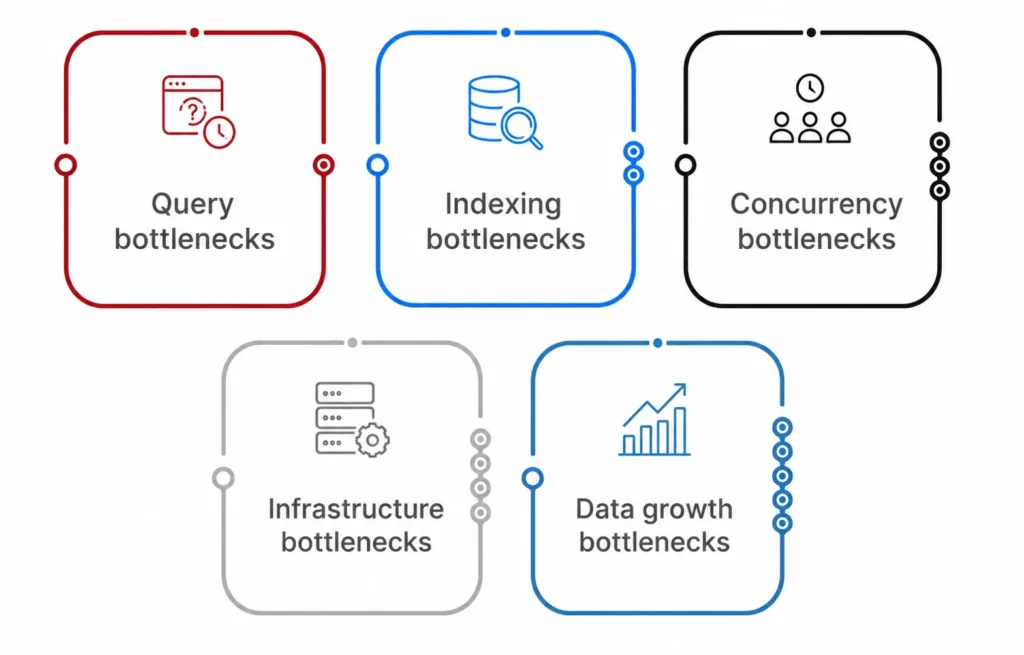
- Query bottlenecks: Test top business queries under normal and peak load. Look for full scans, poor joins, bad filters, and unstable plans.
- Indexing bottlenecks: Validate whether indexes support real query patterns. Over-indexing can also damage writing performance.
- Concurrency bottlenecks: Simulate simultaneous users, batch jobs, and API calls. Watch lock waits, deadlocks, and transaction time.
- Infrastructure bottlenecks: Test CPU, memory, storage I/O, network latency, and connection pool limits together.
- Data growth bottlenecks: Run tests against production-scale data volumes. A query that works on small data can fail badly at scale.
This structure helps developers, QA engineers, DBAs, and platform teams diagnose risk without blaming the wrong layer.
Diagnosing Bottlenecks Fast: Isolating Database, Application, and Infrastructure Root Causes
A slow transaction does not automatically mean the database is responsible. The root cause may sit in application code, network calls, external dependencies, cloud capacity limits, or inefficient query design. Effective diagnosis requires teams to correlate signals across the entire delivery stack.
| Investigation Area | Issues | Indicators | Recommended Validation |
|---|---|---|---|
| Database Layer | Slow queries, lock waits, deadlocks | High query latency, execution plan changes, replication lag | Analyze query plans, indexing strategy, and transaction behavior |
| Application Layer | Slow business transactions | Long processing times, inefficient ORM behavior, excessive retries | Review application traces and code execution paths |
| Infrastructure Layer | Resource saturation | CPU pressure, memory exhaustion, storage bottlenecks | Monitor compute, memory, disk I/O, and network utilization |
| External Dependencies | Intermittent delays | API latency, third-party service degradation | Trace external service calls and response patterns |
| Cloud Platform | Scaling and capacity issues | Connection exhaustion, autoscaling delays, regional latency | Validate instance sizing, failover behavior, and scaling policies |
Integrating Database Performance Checks into Your Pre-Release Quality Gates
Database performance checks should be part of pre-release quality gates, not post-release firefighting. A strong quality gate includes baseline comparisons, slow-query thresholds, transaction latency limits, deadlock tolerance, resource utilization limits, and execution plan regression checks.
Database Performance Testing Maturity Framework
Organizations typically progress through four stages of database performance maturity:
- Level 1: Reactive Troubleshooting
Teams investigate database issues only after production incidents or customer complaints occur. - Level 2: Release-Based Validation
Performance testing is performed before major releases but remains periodic and project-driven. - Level 3: Continuous Performance Governance
Database performance checks become part of CI/CD pipelines, release quality gates, and regression testing. - Level 4: Predictive Quality Engineering
AI-led analytics, anomaly detection, and trend analysis help teams identify performance risks before they affect production.
Organizations that advance toward continuous governance and predictive quality engineering can identify performance risk earlier, reduce avoidable release delays, and improve cloud resource efficiency.
How Does TestingXperts Assist with Database Performance Testing?
Enterprises need a Quality Engineering partner that can connect database behavior with release readiness, customer experience, operational resilience, and cloud efficiency.
Performance Baselines and Production-Scale Validation
TestingXperts helps organizations establish realistic database performance baselines using production-representative data volumes, transaction patterns, concurrency levels, and workload models. This enables teams to identify bottlenecks before they become production incidents or release delays.
Data Quality, Integrity, and Validation Across the Data Lifecycle
Database performance and data quality are closely connected. TestingXperts supports data validation, integrity testing, ETL validation, and data movement verification to ensure that performance improvements do not introduce inconsistencies, reporting errors, or downstream business risks.
Cloud Database Performance and Cost Optimization
For cloud-managed databases and modern data platforms, TestingXperts validates autoscaling behavior, resource utilization, storage performance, connection limits, and failover readiness. This helps enterprises balance response time objectives with infrastructure efficiency and cloud cost control.
AI-Led Quality Engineering and Continuous Performance Governance
TestingXperts combines performance engineering with AI-powered Quality Engineering practices, continuous monitoring, anomaly detection, and release governance. By integrating database performance checks into CI/CD pipelines and quality gates, organizations gain earlier visibility into performance regressions and release risk.
Conclusion
Database Performance Testing must go beyond isolated load tests and late-cycle query tuning. It should validate how the data layer behaves under real concurrency, production-scale volume, cloud constraints, and business-critical workflows.
The strongest teams do not wait for a production slowdown to discover where the database will struggle. They build database performance checks into release quality gates, use clear thresholds for risk, and create evidence that critical transactions can perform under real business demand.
With TestingXperts, enterprises can bring database performance validation into the release process, identify data-layer risk earlier, and move into production with greater confidence.

VP, Delivery Quality Engineering
Manjeet Kumar, Vice President at TestingXperts, is a results-driven leader with 19 years of experience in Quality Engineering. Prior to TestingXperts, Manjeet worked with leading brands like HCL Technologies and BirlaSoft. He ensures clients receive best-in-class QA services by optimizing testing strategies, enhancing efficiency, and driving innovation. His passion for building high-performing teams and delivering value-driven solutions empowers businesses to achieve excellence in the evolving digital landscape.
Discover more