

Recommended Blogs

How Does Data Analytics Improve Decision-Making in Retail?
Table of Content
- Data Analytics in Retail: An Overview
- Types of Data Collected in Retail Data Analytics
- Leveraging Data Analytics in Retail to Improve Decision-Making
- How Does AI-Driven Predictive Analytics Improve Retail Inventory Management?
- How Does Augmented Analytics Enable Dynamic Pricing in Retail?
- What is the Future of Data Analytics in the Retail?
- How Can Tx Assist with Data Analytics Testing for Your Retail Business?
- Summary
Share On


Transform Your Retail Business with Data-Driven QA - Ensure flawless analytics pipelines and retail platforms with our specialized testing services. Talk to a Retail QA Expert Today
It is not wrong to say that retail is one of the most competitive industries and a data goldmine. To remain competitive, retailers have to adapt to new market trends and technologies quickly. Those who don’t change with the trends will lose to their peers.
Customers nowadays want more personalized shopping experiences; hence, retailers must invest in areas that allow them to understand changing customer behaviours. Then, there’s the critical role of data in supporting business operations. When utilized correctly, every customer interaction, transaction detail, stock movement, and workhour data can offer valuable insights for business intelligence.
By leveraging advanced retail data analytics, retailers can transform raw data into important information. But to perform data analytics in retail, they require quality data consisting of:
- Customer data
- Online transitions data
- Transactional data from eCommerce platforms
- User Feedback
- Product Performance data and more
Data Analytics in Retail: An Overview
Data is the core of all operations in the retail business, especially in the digital-driven world. Every day, businesses generate tons of data in the form of customer profiles, transnational data, social media, website analytics, and much more. This data allows retailers to gain insights into their daily operations, the latest market trends, and customer buying behavior. The process involves using software and automated tools to collect and analyze data from online and physical sources.
Retail analytics can also improve areas involving decision-making such as store operations, pricing, marketing, merchandising, and inventory management. By extracting retail data analytics from external and internal repositories, retailers can improve their profitability, reduce costs, and increase sales rates.
Data analytics in retail can also help analyze overall customer loyalty, forecast demand, optimize store layout, and identify purchase patterns. It can give retailers deep insights into their business and customers and offer competitive benefits over other brands. According to a survey, businesses leveraging data analytics noticed 93% higher profits and 115% higher ROI.
Let’s take a quick look at some of the benefits of retail data analytics:
Improve Bottom Line
By predicting demand and market trends, retailers can avoid excessive discounting and stockout issues. They can also ensure the correct inventory level to meet consumers’ demands.
Better Pricing
Retailers can analyze multiple factors to find the best pricing, which includes abandoned carts, competitor pricing, marketing strategies, etc. This would allow them to set pricing that can deliver maximum profits without affecting customers’ budgets.
Smarter Planning
By utilizing real-time data (weather, shopping trends, etc.), retailers can plan their shelves to distribute products strategically across their stores. It would ensure that the customers get their products when they actually need them.
Personalized Experience
Shoppers love the personalized shopping experience. By implementing data analytics in retail, retailers can better understand their target audience preferences and promote relevant products to them.
Types of Data Collected in Retail Data Analytics
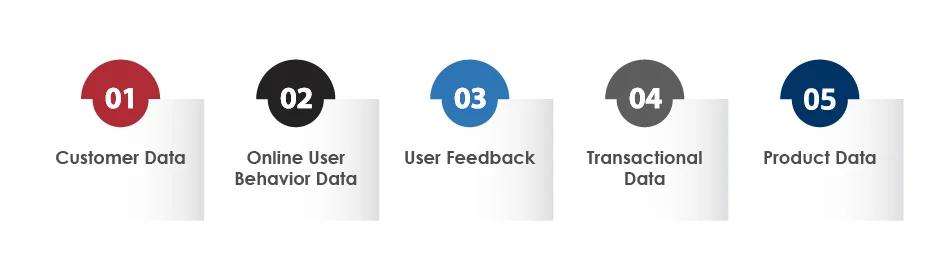
Data analytics assists in uncovering valuable information from a vast data pool. Let’s take a look at the type of data collected in retail data analytics:
Customer Data
Knowing and understanding the customer is a key to business success. Retailers collect demographic data like purchase history, payment method, age, and location to deliver personalized shopping experience. It helps in drafting targeted marketing strategies.
Online User Behaviour Data
Having a complete understanding of online customer behavior is beneficial for businesses. Capturing website/app usage data, page views, abandoned cart rates, clicks, and number of visits, reveals how users are interacting with the brand online and allows retailers to improve their online shopping experience.
User Feedback
One of the best ways to improve is to directly hear from the customers. Retail analytics collects data from social media comments, feedback surveys, and product review sections to deliver deep insights into user preferences and satisfaction. This enables retailers to improve their services and keep the retention rate high.
Transactional Data
Every successful order and transaction have a story to tell. Retail analytics allow retailers to capture transaction data which consists of details such as what items were purchased, when were they purchased, how much amount was paid, and what was the quantity.
Product Data
Every product is different and has a different target audience. Data containing product names, prices, inventory, and description details enable retailers to improve their product selection, stock management, marketing campaigns, and pricing strategies.
Leveraging Data Analytics in Retail to Improve Decision-Making
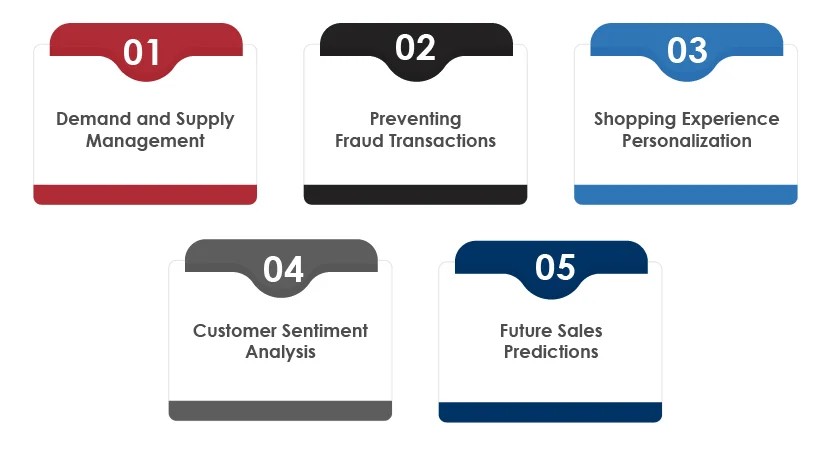
The significance of data analytics in modern retail business could assist in implementing data-driven decision-making to enhance customer experience, inventory management, and much more. Let’s take a quick look at how data analytics assists retailers in making smarter decisions and achieving greater business success:
Demand and Supply Management
The supply chain is the backbone of a retail business. Data analytics enables retailers to manage demand and supply by analyzing sales patterns, future demands, and trends with higher accuracy. It helps in making purchase decisions, reducing overstocking/understocking issues, and improving inventory levels. Integrating data analytics tools with inventory management systems enables continuous data collection and real-time demand forecasting.
Preventing Fraud Transactions
There are always some people who try fraudulent transactions, which is very common in any type of B2C business. And this could wreak havoc if not addressed on time. For retailers, depending on human oversight to process a high volume of transactional data is not an option.
It is humanly impossible to process a high number of orders. Data analytics could assist in preventing fraudulent transactions by enabling retailers to identify suspicious activities accurately and quickly. This could save a lot of money from going into financial loss.
Shopping Experience Personalization
Customer shopping experience is the key to a retail business’s success. Data analytics enables retailers to enhance CX by facilitating personalized service. They can analyze and identify individual user preferences, shopping histories, and buying habits to offer tailored services and communication channels.
It can even segment the target audience and design tailored marketing strategies for each segment. This type of targeted and effective marketing strategy would assist in recommending products to specific customers and designing loyalty programs accordingly.
Customer Sentiment Analysis
Customer sentiment analysis uses Natural Language Processing (NLP) tools to evaluate customer reviews, feedback, and social media comments. By identifying emotions and opinions in customer feedback, retailers can gain valuable insights into how customers feel about their products, services, or brand.
This data helps improve decision-making by enabling retailers to adjust marketing strategies based on customer preferences, refine product offerings to align with customer desires and enhance customer service in response to negative reviews. NLP-driven sentiment analysis adds value to data analytics by providing a deeper understanding of customer attitudes, ultimately improving retail sales.
Future Sales Predictions
Future sales predictions leverage historical data to identify patterns and trends that inform future business decisions. Retailers can accurately anticipate future product demand by analyzing factors such as seasonal trends, consumer behavior, and sales cycles.
This approach helps optimize inventory levels to prevent overstocking or stockouts, plan marketing and promotional campaigns more effectively, and allocate resources and budgets based on expected demand. By utilizing data analytics for sales predictions, retailers gain valuable foresight into future trends, enabling proactive decision-making and maximizing sales potential.
How Does AI-Driven Predictive Analytics Improve Retail Inventory Management?
Retailers can use AI-driven predictive analytics to guess what customers will buy, when they will buy it, and how much stock they need. Here’s the thing: businesses can have the right amount of stock on hand without tying up money once they can see how demand changes.
Keyways it helps you make better judgments about your inventory:
- Uses historical sales, seasonality, and outside influences to make better guesses about how much demand there will be.
- By optimizing purchase amounts and restocking cycles, it cuts down on overstocking and stockouts.
- Helps stores set up automatic reorder points based on signals of real-time demand.
- Makes it easier to plan warehouses, use storage space, and get products when you need them.
- Helps with store-level inventory allocation to fill in gaps at the last mile.
If your retail processes depend on analytics, ensure sure your data is correct, consistent, and reliable. TestingXperts can check your data pipelines, integrations, and analytics outputs to make sure that your predictive models give you solid results.
Personalization Using Customer Data Insights in Retail
Data-driven personalization in retail helps organizations create experiences that seem unique instead of generic. Targeting gets better when customer profiles and behavior patterns are cleaner.
What makes personalization work well:
- How often you buy, what products you like, and how you search.
- Demographics, where they live, and how they like to pay.
- Mapping the trip across apps, retailers, and reward programs.
How it makes things better:
- Better product suggestions throughout the customer’s life.
- Personalization of emails and campaigns in real time based on purpose.
- Less waste in marketing and more interaction across all digital touchpoints.
How Does Augmented Analytics Enable Dynamic Pricing in Retail?
Augmented analytics uses both technology and human knowledge to help businesses make pricing decisions faster and more profitable. It looks at a lot of data, checks how much competitors charge, and finds out how much each product category’s price can change.
Where it helps the most:
- Automatic price changes are based on changes in demand, supply levels, and what competitors do.
- Get alerts right away when a product is too cheap or too expensive.
- Margin optimization by predicting how changes in price would affect conversion.
- You can clearly see which SKUs are the most price sensitive.
What is the Future of Data Analytics in the Retail?
The future of data analytics in retail is all about speed, predictions, and personalization. AI and ML will handle routine analysis automatically, spot trends, and forecast demands shift faster than humans. Real-time dashboards and streaming data will help retailers adjust pricing, promotions, and inventory on the go.
At the same time, shoppers expect brands to use their data responsibly. So, the future will balance hyper-personalized shopping with clear data privacy and transparency. The retailers that combine smart analytics with ethical practices will stay ahead, building trust while using data to make every decision sharper.
Hyper-Personalization and Customer Experience
Hyper-personalization uses real-time data and AI to tailor product recommendations, marketing messages, and promotions for individual shoppers. This approach leads to more engaging and relevant experiences, which can increase loyalty and conversion rates.
Predictive Analytics and Forecasting
Predictive analytics enables retailers to forecast trends, inventory needs, and customer demands with much greater accuracy than ever before. Leveraging historical and real-time data, retailers can anticipate shifts in buying patterns, optimize assortment, and proactively address supply chain disruptions, staying ahead of market fluctuations.
Operational Efficiency and Supply Chain Optimization
By integrating data analytics into operations, retailers streamline processes such as inventory management, demand planning, and logistics. AI-powered tools detect inefficiencies, automate routine tasks, and reduce waste through smarter stocking and distribution, leading to lower costs and improved responsiveness to market trends.
AI and Machine Learning Integration
AI and machine learning are foundational for modern retail analytics, automating analysis, revealing hidden patterns, and enabling instant data-driven decisions. These technologies power real-time dashboards, automate customer interactions, and make forecasting more accurate, helping businesses optimize every aspect of retail management.
Data-Driven Culture and Skills
A data-driven culture ensures that insights guide every decision, from the sales floor to the boardroom. Retailers are investing in staff training, accessible analytics tools, and leadership buy-in to build this culture. Success increasingly depends on data literacy across the organization, supported by user-friendly visualization platforms and continuous learning
How Can Tx Assist with Data Analytics Testing for Your Retail Business?
Data analytics for business decision-making is a must-have for modern retailers. Retailers leveraging data analytics can improve their decision-making, enhance CX, and optimize retail operations. But, to ensure its successful integration with your processes, you need to go through analytics testing. Tx, being the leader in retail testing, assists businesses undergoing business transformations with its results-driven strategies.
We utilize best-in-the-industry, our in-house accelerators, tailored testing frameworks, and domain-specific expertise to bring agility to your overall business operations. Our data analytics testing can ensure the validation of all structured/unstructured data while achieving superior data quality to enable seamless analytics. By testing data for security, accuracy, and performance, we ensure the successful integration of data analytics within your retail operations.
Summary
Data analytics plays a vital role in improving decision-making in the competitive retail industry by transforming raw data into actionable insights. Retailers can leverage various types of data, including customer behavior, transactional data, product performance, and user feedback, to optimize operations, enhance customer experiences, and forecast future trends. Advanced analytics allows for better inventory management, personalized shopping experiences, fraud prevention, and ensuring business profitability.
Retailers using data analytics report higher profits and ROI. To maximize the benefits, businesses need quality data and robust analytics testing. Tx offers specialized data analytics testing services, ensuring the accuracy, security, and performance of data used for decision-making, thus empowering retailers to make informed choices and stay ahead of market trends. To know how Tx can help, contact our data analytics and retail testing experts.

Manikya Girish
Director - Delivery
Dynamically dedicated and strategic leader with over 21 years of multicultural and diversified experience in leading Delivery Management, Program Management, and Project Management in Software Testing and Quality Control. Proven expertise in engaging with executive management and diverse teams at all levels, adept at developing IT roadmaps encompassing vision, strategy, and plans.
FAQs
How can AI-powered analytics optimize retail inventory management?
AI-powered analytics can automatically predict demand, change the cycles for restocking, and update reorder points. It cuts down on stockouts, keeps extra inventory to a minimum, and helps store staff plan more correctly by giving them real-time data.
What are the cost savings of using predictive analytics in retail?
Predictive analytics lowers the cost of retaining inventory, cuts down on waste, stops people from buying too much, and makes the supply chain work better. Depending on the category, how much demand changes, and how good the data is, retailers can often save 10 to 25 percent on costs.
How secure is customer data when using AI for retail analytics?
Encryption standards, access controls, data governance processes, and following rules like the GDPR are all important for security. Retailers can keep client details safe and stop anyone from getting in by utilizing secure pipelines and audited models.
What tools are best for real-time data analytics in retail?
Some technologies that people often utilize are Snowflake, Databricks, Google BigQuery, Power BI, and Apache Kafka for streaming data. Each tool can handle fast processing, combining data from many sources, and analytical workloads that can grow.
How can data analytics help with customer segmentation in retail?
Analytics sorts of buyers into groups based on their behavior, likes and dislikes, past purchases, how often they buy, and their demographics. This segmentation lets stores customize their discounts, improve their product recommendations, and make their retention methods better.
What role does data analytics play in improving retail customer experiences?
Data analytics shows what customers desire, where there are problems, and where there are chances to make things more personal. It helps stores change the way their stores are set up, improve online shopping experiences, and send out timely and useful offers that make shopping better.
Discover more