Recommended Blogs

A Deep Dive Into AI/ML Trends in 2026 and Beyond

 Last Updated: March 16th, 2026
 Read Time: 2 minutes
Table of Content
- AI/ML Trends in 2026
- Impact of AI/ML on Various Industries
- Future of AI/ML Beyond 2026
- Conclusion
- How Can TestingXperts Help with AI and ML Testing?
Share On


Artificial Intelligence (AI) and Machine Learning (ML) have been driving transformative changes across industries, and the year 2026 holds even more significant potential for these technologies.
According to recent studies, 77 per cent of our everyday devices are now equipped with built-in AI capabilities. From a wide array of smart gadgets to personalised recommendations on streaming platforms like Netflix and the emergence of voice-activated assistants such as Amazon’s Alexa and Google Home, AI has become the driving force behind the technological conveniences that have seamlessly integrated into our daily routines. As the involvement of these technologies is growing rapidly, it is becoming necessary to implement AI and ML testing processes to provide a seamless experience to users and ensure security.
Based on a comprehensive AI study conducted by PwC, it has been projected that the global economy is poised to experience a remarkable 26% surge in GDP by the year 2030 with the involvement of AI. This substantial growth has the potential to generate a staggering increase of approximately $15.7 trillion, thereby signalling a significant economic boost on a global scale. As businesses increasingly recognise the value of AI and ML, it becomes crucial to understand the emerging trends and their impact.
In this blog, we will explore the key AI/ML trends in 2026 and their impact on various industries and discuss the future of these technologies.
AI/ML Trends in 2026
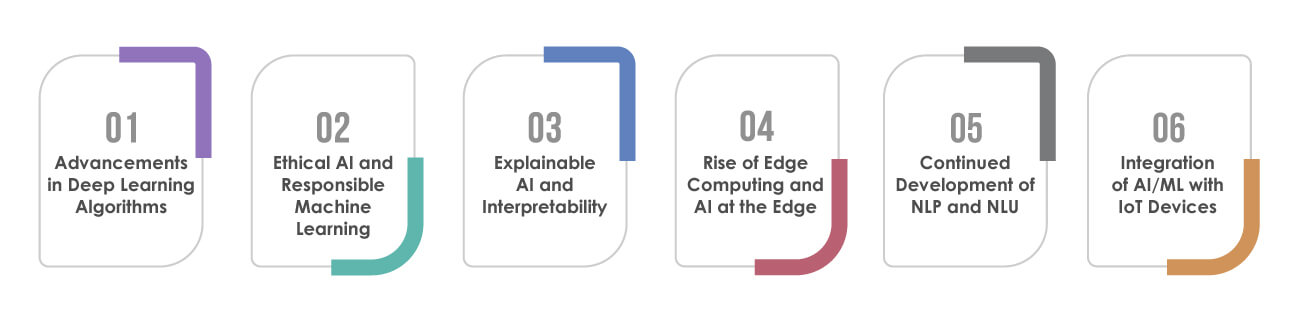
In 2026, we can expect to witness a significant surge in the adoption of AI/ML across industries. As organisations realise these technologies’ competitive advantages, they will leverage AI/ML to enhance efficiency, optimise processes, and drive innovation. Here are some trends that will dominate in 2026:
Advancements in Deep Learning Algorithms
Deep learning, a subset of ML, will continue to advance in 2026. Neural networks with improved architectures will enable more accurate predictions, natural language understanding, and image recognition. These advancements will propel breakthroughs in healthcare, finance, and autonomous systems.
Ethical AI and Responsible Machine Learning
With the growing impact of AI on society, the focus on ethical AI and responsible machine learning will intensify. Organisations will prioritise transparency, fairness, and accountability in their AI systems, ensuring they align with societal values and avoid biases.
Explainable AI and Interpretability
As AI applications become more complex, there will be an increasing demand for explainable AI. Stakeholders will seek insights into how AI systems make decisions, leading to the development of interpretability techniques that enhance trust and facilitate regulatory compliance.
Rise of Edge Computing and AI at the Edge
Edge computing, the decentralised data processing near the source, will gain prominence in 2026. By bringing AI capabilities closer to the data source, organisations can reduce latency, enhance privacy, and enable real-time decision-making in applications like autonomous vehicles, IoT devices, and smart cities.
Continued Development of NLP and NLU
Natural Language Processing (NLP) and Natural Language Understanding (NLU) will significantly advance in 2026. We can expect more sophisticated chatbots, voice assistants, and language translation systems that offer improved human-like interactions and understanding of context. ChatGPT is a good example in the current scenario.
Integration of AI/ML with IoT Devices
The convergence of AI/ML with Internet of Things (IoT) devices will accelerate in 2026. AI-powered IoT applications will enable intelligent data processing, predictive analytics, and automation, driving efficiencies and delivering value across healthcare, manufacturing, and smart homes.
Impact of AI/ML on Various Industries
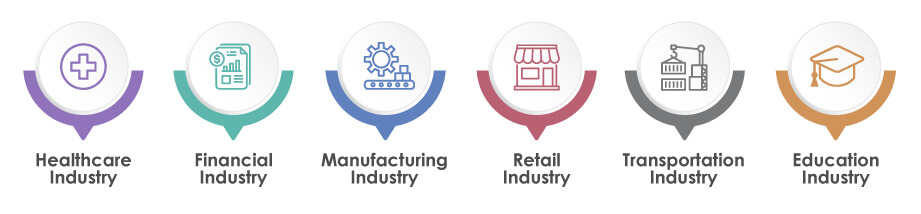
AI/ML has revolutionised various industries, empowering them with cutting-edge technologies to enhance productivity, efficiency, and customer experiences. From healthcare to finance, manufacturing to retail, and education to transportation, the impact of AI/ML is evident in driving innovation and transforming how these industries operate.
Let us see how these technologies impact different industries:
Healthcare Industry
AI-powered diagnosis and treatment recommendations will improve healthcare outcomes. ML algorithms will aid in the early detection of diseases, while personalised medicine will leverage patient data for tailored treatment plans. AI-assisted robotic surgery will enhance precision and minimise invasiveness.
Financial Industry
Fraud detection and prevention will be strengthened with AI/ML algorithms that analyse vast amounts of data for anomalies and patterns. Algorithmic trading and portfolio management will leverage ML models for real-time decision-making. AI-powered chatbots will enhance customer support, providing personalised assistance.
Manufacturing Industry
Predictive maintenance and quality control will leverage AI/ML to detect anomalies and anticipate equipment failures, minimising downtime. Supply chain and logistics optimisation will benefit from AI algorithms that enhance demand forecasting and streamline inventory management. Robotics and automation will transform manufacturing processes, increasing efficiency and productivity.
Retail Industry
Personalised marketing and customer experience will be enhanced through AI/ML algorithms that analyse customer data, preferences, and behaviour. Demand forecasting and inventory management will optimise stock levels and reduce waste. AI-powered virtual shopping assistants will provide personalised recommendations and streamline the shopping experience.
Transportation Industry
Autonomous vehicles and self-driving technology will revolutionise transportation, improving safety and efficiency. Traffic management and route optimisation will leverage AI algorithms to reduce congestion and enhance transportation planning. Predictive maintenance for fleets will minimise breakdowns and optimise vehicle performance.
Education Industry
Adaptive learning platforms will personalise educational content based on students’ needs and learning styles. Intelligent tutoring systems will provide personalised guidance and feedback, enhancing the learning experience. Automated grading and feedback systems will save time for educators and provide timely assessments.
Future of AI/ML Beyond 2026
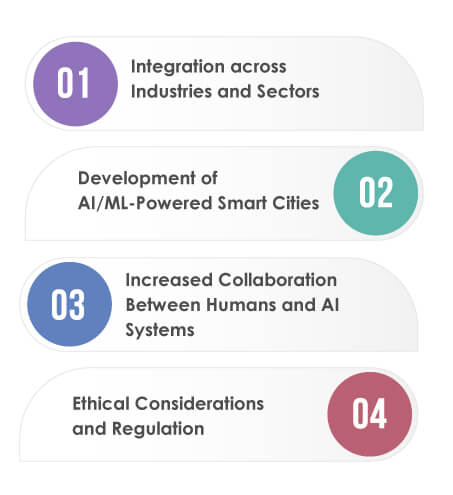
The future of AI/ML beyond 2025 holds immense potential as these technologies continue to evolve and advance. With ongoing research and development, we can anticipate further growth and transformative applications across industries.
Integration across Industries and Sectors
AI/ML will increasingly permeate diverse industries and sectors, including agriculture, energy, and cybersecurity. Integrating AI/ML technologies will unlock new opportunities for automation, optimisation, and data-driven decision-making.
Development of AI/ML-Powered Smart Cities
The concept of smart cities will gain traction, with AI/ML playing a vital role in managing and optimising urban infrastructure. Intelligent systems will enhance energy management, traffic flow, waste management, and public safety, creating sustainable and liveable cities.
Increased Collaboration Between Humans and AI Systems
Collaboration between humans and AI systems will become more seamless and natural. AI/ML technologies will augment human capabilities, enabling humans to focus on high-level decision-making and creative problem-solving, while AI handles repetitive and data-intensive tasks.
Ethical Considerations and Regulation
As AI/ML technology advances, there will be a greater emphasis on ethical considerations and regulation. Stakeholders will prioritise fairness, transparency, and accountability in AI systems, while governments and regulatory bodies will develop frameworks to address privacy, bias, and ethical dilemmas.
Quantum AI:
Quantum AI represents a fusion of quantum computing and artificial intelligence. This innovative field utilizes the power of quantum mechanics to process information at unprecedented speeds, offering vast improvements in data analysis and problem-solving. Quantum AI is set to transform industries by enabling more complex and efficient AI algorithms. Its potential applications range from advanced drug discovery to solving intricate optimization problems in various sectors. While still in its developmental stages, Quantum AI promises significant advancements in technology and problem-solving, making it a pivotal area of research and investment for the future.
Conclusion
The AI/ML trends in 2024 and beyond hold immense potential to transform industries and shape the future of technology. Organisations embracing these trends and leveraging AI/ML capabilities will gain a competitive edge, drive innovation, and deliver enhanced customer experiences. Staying informed about the latest advancements in AI/ML is crucial for individuals and businesses to seize these technologies’ opportunities.
Not to mention that AI and ML testing will also play a crucial role in ensuring that the finished product or service is reliable and secure and offer a seamless user experience. To do so, companies should seek experienced QA outsourcing companies like TestingXperts that specialise in artificial intelligence and machine learning testing services.
How Can TestingXperts Help with AI and ML Testing?
As AI and ML technologies continue to advance, ensuring the reliability, accuracy, and performance of AI/ML systems becomes paramount. This is where TestingXperts, a leading software testing company, can play a crucial role in helping your business validate and optimise your AI/ML implementations. Here’s how TestingXperts can assist you with AI and ML testing:
Test Strategy and Planning
We collaborate with organisations to develop a comprehensive test strategy and plan tailored to AI/ML projects. This includes identifying test objectives, defining scenarios, and determining appropriate test data sets.
Test Data Preparation
AI/ML models heavily rely on quality data for training and validation. Our experts can assist in preparing diverse and representative datasets, ensuring they cover various scenarios and edge cases to validate the accuracy and performance of AI/ML algorithms.
Model Testing and Validation
We conduct thorough testing of AI/ML models, including unit testing, integration testing, and system testing. This ensures the models function as expected, produce accurate results, and adhere to defined requirements.
Performance Testing
AI/ML systems often deal with large datasets and complex algorithms, making performance testing crucial. Our experts can assess the performance of AI/ML applications under different loads and stress conditions, ensuring they can handle real-world scenarios and deliver optimal.
Security and Compliance Testing
With the increasing use of AI/ML in sensitive areas such as healthcare and finance, security and compliance testing have become essential. We can conduct vulnerability assessments, penetration testing, and compliance checks to identify potential security risks and ensure adherence to regulatory standards.
Bias and Fairness Testing
Addressing biases and ensuring fairness in AI/ML systems is paramount. Our QA engineers use techniques to detect and mitigate biases, assess fairness in decision-making processes, and ensure ethical and unbiased outcomes.
Continuous Testing and Monitoring
Our experts can assist you in implementing continuous testing and monitoring frameworks for AI/ML systems. This involves automating test processes, establishing feedback loops, and leveraging AI-powered monitoring tools to detect anomalies and performance degradation.
Explainability and Interpretability Testing
We test the interpretability and explainability of AI/ML models. Potential risks and biases can be identified and mitigated by validating the transparency and interpretability of AI systems.
TestingXperts enables your business to deploy AI/ML solutions confidently by leveraging your software testing and quality assurance expertise. Our specialised AI/ML testing services ensure these intelligent systems are robust, accurate, secure, and compliant. Contact our experts to know more.

Sr. Test Manager
With 10 years of experience in automation development and testing, He has led the creation of innovative solutions that enhance software delivery and product quality. Skilled in UiPath, Katalon, Selenium, and Appium, with a strong focus on CI/CD. Extensive expertise in RPA, including custom UiPath solutions like screenshot comparison libraries and advanced drag-and-drop simulations, tailored to complex project needs.
FAQs
What are the key AI and Machine Learning trends shaping 2025?
The major AI/ML trends include deep learning advancements, explainable AI (XAI), ethical and responsible AI, Edge AI, NLP evolution, and AI-IoT convergence. Together, these trends are driving smarter automation, real-time decision-making, and scalable enterprise intelligence while increasing regulatory and governance requirements.
Why are AI and ML trends important for business leaders?
AI/ML trends directly impact competitive advantage, operational efficiency, and innovation speed. Organizations that adopt these trends early benefit from:
-
Better predictive insights
-
Faster time-to-market
-
Reduced operational costs
-
Improved customer experiences
3. What is Explainable AI (XAI), and why does it matter for enterprises?
Explainable AI focuses on making AI decisions transparent and interpretable. This is critical for:
-
Regulatory compliance (GDPR, AI governance laws)
-
Trust with customers and stakeholders
-
Risk mitigation in high-impact domains like finance and healthcare
-
For leadership teams, XAI reduces legal, ethical, and reputational risk while increasing confidence in AI-driven decisions.
How should enterprises prepare for AI/ML beyond 2026?
Leaders should focus on:
-
Building AI-ready data foundations
-
Investing in AI governance and testing
-
Upskilling teams on ML and ethics
-
Planning for emerging technologies like Quantum AI
Discover more