Recommended Blogs

Automated Software Testing – What, Why, Tools, Challenges

 Last Updated: July 7th, 2026
 Read Time: 7 minutes
Table of Content
- What is Automated Software Testing?
- Why Automated Software Testing is important?
- What are the benefits of Automated Software Testing?
- How does Automated Testing work?
- What are the most commonly used Automated Testing Tools?
- Conclusion
Share On


With the stiff business competition existing today, enterprises need faster releases and quality software to meet the increasing demand of their services and products. They are embracing agile and DevOps practices by leveraging automated testing software to achieve faster releases and quality products along with achieving quicker return on investment.
What is Automated Software Testing?
Automated Testing Software is the methodology that helps to validate the functioning of the software before it is moved to production. In this process, automated testing tools are used by the QA teams to execute the test scripts. With the use of automated software testing tools, QA teams can quickly test the software, prepare the defect reports, and compare the software results with the expected results.
Also, this automated testing process provides several benefits such as faster delivery, eases regression testing time, and also ensures quality software along with reducing manual testing efforts. Thus, the QA teams can function faster and help to push the software to production quickly as per the given timelines as automated testing ensures faster and higher-quality releases leveraging automated testing tools.
Ready to Accelerate Your Releases with Test Automation?
Build a scalable automation framework that increases test coverage, reduces regression time, and improves accuracy.
Talk to a Test Automation ExpertWhy Automated Software Testing is important?
The automated software testing uses open-source and paid test automation tools to test applications quickly and more efficiently 24×7 without any human intervention. It takes up different testing approaches and replaces several tasks of manual testers and ensures to improve the overall test coverage effectively. Within this software testing type, pre-written scripts are tested to ensure quality software is released. Thus, it plays an important role for delivering quality software at a faster speed and essentially reduces the regression testing time. Therefore, this automated software testing method is important as it helps QA teams to re-check and validate the outcomes quickly and more effectively with less human effort. This process also ensures the developed software application is flawless and performs well under all conditions. Thus, evidently, by embracing the automated software testing method, enterprises get many benefits which have been detailed below.
What are the benefits of Automated Software Testing?
The benefits have been broadly classified as Application-Wise benefits and Cost-wise benefits.
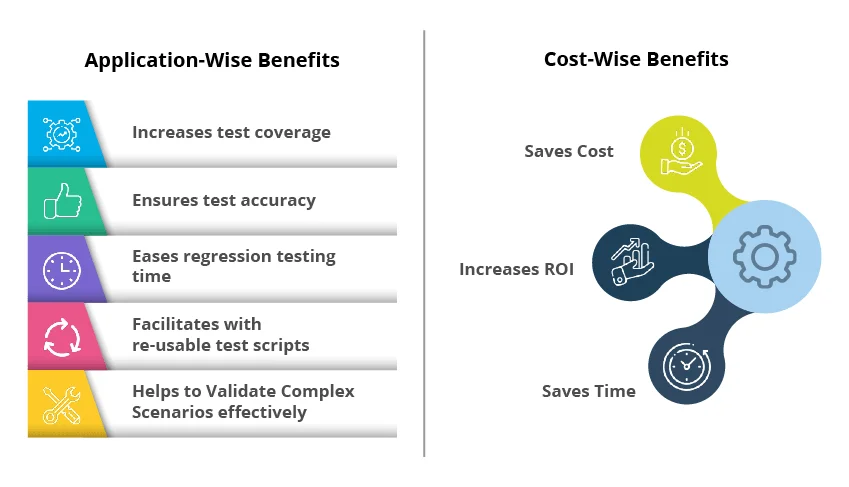
Automated Testing Application-Wise Benefits
Increases test coverage:
This method of automated software testing services helps to perform a more number automated test scripts and increases the test coverage and the scope of tests to enhance the quality of the application. It also helps in saving time and significantly reduces manual testing efforts.
Ensures test accuracy:
Manual testing involves human intervention and this may have chances for some un-notified errors in the testing process. Manual test cycles might lead to errors, but with automated software testing tools, there is an assurance that the testing practice and validation of the application are performed with good accuracy as errors are identified at every phase.
Eases regression testing time:
Performing regression testing with manual methods takes a lot of time and human efforts which may also lead to a lot of unidentified bugs. The repetition of the same test cases over time and again might cause disinterest amongst the testers and may even reduce the overall testing efficiency. However, these can be resolved when automated regression testing is practised with testing tools and manual testers get time to be used for other quality works.
Facilitates with re-usable test scripts:
With automated software testing in use, it eases the tester’s efforts as the test scripts can be reused with some minor changes made in the test scripts. Also, these scripts can be used multiple times as they can be stored, and can be re-used for repeating the tests.
Helps to Validate Complex Scenarios effectively:
Automated testing as a service is effective to validate numerous complex scenarios as most of today’s applications are complex apps with smart and IoT connected devices. Automated testing with various types of test automation tools eases the testing process as the tools can be used to test irrespective of the time.
Automated Testing Cost-Wise Benefits
Saves Cost:
With automated app testing, enterprises can effectively save their budget as the test cases are run at a faster speed, defects are identified early and fixed before it is moved to production. Though the initial costs of automation are high, but when once the automated test framework is developed, it eases the testing tasks and remarkably saves the overall costs.
Increases ROI:
Every enterprise aims for achieving better returns from its investments. With the development of an effective test automation framework, returns are huge as testing is performed faster with the inbuilt features. Moreover, automation testing delivers faster and quality results, improves the time to market and finally ensures increased return on investment.
Saves Time:
As tests are run automatically 24×7, automated software testing helps to save time. Moreover, with automated testing tools, manual scripts are automated and the regression testing time will be drastically reduced. This eventually leads to saving the delivery time of the application and largely saves a lot of manual efforts and saves time.
How does Automated Testing work?
Any organization that wants to implement automation testing follows a testing framework approach. The most favoured testing frameworks are keyword-driven framework, data-driven framework, linear scripting framework and modular testing framework.
To test small applications, a linear scripting framework is used, because it uses test scripts that don’t require much planning and also do not support reusable scripts.
When it comes to a modular testing framework, a software tester develops test scripts to perform small, independent tests in order to reduce redundancy.
Data-driven frameworks enable software testers to develop test scripts that are able to work for multiple data sets. This framework offers wide quality coverage with fewer tests.
Keyword-driven frameworks are worked out using table formats to define keywords for each function and execution method. Those software testers who don’t have in-depth knowledge of programming can use keywords to develop test scripts.
The most popular test automation tools which are open-source are Selenium, Robotium and Cypress. Selenium can automate and run tests across various web browsers and also works well with popular programming languages such as C#, Java and Python. Robotium is best used for user acceptance, function and system tests for android devices. End-to-end testing, integration and unit tests work perfectly well with the Cypress tool.
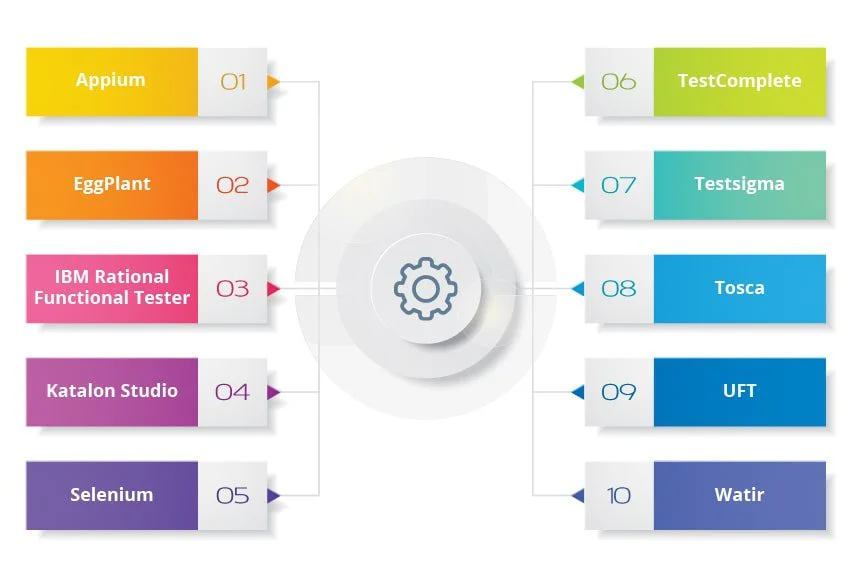
What are the most commonly used Automated Testing Tools?
Appium:
It is the most commonly used open source tool used for automating different types of mobile apps of native, mobile web, and hybrid applications. It can be effectively used on iOS mobile, Android, mobile and windows desktop platforms. Appium is a cross platform tool and allows to write tests against multiple platforms of iOS, android and Windows using the same application programming interface (API). The Appium framework can use any language that Selenium WebDriver supports such as Java, Python, C#, Ruby, and JavaScript, etc.
EggPlant:
Eggplant is an effective functional automated testing tool that uses sophisticated image and text search algorithms to locate objects on the screen. It is the only automated testing tool that dynamically tests the single source of truth for the user experience (UI). It can be used with various types of applications such as web, mobile and thick client based enterprise apps. It provides developers and testers with software to create, schedule and execute automated testing and also supports debugging tasks on many mobile platforms.
Katalon Studio:
Katalon studio is an open-source test automation tool used for mobile and web applications. It is a package of powerful features effectively used to overcome the challenges faced in web UI automation testing. Some of the other features are its support for image-based testing, and supports scripting languages like Java, Groovy, etc.
Selenium:
Selenium is available as an open-source tool and is a publicly accessible and most popular automated testing framework used for performing web application testing across different platforms and browsers. Testers can write test cases by using various programming languages such as PHP, C#, Ruby, Python, Perl, Java, etc. Every selenium supported language has dedicated automated test frameworks that help in writing test scripts for selenium automation. The other most useful feature with selenium framework is that there is no explicit need to rewrite the test scripts separately for each of the browsers, and a single script holds good for all.
TestComplete:
TestComplete is an easy-to-use automated UI testing tool with AI that can be used to perform automation across mobile, web and desktop applications. With its eminent feature of record-and-replay and object identification engine, testers can create complicated automated test scripts without the need for coding. This tool supports several scripting languages such as JavaScript, Python, VBScript, etc.
Testsigma:
This is an AI-driven test automation tool that uses simple English language to automate complex tests. This tool is used to automate web, mobile and API services and is best suited for smart automation initiatives of enterprises. It is best suited for today’s agile and DevOps methodologies to support continuous integration and continuous delivery needs of businesses.
Tosca:
Tricentis Tosca is more commonly used automated testing tool that supports end-to-end testing of software applications. It is used to automate multiple aspects of software testing which includes designing test cases, performing test automation, designing test data and test data generation along with enabling analytics to test graphical user interfaces (GUI) and application programming interfaces (API). It provides a comprehensive test management for software applications and many businesses use it as an effective automated testing tool.
UFT:
It is HP Unified Functional Testing tool that has been widely in use as an effective test automation tool. IT was earlier named as QuickTest Professional (QTP). It is primarily used for functional, and regression testing and it has a powerful automated testing framework and it is a licensed tool and it supports only VB Script.
Conclusion
Enterprises and businesses continue to demand for faster releases and quality products. Software testing plays an important role in enabling quality products. It is essential to test the applications early to identify the bugs and ensure the delivery timelines are met. Though manual testing has been on demand since inception, but now with complex applications and connected devices in place, automated software testing is an effective practice being used for improving the test efficiency and test coverage. Enterprises should embrace automated software testing solutions to take the complete benefits it delivers such as increases the delivery speed with faster releases, frees up manual testers from performing repetitive tasks, reduces regression testing time, and can be used 24×7 to achieve quality. Hence, in order to achieve all these benefits of automation testing, leverage a next-gen testing service provider. Opting services from independent software testing service providers will help to perform effective automated software testing, and ensures faster releases along with quality.

Associate Director at TestingXperts Pvt. Ltd
TVR Naveen Kumar, Associate Director at TestingXperts, with 19.5+ years of experience in Web, Mobile, and API Automation. Expertise in tools like Selenium, Appium, C#, Cucumber, and UiPath. Leads a team of 40+ in RFPs, estimations, automation strategy, and implementation. Skilled in automation assessments, gap analysis, tool comparison, and integration. Proficient in Jira, Maven, Oracle, JMeter, Sauce Labs, and more.
Discover more