Informed decision-making promotes innovation in the workplace and is one of the primary reasons behind every business’s success across its enterprise infrastructure. Businesses spend a lot on software development to ensure the final product meets demand and helps them stay competitive. The application rationalization process prevents the investment from getting out of hand.
The IT budget can quickly become a burden when paid licenses do not return sufficient value. Concurrently, an economical and effective solution might go unnoticed. However, application rationalization can address all these inefficiencies. Now the question is, ‘How?’ But before that, let us understand what it exactly is.
A Brief Overview of Application Rationalization
Application Rationalization is the process of evaluating software applications utilized in an organization to determine their necessity, usage, and the value they are delivering. It helps determine which apps should be kept, replaced, eliminated, or consolidated.
The process involves leveraging various techniques and methodologies to ensure a more effective implementation of the application landscape. Think of it like cleaning a toy room. As toys are sorted and kept based on the child’s preferences, application rationalization happens when enterprises do the same thing with their business applications.
It is one of the IT cost optimization techniques that act as a base for various cost-saving activities like:
App elimination
Project rationalization
Software license optimization
SaaS optimization
Redundancies reduction
Common tech platforms standardization
Server and data storage optimization
Businesses can select applications based on how they positively impact the outcomes while balancing the cost and value of suggested apps, constantly monitoring app value, and adjusting the value accordingly.
Why Businesses Should Rationalize Applications?
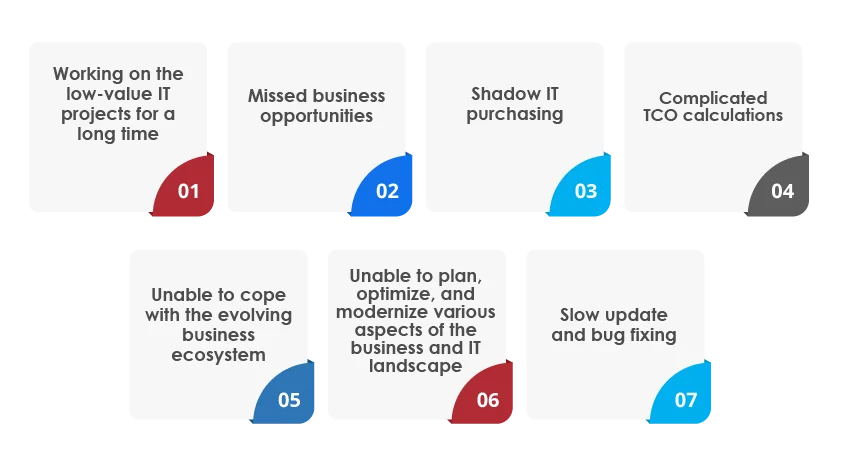
According to a survey, around 70% of companies do not even have a reference document containing the details of the current version of their app portfolio. Such type of carelessness could cost a lot of money. Not having a comprehensive app rationalization protocol can place the business under the following risks:
Working on the low-value IT projects for a long time
Missed business opportunities
Shadow IT purchasing
Complicated TCO calculations
Unable to cope with the evolving business ecosystem
Unable to plan, optimize, and modernize various aspects of the business and IT landscape
Slow update and bug fixing
Effective rationalization can help identify reinvestment capital and assist businesses in streamlining communication between enterprise personnel and IT stakeholders.
5 Business Benefits of Application Rationalization
The core concept of application rationalization involves tackling inefficiencies in a business’s IT infrastructure. Businesses majorly adopt large app stacks and later suffer from shadow IT systems, compliance issues, and slow adoption of next-gen tech. Rationalizing apps can help uncover and address these underlying issues swiftly. It offers organizations the following benefits:
Better Alignment with Business Objectives
Businesses get a bird’s-eye view of their application portfolio, which allows them to make strategic business decisions. As a leader, you can reprioritize your IT support for business-critical apps, which can help you improve business agility and facilitate better alignment within the organization.
Comprehensive Security risk identification
Businesses can quickly identify zombie apps and shadow IT issues to prevent security vulnerabilities. They can mitigate backdoors left by unsupported apps that often go unpatched to prevent malicious individuals from gaining access to your IT infrastructure.
Reduction in Complex App Landscape
Most CIOs think their enterprise uses only 30-40 cloud apps, which is definitely not true. Companies run an excessive number of apps that create an overlay of complex landscapes. Application rationalization helps reduce the number of unnecessary apps while streamlining IT management and support. And it’s done by decluttering the IT environment.
Facilitating Innovation
App rationalization is an ongoing process that allows businesses to ensure their application stack does not become dormant for long. They can clear stagnant apps to free up the budget for reinvestment purposes. By analyzing market trends, businesses can shift to new, cutting-edge apps when they are still economical.
Better Standardization
Application rationalization helps establish a consistent framework across the IT ecosystem by eliminating redundant or non-standard applications. This streamlines processes, enhances interoperability between systems, and ensures uniformity in software usage, which reduces operational inefficiencies and simplifies compliance with regulatory standards.
Challenges of App Rationalization
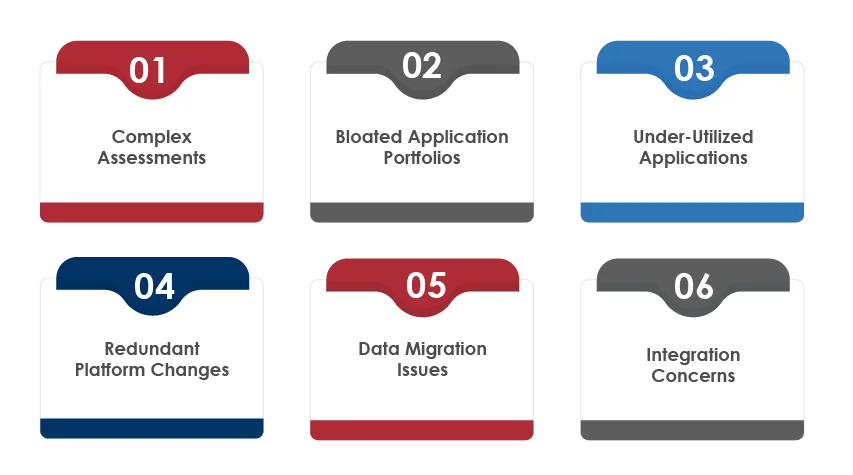
App rationalization is critical for optimizing IT portfolios, but it comes with significant challenges:
Complex Assessments: Evaluating each app’s value, usage, and relevance across departments can be time intensive.
Bloated Application Portfolios: Accumulating too many apps over time creates inefficiencies, overlaps in functionality, and higher maintenance costs.
Under-Utilized Applications: Many apps consume resources without delivering meaningful ROI, requiring thorough usage analysis to identify and address them.
Redundant Platform Changes: Frequent or unnecessary shifts between platforms can disrupt workflows and inflate costs, making long-term planning critical.
Data Migration Issues: Transferring data from one platform to another can lead to disruptions and risks if not managed properly.
Integration Concerns: Ensuring the remaining apps integrate seamlessly with existing systems requires careful planning and execution
Common Pitfalls in App Rationalization
Even well-planned application rationalization methods can run into problems if they aren’t adequately handled throughout implementation.
Integration complexity
Many times, apps connect to more than one system. If dependencies aren’t mapped out correctly, removing or replacing them can mess up workflows.
Data migration risks
It takes careful planning to move data between systems so that it doesn’t get lost, become inconsistent, or cause compliance problems.
Organizational resistance
Teams might not want to get rid of tools they are used to. It’s important to communicate clearly and handle change.
Incomplete portfolio visibility
Organizations could miss shadow IT technologies that raise risk if they don’t have proper application inventories.
A systematic application portfolio management (APM) framework helps address these concerns and makes rationalization projects run more smoothly.
Rationalization is not something you do once. Organizations need to keep an eye on governance and performance once they have streamlined their application landscape.
• Monitor usage and performance metrics across critical applications.
• Standardize integration and data governance practices.
• Align application investments with long-term business goals.
Companies that run big application ecosystems need both technical knowledge and strategic foresight to set up a scalable application rationalization solution. TestingXperts helps businesses look at their application portfolio, find ways to make it better, and run organized rationalization programs that lower costs and make systems more reliable.
How can TX Assist with App Rationalization?
Outdated Applications and legacy systems can hinder progress and increase operational costs. This also brings other challenges, like failing to meet changing compliance standards, struggling with modern tech, being vulnerable to cyber threats, and having redundant and dormant apps.
Tx’s approach to application rationalization aims to ensure your business requirements align with your organizational goals. We evaluate your application portfolio to measure its alignment, value, and performance. We identify retirement apps to improve efficiency, reduce operating costs, and provide reinvestment opportunities for upscaling business strategies.
Our application rationalization service consists of the following:
Risk Assessment
We identify each application’s security, compliance, and operational risks, uncover vulnerabilities, and assess their organizational impact.
Rationalization Recommendations
We recommend retaining, retiring, or replacing applications through a detailed rationalization roadmap and strategy.
Consolidation and Integration
We identify redundant functionalities for consolidation and explore integration to streamline the IT landscape.
Governance and Lifecycle Management
We establish governance frameworks for continuous monitoring, updates, and periodic re-evaluation of applications.
Conclusion
Successful organizations require an efficient and robust application portfolio. All medium—and large-scale enterprises have a list of applications that they refine regularly to increase agility, cost-effectiveness, and efficiency. They make this possible by applying application rationalization, a complex process requiring a deep understanding of technical aspects, business objectives, and the current state of the IT portfolio.
Partnering with Tx enables organizations to simplify this process through expert guidance and strategic execution. By offering tailored rationalization strategies, including risk assessment, consolidation, and governance frameworks, Tx ensures your IT portfolio aligns with business goals. To know more about Tx application rationalization services, contact our experts now.
Ajay is a seasoned Director - Quality Engineering at TestingXperts, contributing significantly to their Innovation & Test Automation COE practice. With over 14 years of comprehensive experience spanning Quality Engineering, Robotic Process Automation (RPA), and DevOps methodologies, Ajay has established a strong reputation for driving quality and efficiency. He possesses a deep understanding of the test automation landscape and a proven ability to architect and implement best-in-class Test Automation and Artificial Intelligence (AI) in Quality Engineering solutions. Throughout his career, Ajay has successfully led QA Automation initiatives for numerous clients across diverse industries and domains, consistently delivering tangible value and measurable improvements. He holds a Bachelor of Technology in Computer Science Engineering degree from JNTUH, India, providing a strong academic foundation for his practical expertise.
FAQs
What is application rationalization in business value?
Application rationalization helps businesses assess their software and systems to decide which ones are valuable, which need upgrades, and which can be retired. Simplifying IT reduces costs, boosts efficiency, and ensures better alignment with business goals.
What is the rationalization of a business?
Rationalization of a business involves streamlining operations to improve efficiency and profitability. It may include restructuring processes, cutting unnecessary costs, or optimizing resources. Businesses can focus on areas that add the most value to their processes.
What are the principles of rationalization in business?
Rationalization in business follows key principles like cost efficiency, resource optimization, innovation, and goal alignment. It’s about eliminating waste, improving productivity, and ensuring all efforts contribute to long-term success.
What is rationalization in the IT industry?
Rationalization in IT means evaluating and optimizing technology systems to improve performance and reduce complexity. It involves retiring outdated tools, consolidating systems, and ensuring the IT infra supports business strategies effectively and cost-efficiently.