Recommended Blogs
AI-Powered Inventory Management: A Retailer’s Must-Have

 Last Updated: March 31st, 2026
 Read Time: 7 minutes
Table of Content
- What is AI in Inventory Management?
- Why Retailers Should Leverage AI in Inventory Management?
- How does AI in Inventory Management Work?
- AI for Demand Planning: Predicting Trends and Managing Seasonal Changes
- Metrics and KPIs for AI-Driven Inventory Success
- AI Implementation Challenges for Inventory Management
- How can Tx help with AI Implementation for Inventory Management?
- Summary
Share On


In the business world, artificial intelligence (AI) has emerged as a game changer over the last few years. Right now, it is a key factor in transforming various aspects of business decision-making and operations. One critical area where AI has shown great potential is inventory management. For businesses, especially retail, inventory management is the core of their operations.
It helps them keep products in stock when needed, keep customers satisfied, and keep costs minimal. Inventory management is a complex process as excess stock can cause potential wastage and escalated storage costs, while stock shortage can cause customer dissatisfaction and missed sales opportunities.
From optimizing supply chains to demand forecasting, AI inventory management challenges have long been a headache for businesses. According to statistics, 46% of small—to medium-sized retailers lack inventory management capabilities. AI in inventory management offers transformative solutions to change the way retailers manage their stock. They can easily address inventory management complexities and gain new growth opportunities.
What is AI in Inventory Management?
AI has a spectrum of capabilities that allow machines to learn from data, automate tasks, and make accurate predictions. From real-time data analysis to automated stock handling, AI can help improve various aspects of inventory management. Its ability to quickly process huge datasets without lagging, make accurate predictions, and identify patterns and trends is valuable for inventory optimization. This technology can be used across various industries, from logistics and manufacturing to retail and eCommerce:
-
- Leveraging AI for retail/eCommerce inventory management would help predict consumer demand, allowing retailers to maintain adequate stock levels.
-
- AI can optimize production planning in the manufacturing industry by helping streamline the supply of raw materials/components.
- AI can assist in logistics route optimization to save delivery costs and time.
Why Retailers Should Leverage AI in Inventory Management?
Integrating AI in inventory management will automate complex processes, provide detailed analytics, and allow retailers to uplift real-time decision-making. It would open a new path for business growth and opportunities.
But how exactly does AI benefit retail inventory management?
One main challenge that retailers face is structuring unstructured/messy data. AI algorithms can clean up the data gaps by removing duplicate data, categorizing data, and structuring this data for analysis, executive debriefs, and visualization purposes. This will help retailers improve their data insights and make more informed decisions. Their data will become a powerful asset in strategic decision-making and facilitate business growth.
AI algorithms help improve the accuracy of data analysis for inventory forecasting and allow retailers to reduce the risks of overstocking and understocking. This will help them ensure that they never run out of stock or waste stock, causing spoiled storage. This precision level would benefit retailers in the long run in today’s tech-driven business environment, where the smallest details matter in deriving positive outcomes.
With AI implementation, retailers can improve the efficiency and accuracy of their management process, saving them a substantial amount of money. They can reduce storage costs, prevent overstocking (leading to less stock wastage), and improve sales margins with accurate forecasting (resulting in a healthier bottom line). Retailers can ensure the availability of the right products and offer superior customer experience. It will result in higher customer satisfaction and a better retention rate. AI can also automate redundant tasks and allow employees to focus on more strategic and growth-focused work.
How does AI in Inventory Management Work?
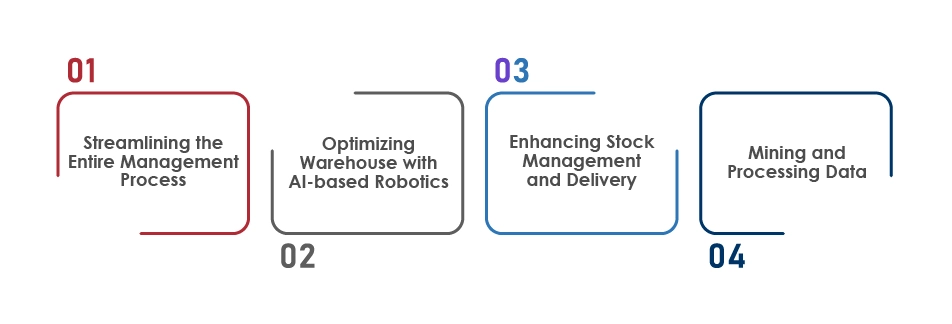
Artificial intelligence (AI) in inventory management can optimize retail business operations at all stages. For example, implementing AI in item-level tagging can improve inventory accuracy by 95%. Here’s how it works in inventory management:
Streamlining the Entire Management Process
If someone thinks inventory management is just about keeping records of stored and delivered items, they are totally wrong. The process involves forecasting, planning, and controlling the entire inventory flow. Integrating AI allows retailers to consider location-specific demand, detect and respond to customer requirements, and remediate overstocking and understocking issues.
AI-based systems can analyze internal and external factors to plan, stock, and deliver products successfully. This, in return, helps decrease inventory management errors, and retailers can save significant costs while improving customer satisfaction levels.
Optimizing Warehouse with AI-based Robotics
Retail brands like Amazon already leverage AI-enabled robots to support their logistical tasks. When discussing productivity in routine operations, AI presents significant benefits over the manual workforce. Robots can work round the clock, 24/7, in the warehouse.
For instance, they have scanners to scan inventory about going out for delivery. From an operational perspective, AI is more efficient in analyzing and predicting demand patterns. AI-based robotics helps remediate human errors and improves the efficiency of time spent per task.
Enhancing Stock Management and Delivery
Warehouse operations directly impact business performance. Issues like inadequate stock monitoring and inventory planning errors can cause stock shortages and delivery delays, negatively impacting customer experience and business revenue. AI in inventory management systems analyzes customer buying and behavior patterns and helps retailers maintain the right stock, arrange products, automate the fulfillment/shipment process, and improve delivery. Leveraging AI, retailers can also improve factory-to-warehouse and warehouse-to-customer commutes, resulting in timely delivery and improved customer experience.
Mining and Processing Data
Retailers can utilize AI-enabled data mining and processing to analyze user data, gain insights into their buying patterns, and follow up with the latest market trends. They can analyze various aspects, such as what’s trending, upcoming events, etc., to address the demand for a particular product. Based on the predictions, retailers can understock or overstock specific products to address sudden surges or declines in sales and prevent dead stock issues.
AI-powered inventory management improves forecasting by analyzing past sales, customer behavior, seasonal trends, and external signals such as specials or events. Instead of using static spreadsheets, merchants use machine learning inventory management models that learn from fresh data and continually update their projections.
With this method, stores can keep the right amount of product on hand without running out or having too much.
Key ways AI strengthens forecasting include:
Predictive demand forecasting
AI models analyze past sales, regional demand trends, and market signals to predict better how much of a product will be needed in the future.
Real-time forecasting updates
Smart inventory systems continuously track new sales data. When demand goes up or down, forecasts change on their own.
Granular demand insights
AI-based inventory forecasting solutions can tell you how much demand there will be based on where you are, what kind of product you have, or when you need it. Retailers may make the best stock choices across multiple stores or warehouses.
Improved supply chain planning
AI supply chain optimization ensures that purchasing and logistics align with expected demand, reducing delays and the costs of emergency restocking.
Better visibility is the actual benefit for retailers. AI forecasting shifts inventory planning from making decisions after the fact to creating plans in advance.
AI for Demand Planning: Predicting Trends and Managing Seasonal Changes
Changes in consumer patterns and seasonal spikes might make it hard to know what you have in stock. AI demand forecasting retail algorithms analyze many datasets to predict what people will want before it happens.
Seasonal spikes and changing consumer trends often create inventory uncertainty. AI demand forecasting retail models analyze multiple datasets to anticipate demand before it happens.
- Identify seasonal buying patterns across regions
- Detect emerging product trends from real-time sales data
- Adjust inventory allocation between stores and warehouses
- Support promotion planning and product launches
Predictive analytics inventory management software also considers external factors such as holidays, weather changes, and social media trends. This helps stores keep their stock ready before demand increases.
Metrics and KPIs for AI-Driven Inventory Success
When using AI inventory management solutions, it’s important to measure performance. To see how well intelligent inventory systems perform, retailers track several metrics.
Some important KPIs are:
Forecast Accuracy
Checks how well AI projections match actual demand.
Inventory Turnover Ratio
Shows how rapidly items leave the inventory.
Stockout Rate
Keeps track of how often things go out of stock.
Carrying Cost of Inventory
Calculates the costs of storing, insuring, and handling goods.
Order Fulfillment Cycle Time
Checks how quickly orders are processed and shipped.
Companies that use AI to manage their inventory often achieve higher forecast accuracy, fewer instances of running out of product, and more efficient operations.
AI systems need precise data, reliable models, and infrastructure that can grow with them. TestingXperts helps stores ensure AI-powered inventory systems work by verifying data integrity, AI model accuracy, and system performance.
Our AI testing professionals ensure that smart inventory systems deliver accurate forecasts, integrate with legacy systems, and maintain security and compliance across all retail settings.
AI Implementation Challenges for Inventory Management
Although integrating AI in inventory management offers various perks, there are also certain challenges associated with it. Businesses should understand these factors to leverage AI solutions for inventory management.
The first challenge is addressing data quality and availability issues. As AI systems are totally dependent on data, using outdated, incomplete, or inaccurate data can result in false predictions and wrong decision-making. Retailers find it challenging to maintain data quality as it’s a long and tedious process that involves data cleaning, integration, and constant updates. Also, there is a chance that retailers may not have past/historical data, which is a critical requirement for training AI models.
The initial cost of implementing AI solutions includes hardware and software implementation, training the workforce about new processes, and system maintenance. This could strain small businesses’ budgets, which can be resolved if they opt for easily accessible cloud-based AI solutions. Also, running AI-enabled inventory management requires skilled professionals with specialized skills. Recruiting or training existing members to handle AI systems could be challenging.
There’s also an issue with AI integrating with existing systems. Many retailers still use legacy systems that may not be compatible with AI solutions and require custom development. Leveraging AI consulting firms will involve using personal data (users/customers), raising concerns about privacy and security. Retailers must ensure that their AI systems are resilient against cyber threats and that no harm will be done to business and customer data.
How can Tx help with AI Implementation for Inventory Management?
Retail business owners need to partner with a reliable and professional QA expert like Tx to address the challenges of AI integration in inventory management. This step would allow them to ensure that the data they are using has gone through proper data quality practices to ensure its integrity, reliability, and update.
Also, you will get access to best-in-the-industry AI-enabled test frameworks like Tx-Automate and Tx-SmarTest, allowing you to keep tabs on testing operations. We have a team of AI testing experts possessing in-depth knowledge of AI algorithms and their application in inventory management. Partnering with Tx would ensure that your AI-based inventory management system complies with data privacy and compliance regulations to handle sensitive information during testing.
Summary
AI-powered inventory management transforms retail by automating processes, improving accuracy, and enhancing decision-making. It addresses common challenges like overstocking, stockouts, and data management inefficiencies. By leveraging AI, retailers can predict demand, streamline warehouse operations, and optimize stock levels, resulting in cost savings and improved customer satisfaction. However, integrating AI poses challenges like data quality issues, high implementation costs, and compatibility with legacy systems.
Partnering with QA experts like Tx ensures successful AI integration, offering advanced testing frameworks like Tx-Automate to enhance data reliability and system efficiency while complying with data privacy and security standards. Contact our experts to learn more about our AI testing services.

Director - Delivery
Dynamically dedicated and strategic leader with over 21 years of multicultural and diversified experience in leading Delivery Management, Program Management, and Project Management in Software Testing and Quality Control. Proven expertise in engaging with executive management and diverse teams at all levels, adept at developing IT roadmaps encompassing vision, strategy, and plans.
FAQs
How can AI improve stock visibility and inventory accuracy?
- Uses IoT sensors and real-time tracking
- Automates stock updates across warehouses
- Detects discrepancies instantly
- Improves inventory accuracy through predictive analytics.
What AI tools integrate best with our existing inventory systems?
ERP and warehousing systems can work with SAP IBP, Oracle Retail AI, Blue Yonder, and NetSuite. The ideal decision relies on how well it can grow, how well it can integrate data, and how accurate its forecasts need to be.
How do we use AI to forecast demand and avoid overstocking?
AI forecasting algorithms look at past sales, seasonal demand, and how customers act to guess what demand will be in the future. After that, retailers may set the right amount of stock and automate decisions about when to restock to avoid having too much inventory.
How do we measure ROI from AI-powered inventory management?
Better forecast accuracy, fewer stockouts, lower carrying costs, and more inventory turnover are all ways to quantify ROI. Retailers also make more money when products are easier to find and orders are filled faster.
How can TestingXperts support AI-powered inventory management implementations?
TestingXperts checks the accuracy of AI models, makes sure the data is correct, and examines how well systems work together on inventory platforms. This enables stores use AI solutions that are trustworthy and provide accurate forecasts, the right amount of stock, and safe operations.
Discover more