Recommended Blogs

AI Testing for Retail – Build Checkout Confidence Before Customers Drop Off

 Last Updated: June 24th, 2026
 Read Time: 6 minutes
Table of Content
- Why Checkout Confidence Matters for Retail and E-Commerce Leaders?
- Where in Retail Software Testing Services Do Checkout Risks Occur?
- How AI Testing Solutions for Retail Detect Cart Abandonment Root Causes Faster?
- Checkout Flow Regression Testing: What Must Be Covered Before Every Release
- Ecommerce QA Checklist for Reducing Cart Abandonment Risk
- Building a Scalable AI-Based Testing Model for Ecommerce
- How Can TestingXperts Assist with AI Testing for Retail?
- Conclusion
Share On


For enterprise retailers, cart abandonment often reflects quality gaps across payments, inventory, promotions, tax logic, shipping rules, mobile journeys, and third-party integrations. As per a research, the average documented online shopping cart abandonment rate at 70.22%. That number makes checkout reliability a greater concern for retail and eCommerce brands.
That’s where retail software testing services and AI testing solutions for retail become critical to revenue protection. As retail IT teams increase AI adoption, the quality challenge is evolving as well. Gartner reports that 91% of retail IT leaders are prioritizing AI as the top technology to implement in 2026. It means QA teams must validate both ecommerce platforms and the AI-led experiences shaping checkout behavior.
Why Checkout Confidence Matters for Retail and E-Commerce Leaders?
Checkout confidence means customers can complete a purchase without friction, failure, or uncertainty. For CIOs, CTOs, QA leaders, and product leaders, it also means releases can go live without increasing business risk.
Cart abandonment often starts before the payment page. Customers may leave because a promo code fails, shipping fees appear late, inventory changes after cart selection, or the mobile page takes too long to respond. McKinsey reports that 90% of consumers are likely to abandon carts that feature high shipping costs for standard items, making cost transparency and delivery promise validation important parts of checkout QA.
Enterprise eCommerce journeys are harder to test because the checkout path depends on many systems. Payment gateways, fraud engines, tax services, order management systems, inventory platforms, loyalty tools, shipping partners, and personalization engines must work together. A small defect in one system can quietly break the customer’s journey.
Where in Retail Software Testing Services Do Checkout Risks Occur?
Retail software testing services help teams identify checkout risks before they reach production. The goal is not only to find defects. It is to validate whether revenue-critical journeys can perform under real customer conditions.
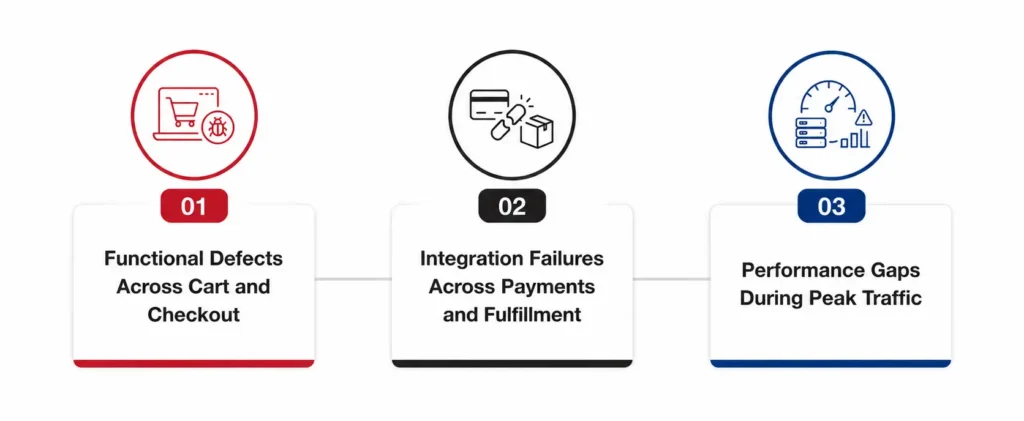
Functional Defects Across Cart and Checkout
Functional checkout defects can appear in simple interactions. A customer may update cart quantity, apply a coupon, change the delivery address, select a store pickup option, or switch payment methods. Each step must calculate the right price, tax, shipping fee, discount, and order total.
QA teams should also validate confirmation emails, order IDs, loyalty points, refund triggers, and post-purchase status updates. These touchpoints influence trust after the sale.
Integration Failures Across Payments and Fulfillment
Retail platforms depend on APIs and third-party services. A payment timeout, an inventory sync delay, a failed fraud check, or an order routing error can stop a valid purchase.
Payment gateway stress testing retail platforms is especially important during campaigns, holiday sales, and product drops. Retailers must know how gateways behave during high transaction volume, retries, partial failures, and delayed responses.
Performance Gaps During Peak Traffic
Performance failures are often conversion failures. Slow cart pages, lagging address validation, delayed payment authorization, and overloaded product recommendation services can push customers away.
Retail QA must test peak traffic conditions before the campaign starts. This includes load testing, stress testing, endurance testing, and performance monitoring across web, mobile, APIs, and payment flows.
How AI Testing Solutions for Retail Detect Cart Abandonment Root Causes Faster?
AI testing solutions for retail help QA teams move from broad test execution to smarter risk detection. They can analyze change patterns, defect history, user behavior, logs, transaction failures, and test results to identify where checkout risk is highest.
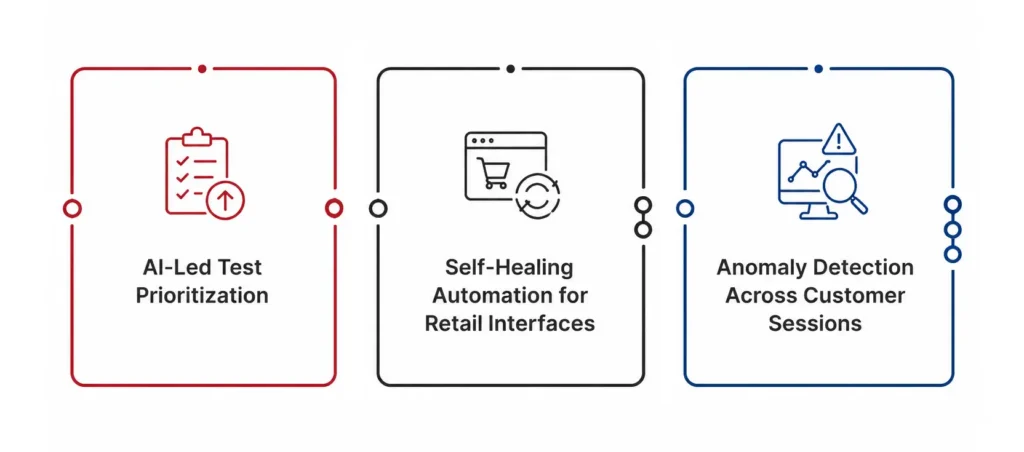
AI-Led Test Prioritization
Not every test carries the same business value. AI-led test prioritization can help teams focus on revenue-critical checkout paths affected by recent code, integration, or configuration changes. For example, if a release changes tax logic, shipping rules, and payment retry handling, the regression suite should prioritize checkout scenarios connected to those areas. It makes AI-based testing for ecommerce more practical for fast release cycles.
Self-Healing Automation for Retail Interfaces
Retail pages change often. Promotions, banners, product layouts, personalization rules, and A/B tests can break automation scripts that depend on static identifiers. Self-healing automation can reduce test maintenance by adapting to controlled UI changes. It helps QA teams maintain coverage of checkout flow regression testing when digital commerce teams release frequent updates.
Anomaly Detection Across Customer Sessions
AI can also help detect unusual patterns across logs, payment retries, latency spikes, failed API calls, and customer session behavior. These signals help teams perform cart abandonment root cause QA with better context. Instead of only knowing that customers dropped off, teams can investigate whether the issue stemmed from payment errors, slow page load times, failed coupon validation, address lookup delays, or mobile rendering issues.
Checkout Flow Regression Testing: What Must Be Covered Before Every Release
Checkout flow regression testing should validate the complete customer journey, not isolated screens. Retailers need confidence that each release protects conversion, payment accuracy, and order integrity.
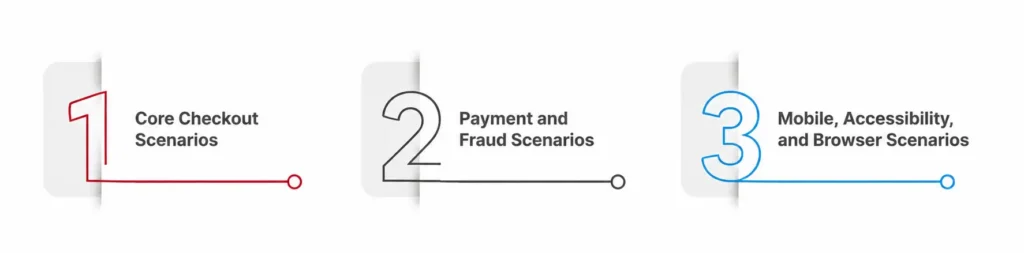
Core Checkout Scenarios
Core regression coverage should include guest checkout, registered checkout, cart edits, saved addresses, new addresses, multi-address shipping, store pickup, tax calculation, shipping selection, and order confirmation. QA teams should also test negative scenarios. These include invalid addresses, expired coupons, out-of-stock products, payment retries, and session timeout behavior.
Payment and Fraud Scenarios
Payment testing should include credit cards, wallets, buy now pay later options, gift cards, refunds, failed payments, duplicate payments, gateway timeouts, retry logic, and fraud review flows. Retailers should also validate error messaging. Customers need clear next steps when payment fails, rather than a generic failure message that pushes them to abandon the cart.
Mobile, Accessibility, and Browser Scenarios
Mobile checkout requires focused testing because many shoppers browse and buy from phones. QA teams should validate responsive layouts, form fields, autofill behavior, tap targets, page speed, and device-specific payment options. Accessibility testing also matters. Checkout forms, buttons, labels, error messages, and keyboard flows should support customers who use assistive technologies.
Ecommerce QA Checklist for Reducing Cart Abandonment Risk
A practical ecommerce QA checklist should connect test coverage to customer behavior and business impact.
Key areas include:
- Cart updates, product availability, pricing, and order totals
- Promo codes, coupons, loyalty points, gift cards, and discounts
- Shipping rules, tax logic, delivery promises, and pickup options
- Guest checkout, registered checkout, and account creation flows
- Payment gateway stress testing retail scenarios
- Wallets, cards, BNPL, refunds, retries, and timeout handling
- API validation across OMS, ERP, CRM, inventory, and shipping systems
- Mobile, browser, device, and accessibility coverage
- Performance testing for campaigns, holidays, and flash sales
- AI personalization, recommendation, and search validation
- Order confirmation, email triggers, tracking, and post-order status
This checklist provides QA leaders with a practical framework for reducing cart abandonment risk. It also helps product teams understand where checkout quality can directly affect revenue.
Building a Scalable AI-Based Testing Model for Ecommerce
Retailers need a QA model that keeps pace with the speed of eCommerce releases. Manual test execution alone cannot keep pace with frequent promotions, content changes, payment updates, and platform enhancements.
A scalable model starts by mapping QA coverage to revenue-critical journeys. High-value paths, such as checkout, payment, search, cart recovery, and order fulfillment, should receive deeper regression and performance coverage. The next step is continuous checkout assurance. QA should run earlier in the delivery cycle and continue through production monitoring. It gives teams faster feedback and improves release decisions.
Executive metrics should include release readiness, payment pass rate, checkout response time, critical defect aging, automation coverage, regression pass rate, and production incident trends. These metrics help leaders decide whether a release is safe for customers and revenue.
How Can TestingXperts Assist with AI Testing for Retail?
TestingXperts helps retail and ecommerce brands strengthen quality across digital commerce ecosystems. Our retail testing services cover web, mobile, POS, OMS, CRM, ERP, inventory, payment, loyalty, and third-party integrations.
Our AI testing solutions support smarter regression planning, test automation, anomaly detection, and risk-based quality engineering. This helps retail teams identify high-risk checkout paths, improve release confidence, and reduce defects across complex customer journeys.
TestingXperts also supports payment gateway testing, performance testing, API validation, cross-browser testing, accessibility testing, mobile QA, and end-to-end ecommerce assurance. These capabilities help retailers prepare for peak traffic, campaign launches, platform upgrades, and continuous digital commerce releases.
Conclusion
Cart abandonment is not only a marketing challenge. It often reflects quality issues across checkout flows, payment systems, performance, integrations, and mobile experiences. Retail software testing services help brands find these risks before customers experience them. AI testing solutions for retail add speed, intelligence, and better prioritization to that effort.
For retail and ecommerce leaders, the goal is clear: build checkout confidence before customers drop off. Strong QA turns every release into a stronger opportunity to protect revenue, trust, and customer experience. To know how TestingXperts can assist, contact our retail testing experts now.

VP, AI & QE Transformation
Michael Giacometti is the Vice President of AI and QE Transformation at TestingXperts. With extensive experience in AI-driven quality engineering and partnerships, he leads strategic initiatives that help enterprises enhance software quality and automation. Before joining TestingXperts, Michael held leadership roles in partnerships, AI, and digital assurance, driving innovation and business transformation at organizations like Applause, Qualitest, Cognizant, and Capgemini.
Discover more