Recommended Blogs

How does AI-driven DevOps Transform Software Development?

 Last Updated: May 20th, 2026
 Read Time: 7 minutes
Table of Content
- Practical Applications of AI-driven DevOps in Software Development
- Key Business Benefits of AI in DevOps
- Challenges in AI-Driven DevOps Adoption
- AI Tools for DevOps: Platforms Powering Intelligent Pipelines
- Future of AI-driven DevOps in Software Development
- How can Tx help with AI-driven DevOps Implementation?
- Summary
Share On


AI and DevOps integration has become integral to the success of modern software development. Today, almost half of the code on GitHub is AI-generated using Copilot. Around 92% of developers and business organizations are using AI developer tools to improve the efficiency of their software development. As Gartner says, by 2028, 75% of enterprises will use AI code assistants to upscale and fasten their development cycle. If we talk about AI-driven DevOps, it will accelerate software delivery, reduce development costs, and enhance overall quality. But how does DevOps support the use of AI?
Integrating AI in DevOps could provide transformative business outcomes. DevOps is the backbone of modern software development, allowing businesses to control software quality, reliability, and security. Without DevOps, AI-assisted development will require manual assistance in different backlogs, such as security reviews, integration, testing, and deployment. Think of DevOps as a safety net that streamlines modern software development. At the same time, incorporating AI into DevOps assists enterprises in addressing several software development challenges.
The traditional DevOps practices struggle with handling large datasets, predicting issues, and automating repetitive tasks. With AI-driven DevOps, businesses can improve these processes by incorporating predictive analytics, intelligence automation, and real-time insights. It is like a competitive advantage where agility and scalability are critical. According to a report by Forbes, AI is upscaling DevOps by assisting software development organizations to write higher-quality code and automate manual tasks. Not only that, but AI solutions can also enforce regulatory compliance. For instance, they ensure that all pull requests are linked to certain tickets in the project management system. It will also ensure that updates are automatically recorded in the change log and release notes.
Practical Applications of AI-driven DevOps in Software Development
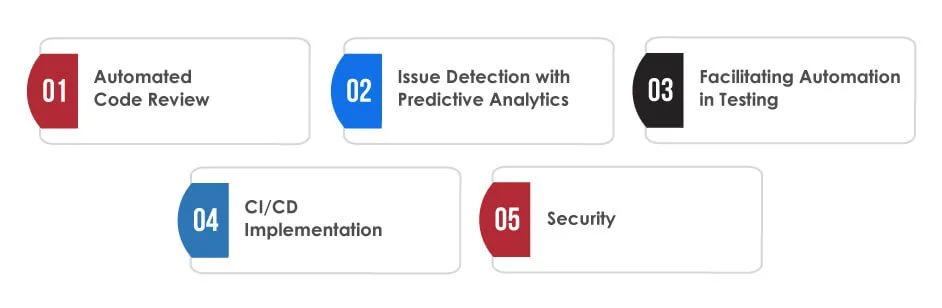
AI is constantly evolving DevOps that utilizes software development and technology to upscale the delivery process. By integrating AI into DevOps, businesses can achieve better quality, higher efficiency, and reliability in the software delivery pipeline. Here are some of the practical applications of AI-driven DevOps in software development:
Automated Code Review:
AI in DevOps helps enhance software development by facilitating automatic code review. The team utilizes tools to analyze actual code to identify bugs, security weaknesses, or even slight inconsistencies. Then, the feedback is returned to developers so they can fit the code per QA and code compliance. It helps improve software security protocols and stability and speeds up the development and deployment.
Issue Detection with Predictive Analytics:
AI-driven DevOps utilizes predictive analytics to pinpoint problems that might become critical if not addressed on time. ML algorithms analyze past data to make predictions of future system behaviors. For instance, AI can spot patterns indicating a system failure or performance loss. Businesses can prevent downtime and enjoy seamless operations by addressing such issues early on.
Facilitating Automation in Testing:
Automation plays a big role in DevOps, and AI supports this by making it smarter and more efficient. Organizations utilize AI-driven automation tools to create and execute test cases, analyze test results, and prioritize test cases to run. This assists them in reducing dependency on manual testing and improving software quality.
CI/CD Implementation:
AI integrated with DevOp would shorten the time to release new software versions, as the CI/CD cycle would be implemented. CI/CD processes will become more efficient with AI integration, and software will be up to standard while new updates are released on time. This would improve deployment and development cycle time.
Security:
Security has been an important concern in the AI-driven DevOps environment. AI optimizes security by identifying and mitigating code, configuration, and infrastructure vulnerabilities. The advanced algorithms enable AI to examine huge data volumes in seconds and identify patterns indicating security risks. With this proactive approach, businesses can improve security and decrease the financial damage caused by data breaches.
Key Business Benefits of AI in DevOps
Incorporating AI in DevOps is a significant step organization should take to upscale app design and deployment. They can achieve higher efficiency, greater quality, and improved CX.
Let’s take a closer look at the significant business benefits of AI-driven DevOps:
Improved Software Quality:
AI assists in improving software quality by optimizing QA and monitoring processes. AI-enabled testing tools can identify bugs more accurately and faster, reducing issues during deployment. Also, AI-driven monitoring offers real-time insights into app performance, allowing teams to ensure high quality in the final product and deliver better UX.
Enhanced Productivity:
ML improves DevOps efficiency by replacing complex, repetitive, manual tasks like testing and code analysis. It reduces the errors in an app’s functionality and boosts the software production and update cycle. AI enables organizations to avoid repetitive work so their development teams can concentrate on high-priority tasks critical to the development process. As a result, they can deploy the final product with greater speed and efficacy.
Faster Time-to-Market:
Integrating AI into the DevOps pipeline optimizes software processes and reduces the time required for manual tasks by automating them, leading to faster time-to-market. DevOps teams can improve their software delivery speed with faster development cycles and instantly deploy new updates or features for their existing applications. This capability allows businesses to respond to market needs quickly, on time, and more efficiently and address new opportunities.
Better Decision-Making:
AI offers valuable insights via data analysis and predictive analytics. It enables DevOps teams to analyze vast amounts of data and make better decisions about development, operations, deployment, resource allocation, and addressing potential risks. This results in more strategic planning and better outcomes, contributing to business success.
Workflow Optimization:
With AI-driven DevOps, workflow optimization is an area of interest for organizations. AI allows them to thoroughly analyze and optimize DevOps workflows by locating inefficiencies and potential areas of improvement. AI optimizes workflow efficiency by identifying bottlenecks and streamlining processes. This reduces operational costs and improves the AI’s capability to adapt and learn from data.
Challenges in AI-Driven DevOps Adoption
Even with its benefits, businesses face several challenges when using DevOps with AI.
Integration with Legacy Systems
Many companies still use old technology that doesn’t work well with AI-based automation. To add AI models to current CI/CD pipelines, you may need to update them.
Data Quality and Availability
AI models depend on accurate historical data. Predictive analytics may not perform as well if the logs are incomplete, the measurements are inconsistent, or the repositories are poorly maintained.
Skill Gaps
To use machine learning in DevOps, you need to know a lot about AI, automation, and cloud architecture. Many teams need further training or support from outside.
Security and Governance
AI systems that analyze pipelines and infrastructure must adhere to strict security rules. Organizations need to ensure they have processes for compliance, access control, and monitoring.
Companies that address these problems early are more likely to build AI-powered DevOps ecosystems that can grow.
AI Tools for DevOps: Platforms Powering Intelligent Pipelines
Many platforms provide smart DevOps automation and AI-driven continuous delivery.
Jenkins
- Makes CI/CD pipelines automatic
- Supports AI plugins for optimizing pipelines and predicting builds
Kubernetes
- Manages containerized applications at scale
- Allows for automated deployment, scaling, and infrastructure management
AI-Driven Monitoring Platforms
- Look at logs and performance data
- Find problems and guess when the infrastructure will go down
GitHub Copilot and AI Coding Assistants
- Make developers more productive
- Help you write and review code more quickly
Companies that use these tools can build automated DevOps pipelines that continuously learn from system data.
When companies want to use smart DevOps automation, they typically need people who know how to test, optimize pipelines, and integrate AI. TestingXperts helps businesses adopt AI-driven DevOps by providing automated testing frameworks, predictive QA, and secure CI/CD pipelines. These tools speed up software delivery while ensuring it meets quality and compliance standards.
Future of AI-driven DevOps in Software Development
The future of AI in DevOps to optimise software development is promising and transformative. As AI solutions evolve, they will seamlessly integrate into DevOps to make the SDLC more impactful. Predictive analytics will make it possible to predict problems and resolve them before they arise. AI-enabled tools will make team collaboration more engaging and value-driven, resulting in high software quality and quicker release cycles. DevOps is also turning into AIOps, where AI will lead tech innovation and facilitate continuous improvement by analyzing, automating, and enhancing business processes.
Gen AI is another innovation that would greatly impact DevOps by automating routine tasks and optimizing complex decision-making. It will redefine the software development environment by making processes more precise, highly adaptive, and faster to address evolving business needs. By embracing AI trends and advancements, businesses can achieve greater security, innovation, and efficiency in their software development and deployment processes.
How can Tx help with AI-driven DevOps Implementation?
Modern software development and testing depend on DevOps for efficiency, teamwork, and automation benefits. Resolving integration obstacles becomes necessary as businesses heavily rely on AI to optimize their DevOps practices. Tx, as one of the leading DevOps consulting services providers with extensive experience in AI, offers comprehensive solutions to assist you in navigating this challenging ecosystem seamlessly and successfully. Our experts can guide you through your AI-driven DevOps journey, from automation to data management. We have worked on various DevOps projects, helping businesses set up scalable architecture.
What makes us unique is:
• Our deep understanding of AI and DevOps practices allows us to implement optimized software development processes to upscale your application delivery.
• We integrate testing at the start of the project to help you deliver quality products in the deployment stage.
• We ensure code quality assessment and security and build a solution for application monitoring.
• Our experts are knowledgeable about the latest AI regulations to help you stay away from legal implications during and after app development.
• We assist you in improving your business bottom line with well-defined automation in place.
• We utilize our in-house accelerators, Tx-DevOps, Tx-IaCT, Tx-DevSecOps, and Tx-Insights, to ensure successful and secure DevOps implementation.
Summary
AI-driven DevOps is changing how businesses develop software by optimizing efficiency, security, and quality. It facilitates better communication among teams to speed up the SDLC process. As AI continues to evolve, its applications in DevOps will surely be more pertinent as it will enable development and testing teams to release software with higher quality on time. Long story short, AI is necessary for businesses to remain relevant in the current and future digital ecosystem. Partnering with Tx would allow you to implement these advanced technologies successfully for your software development and testing projects. Contact our DevOps consulting experts to know more.

VP, AI & QE Transformation
Michael Giacometti is the Vice President of AI and QE Transformation at TestingXperts. With extensive experience in AI-driven quality engineering and partnerships, he leads strategic initiatives that help enterprises enhance software quality and automation. Before joining TestingXperts, Michael held leadership roles in partnerships, AI, and digital assurance, driving innovation and business transformation at organizations like Applause, Qualitest, Cognizant, and Capgemini.
Discover more