

Recommended Blogs

AI Test Automation: From Fragile Scripts to Adaptive Quality Engineering
Table of Content
- Why Test Maintenance Is a Major QA Challenge
- How AI Reduces Test Script Maintenance
- Self-Healing Automation and Smarter Test Updates
- Benefits of Intelligent test automation for Enterprise QA Teams
- Key Considerations Before Adopting AI in Software Testing
- How TestingXperts Helps Enterprises Build Adaptive Test Automation?
- Conclusion
Share On


AI-powered testing is becoming a serious enterprise priority as application change outpaces the ability of traditional QA models to keep automation current.
For many teams, the real challenge is not testing execution. A UI change, revised workflow, new integration, or data update can trigger script failures that take time to investigate and repair. As this effort builds, automation becomes harder to trust, and regression cycles become harder to manage.
AI-driven testing helps address this maintenance burden. It can reduce repetitive script repair, improve test selection, and help QA teams focus on the failures that carry real release risk. The shift is from automation that simply executes automation that can adapt as the application evolves.
Why Test Maintenance Is a Major QA Challenge
Test maintenance is often underestimated when planning automation programs. Teams tend to focus on the initial build effort, coverage targets, and execution speed. The maintenance required after a few quarters of continuous change is harder to estimate.
A redesigned form may make test data behave differently. A new integration may affect response timing or error handling. Eventually, QA teams can find themselves spending a meaningful part of every sprint updating tests that were working perfectly well a few weeks earlier.
The maintenance burden shows up in several ways:
- Regression suites take longer to prepare.
- Automation failures become difficult to trust.
- Teams rerun tests to confirm false failures.
- Test coverage becomes outdated.
- Release teams lose confidence in automation results.
This is why test maintenance reduction is now an executive issue. When automation becomes expensive to maintain, it slows delivery and weakens release confidence. As enterprises look for ways to make automation more resilient and scalable, AI-powered testing is emerging as a practical approach to reducing maintenance effort while improving release confidence.
The pressure is growing because AI-assisted development is increasing code volume. ITPro reported that 60% of global organizations still ship untested codes. The same article noted that 32% knowingly do so due to pressure to prioritize speed over quality.
How AI Reduces Test Script Maintenance
Traditional automation depends heavily on fixed scripts. When the application changes, the script fails even if the user’s journey still works. AI-assisted testing changes this model. It can detect changes in the application and suggest updates to the affected test assets. This reduces manual correction effort.
What usually breaks in traditional automation:
- Object locators
- Dynamic IDs
- Page structures
- Form fields
- User flows
- API responses
- Test data dependencies
How intelligent test automation helps:
- Identifies changed elements automatically
- Maps alternate locators
- Suggests script corrections
- Flags unstable tests
- Removes duplicate test cases
- Prioritizes high-risk test execution
This is where AI test automation becomes valuable. It reduces the hidden cost of maintaining large automation suites.
Self-Healing Automation and Smarter Test Updates
Self-healing test automation is one of the clearest use cases for intelligent automation testing. It helps automation scripts adapt when application elements change. For example, a login button may change its ID after a UI update. Traditional automation fails because the script cannot find the old locator. Self-healing automation can compare element attributes and identify the correct object.
| Traditional Automation | Self-Healing Test Automation |
| Fails when the locator changes | Searches for alternate element matches |
| Needs manual script repair | Suggests or applies script updates |
| Creates false failures | Reduces noise in test results |
| Slows regression cycles | Supports faster validation |
| Depends on script stability | Adapts to controlled application change |
Self-healing works best when the test design is clean, locators are meaningful, and test data is stable. It also needs human review for high-risk business flows. AI-powered testing should improve reliability, not hide defects. QA teams must define when self-healing changes can be automatically accepted and when expert review is required.
Katalon’s test automation statistics show that 72% of surveyed QA professionals use AI tools for test case and script generation, while 35% use AI for test optimization. This reflects how AI is moving from experimentation into practical QA workflows.
Benefits of Intelligent test automation for Enterprise QA Teams
Intelligent test automation delivers the most value when it is tied to business outcomes. The goal is not simply faster automation. The goal is stronger release confidence with less maintenance drag. Key benefits include:
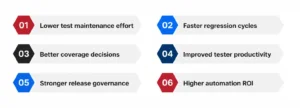
- Lower test maintenance effort: Self-healing automation reduces repetitive script repair and false failures.
- Faster regression cycles: AI test automation can prioritize relevant tests and reduce unnecessary execution.
- Better coverage decisions: Predictive QA helps teams focus on risk-prone modules and business-critical workflows.
- Improved tester productivity: QA teams spend less time repairing scripts and more time improving test strategy.
- Stronger release governance: AI-supported insights can improve release readiness reporting.
- Higher automation ROI: Reusable, adaptive test assets reduce long-term automation cost.
Fortune Business Insights valued the AI-driven testing market to reach USD 4.64 billion by 2034, at an 18.30% CAGR. This market growth reflects rising demand for intelligent test automation across enterprises.
Key Considerations Before Adopting AI in Software Testing
Smart test automation needs structure. Without governance, enterprises may create more noise, tool sprawl, and trust issues. Before adoption, enterprises should assess:
| Decision Area | Key Question |
| Automation maturity | Are existing tests stable enough for AI improvement? |
| Tool fit | Does the platform support enterprise applications and integrations? |
| Data quality | Is the test data reliable and secure? |
| Human review | Which AI decisions need QA approval? |
| Auditability | Can teams explain AI-driven test decisions? |
| Security | How is sensitive test data protected? |
| Metrics | How will maintenance reduction be measured? |
The best approach is phased adoption. Start with a controlled regression suite. Measure maintenance effort, false failures, execution time, and defect detection before expanding. AI in software testing should be governed like any enterprise capability. It needs standards, ownership, metrics, and clear accountability.
How TestingXperts Helps Enterprises Build Adaptive Test Automation?
TestingXperts helps enterprises build adaptive Quality Engineering capabilities that keep test automation aligned with continuous application change.
Our approach brings together AI-powered QA services, reusable automation assets, self-healing capabilities, test impact analysis, defect prediction, CI/CD integration, and governance.
The objective is not simply to update scripts faster. It is to help QA teams reduce maintenance effort, improve test selection, strengthen validation across critical journeys, and make release decisions with greater confidence.
TestingXperts works with organizations to identify where intelligent test automation can add the most value. This may include improving automation foundations, prioritizing high-risk tests, introducing self-healing capabilities, or connecting automation more closely to CI/CD and release processes.
Through accelerators such as NG-TxAutomate and Tx-HyperAutomate, TestingXperts helps teams develop automation that is measurable, more responsive to change, and aligned with business risk.
Conclusion
Test automation should help teams manage application change. It should not become a separate maintenance problem that absorbs the same people it was meant to support.AI test automation can reduce repetitive repair work, improve the usefulness of regression suites, and help QA teams focus their attention where it has the greatest impact. Self-healing test automation, impact analysis, and smarter prioritization do not replace QA judgment. They make that judgment easier to apply at the right point in the release process.
For enterprise QA teams, the outcome is straightforward: less time spent repairing automation, clearer quality signals, and greater confidence in the decisions made before release.
Explore how TestingXperts can help build adaptive test automation that supports faster delivery, stronger quality, and sustained release confidence.


Manjeet Kumar
VP, Delivery Quality Engineering
Manjeet Kumar, Vice President at TestingXperts, is a results-driven leader with 19 years of experience in Quality Engineering. Prior to TestingXperts, Manjeet worked with leading brands like HCL Technologies and BirlaSoft. He ensures clients receive best-in-class QA services by optimizing testing strategies, enhancing efficiency, and driving innovation. His passion for building high-performing teams and delivering value-driven solutions empowers businesses to achieve excellence in the evolving digital landscape.
Discover more