Recommended Blogs

Before GenAI Scales, It Must Be Proven: The AI Assurance Framework

 Last Updated: July 7th, 2026
 Read Time: 5 minutes
Table of Content
- Why GenAI Deployment Requires an AI Assurance Framework?
- What Does an Enterprise AI Assurance Framework Must Validate Before Go-Live?
- Traditional QA vs GenAI Assurance: What Needs to Be Modernized
- Which Assurance Approach Fits Your GenAI Use Case?
- How Can TestingXperts Assist with AI Assurance Services?
- Conclusion
Share On


GenAI has moved faster than most enterprise control models were built to handle. Pilots that once supported content drafts now influence customer service, software delivery, knowledge management, and operational decisions.
McKinsey’s 2025 global AI survey found that 88% of respondents report regular AI use in at least one business function, yet only about one-third say their companies have begun scaling AI programs enterprise-wide. That gap matters because adoption is rising faster than assurance maturity.
This is where an AI assurance framework becomes an enterprise-level issue. Organizations do not need another testing checklist. They need a disciplined approach to demonstrate that GenAI systems are accurate, safe, compliant, secure, explainable, and fit for production.
Why GenAI Deployment Requires an AI Assurance Framework?
The early GenAI conversation focused heavily on productivity and experimentation. That was understandable when use cases were narrow, supervised, and mostly internal.
Now, GenAI systems are connected to customer data, business workflows, enterprise knowledge bases, code repositories, and decision support processes. That shift changes the risk profile.
These assurance practices are especially important in regulated industries such as insurance, where AI is increasingly used to automate underwriting decisions. Learn more in our AI in P&C Insurance Underwriting blog.
A conventional application fails in repeatable ways that teams can often reproduce. A GenAI system can fail differently across prompts, users, contexts, and data retrieval paths.
Why Traditional Confidence Breaks Down
A GenAI answer may sound fluent while being incomplete, biased, outdated, or unsupported. In regulated functions, that is not just a user experience issue. It becomes an operational, compliance, and reputation risk. McKinsey also reported that 51% of respondents using AI had seen at least one negative consequence, with inaccuracy being a common issue.
That is why enterprise AI quality assurance must move upstream. Executive teams need evidence before deployment, not incident reports after adoption. An AI assurance framework provides that evidence. It integrates technical validation, governance, risk thresholds, and monitoring into a single accountable operating model.
What Does an Enterprise AI Assurance Framework Must Validate Before Go-Live?
A mature AI assurance framework covers far more ground than functional correctness. Each layer addresses a distinct failure mode that conventional testing cannot detect.
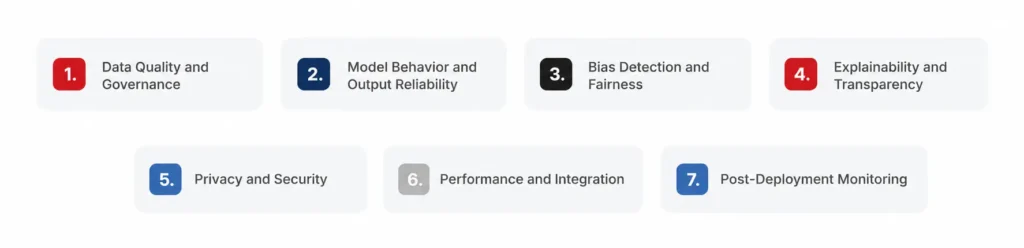
Data Quality and Governance
Training and retrieval data must be assessed for completeness, recency, relevance, and potential bias. Data lineage documentation should confirm where data originated, how it was processed, and whether it reflects populations the model will serve in production.
Model Behavior and Output Reliability
GenAI validation testing must evaluate output consistency across paraphrased inputs, edge cases, and adversarial prompts. Hallucination rate benchmarks, factual accuracy scores, and confidence calibration all belong here.
Bias Detection and Fairness
Automated bias audits should test model outputs across demographic groups, linguistic patterns, and sensitive attributes. For regulated industries, this layer often determines whether the system can be deployed at all.
Explainability and Transparency
Enterprise AI governance requires that model decisions be explainable to stakeholders, auditors, and, in some jurisdictions, end users. Explainability testing verifies that the rationale can be traced and communicated clearly.
Privacy and Security
AI regulatory compliance testing must verify that personally identifiable information is not exposed, memorized, or reconstructed through prompting. Security assessments should include prompt injection testing, jailbreak evaluations, and data exfiltration scenarios.
Performance and Integration
Latency benchmarks, throughput testing under peak load, and integration validation with upstream data sources all determine whether the model performs reliably in real operating conditions.
Post-Deployment Monitoring
A go-live sign-off is not the end. Continuous monitoring for model drift, output quality degradation, and anomalous usage patterns must be built into the operational model from day one.
Traditional QA vs GenAI Assurance: What Needs to Be Modernized
Traditional QA assumes that expected inputs should produce expected outputs. That logic still matters for workflows, APIs, integrations, and user interfaces. GenAI adds a probabilistic layer. The same prompt can yield acceptable variation, weak reasoning, or unsafe confidence, depending on the context.
| Modernization Area | Traditional QA Approach | GenAI Assurance Approach |
|---|---|---|
| Testing logic | Validates predefined inputs against expected outputs. | Evaluates acceptable behavior across varied prompts, contexts, and model responses. |
| Test design | Uses scripted test cases, regression suites, and fixed acceptance criteria. | Uses scenario libraries, benchmark datasets, adversarial prompts, and evaluation rubrics. |
| Output validation | Checks whether the application returns the correct functional result. | Assesses accuracy, grounding, relevance, toxicity, bias, and hallucination risk. |
| Quality measurement | Relies on pass or fail results and defect counts. | Uses confidence scores, risk thresholds, human review, and qualitative judgment. |
| Risk coverage | Focuses on functional defects, performance issues, and integration failures. | Covers bias, privacy leakage, unsafe responses, prompt injection, and model drift. |
| Release readiness | Treats testing as a release gate before deployment. | Treats assurance as a continuous control before and after deployment. |
| Ownership model | Sits mainly with QA and engineering teams. | Involves QA, data science, security, legal, compliance, risk, and business owners. |
| Post-release monitoring | Tracks application incidents, defects, uptime, and performance. | Monitors output quality, drift, misuse, policy breaches, and real-world behavior. |
Which Assurance Approach Fits Your GenAI Use Case?
Not every GenAI deployment carries the same risk profile. CIOs and CTOs need a practical way to match assurance investment to use case criticality. The table below provides a structured starting point.
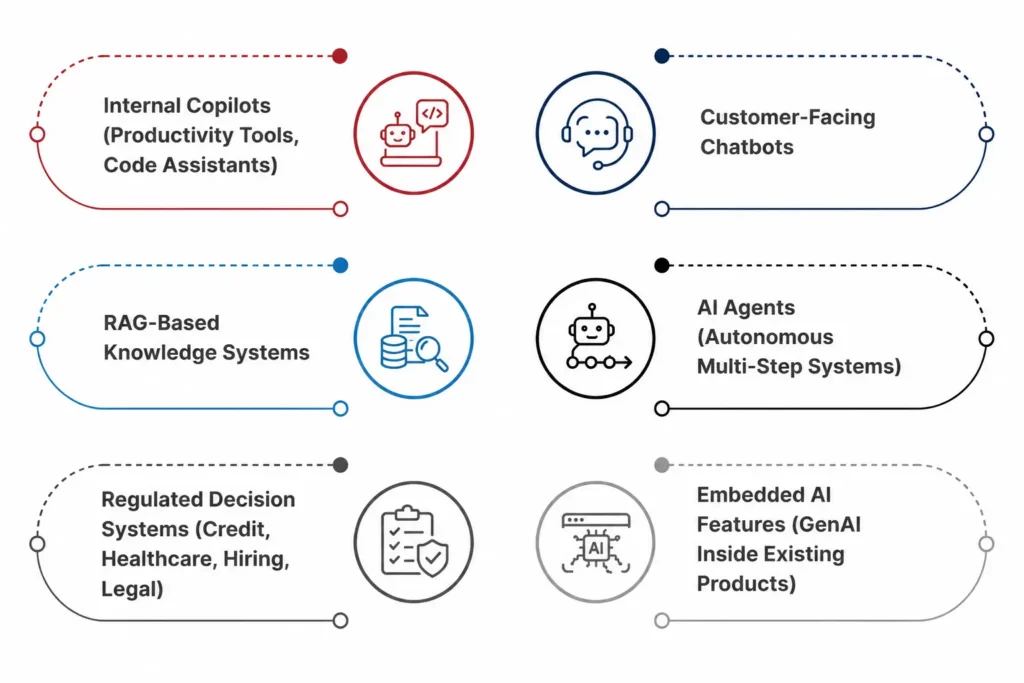
Internal Copilots (Productivity Tools, Code Assistants)
The risk profile is generally moderate. Priority assurance activities include output consistency testing, hallucination rate benchmarks, and integration security. Full red teaming and bias audits are less critical unless the tool influences performance evaluations or sensitive internal decisions.
Customer-Facing Chatbots
The risk profile is high. Outputs are customer-visible and legally attributable. Priority assurance activities include bias audits, prompt injection testing, factual accuracy benchmarking, privacy controls, and human-in-the-loop review for sensitive topics. Continuous monitoring for output drift is essential.
RAG-Based Knowledge Systems
The risk profile depends heavily on data sensitivity. Priority assurance activities include retrieval accuracy validation, access control testing, and data leakage assessments. If the knowledge base contains regulated or confidential information, security testing and data governance controls are non-negotiable.
AI Agents (Autonomous Multi-Step Systems)
The risk profile is the highest among common enterprise deployments. Agents take actions, not just generate text. Priority assurance activities include action boundary testing, rollback capability validation, adversarial scenario testing, and rigorous human-in-the-loop controls at consequential decision points.
Regulated Decision Systems (Credit, Healthcare, Hiring, Legal)
The risk profile is critical. AI regulatory compliance testing is mandatory, not optional. Priority assurance activities include bias audits with documented outcomes, explainability validation, model validation against regulatory standards, and full audit trail implementation. Red teaming and external assurance reviews are strongly advisable before go-live.
Embedded AI Features (GenAI Inside Existing Products)
The risk profile varies by feature. Priority assurance activities include regression testing of existing functionality, benchmarking output reliability, and privacy impact assessments. The integration layer often carries a hidden risk that standard AI testing misses.
How Can TestingXperts Assist with AI Assurance Services?
TestingXperts approaches AI assurance across four interconnected pillars that address the full lifecycle of enterprise GenAI deployment.
- Data Governance services validate the quality of training data, document lineage, and ensure the integrity of the retrieval pipeline. This includes bias detection in datasets before they influence model behavior.
- Data Privacy and Security testing covers prompt injection assessments, PII exposure testing, access control validation in RAG architectures, and adversarial red teaming for customer-facing and regulated deployments.
- Ethical AI Framework engagements audit model outputs for demographic bias, evaluate explainability mechanisms, and help teams produce the documentation that regulators and auditors expect.
- AI Governance Practices help enterprises build continuous monitoring pipelines, detect model drift, and enable audit-ready reporting that connects model behavior to business accountability.
These capabilities translate directly into measurable enterprise outcomes: faster go-to-market confidence, fewer model drift incidents after launch, stronger audit readiness, and reduced regulatory exposure. Contact our AI experts to learn how AI assurance services can support GenAI validation.
Conclusion
Governing AI is not the same as slowing it down. A mature AI assurance framework helps leaders move faster without accepting blind risk. It gives enterprises a shared model for GenAI validation testing, enterprise AI quality assurance, and continuous governance. The enterprises that scale GenAI well will not be the ones that move recklessly. They will be the ones who prove what they deploy, monitor what they scale, and govern what they automate. To know how TestingXperts AI assurance services can assist, contact our experts now.

VP, AI & QE Transformation
Michael Giacometti is the Vice President of AI and QE Transformation at TestingXperts. With extensive experience in AI-driven quality engineering and partnerships, he leads strategic initiatives that help enterprises enhance software quality and automation. Before joining TestingXperts, Michael held leadership roles in partnerships, AI, and digital assurance, driving innovation and business transformation at organizations like Applause, Qualitest, Cognizant, and Capgemini.
Discover more