Recommended Blogs

Why the AI Assurance Gap Is Becoming a Boardroom Risk

 Last Updated: July 14th, 2026
 Read Time: 5 minutes
Table of Content
- How AI Trust Is Becoming a Business Risk
- Why Traditional QA Cannot Fully Validate AI Systems
- The Assurance Gap Between AI Pilots and Production AI
- What AI Assurance Must Prove Before Scale
- How AI Assurance Helps Leaders Govern Enterprise AI Trust
- Conclusion
Share On


An AI assistant at a financial services firm confidently explains a policy clause that does not exist. Nothing crashed. No error was logged. The response was fluent, authoritative, and wrong, and it reached a customer before anyone inside the company knew the system could produce it.
That’s the defining characteristic of AI failure in the enterprise, which rarely announces itself. Traditional software breaks visibly, with error codes and failed transactions; however, AI systems fail plausibly, producing outputs that look correct while being subtly or seriously wrong.
As enterprises embed AI deeper into customer journeys, operations, and decision support, the AI assurance gap is becoming a boardroom concern. Leaders are no longer asking only whether AI works. They are asking whether the organization can prove it is accurate, governed, explainable, compliant, and safe to scale.
How AI Trust Is Becoming a Business Risk
During the first wave of enterprise AI adoption, the question was capability: can AI do this task? That scenario is already over. AI now drafts customer communications, routes service requests, supports credit and claims decisions, and executes multi-step workflows with growing autonomy.
Now the question is, “Can leadership trust how these systems behave at scale?” Not in a demonstration, but across millions of real interactions with real customers, live data, and regulatory consequences attached to every output. This shifts AI trust from a technology question to a leadership accountability question.
Enterprises are asking whether the AI involvement is grounded, safe, explainable, compliant, and consistent enough to influence business outcomes. McKinsey’s global AI survey found that 88% of organizations use AI in at least one business function. Yet only about one-third have begun to scale their AI programs. That gap shows that adoption is easy to start, but trust is much harder to industrialize.
The AI assurance gap is the space between AI capability and leadership confidence. It appears when organizations can build or deploy AI faster than they can prove it behaves correctly, responsibly, and reliably under real-world conditions. Organizations can build AI faster than they can prove it behaves correctly, responsibly, and reliably under real-world conditions.
Why Traditional QA Cannot Fully Validate AI Systems
Traditional QA was built for systems that behave in predictable ways. Given the same input, the system produces the same output. Write the test, define the expected result, and verify the match. Decades of quality engineering are built on that logic. However, AI systems work differently. Their outputs can shift with:
- Prompts: Minor rephrasing of the same request can produce different outputs.
- Data: The documents and records the system retrieves change daily, and its answers change with them.
- Context: The same question earns different responses depending on what preceded it in the conversation.
- Model Updates: Providers routinely update hosted models, silently changing behavior across every prompt in an application.
- User Intent: Real users phrase requests in ways no test suite anticipated, including adversarial ways.
Against this behavior, pass/fail testing remains useful but is no longer sufficient on its own. A test that passed yesterday can fail tomorrow with no code change. This is why your AI assurance strategy must include:
- Semantic evaluation
- Adversarial testing
- Data validation
- Prompt regression
- Bias checks
- Drift monitoring
- Observability
- Auditability
- Human oversight
The Assurance Gap Between AI Pilots and Production AI
The pilot proves potential. Production proves whether the enterprise can govern the risk. Many AI pilots succeed because they operate in controlled conditions. They use curated data, limited users, narrow workflows, and controlled assumptions. The pilot demonstrates potential, and the organization gains confidence. But the production environment is different. The gap opens when controlled conditions end:
| Pilot conditions | Production reality |
|---|---|
| Curated, clean datasets | Live data that is inconsistent and constantly changing |
| Limited, friendly users | Real users with unpredictable and adversarial inputs |
| Relaxed governance | Full regulatory and compliance expectations |
| Manual fixes by experts | Continuous operation without expert intervention |
| Success is measured by model accuracy | Success is measured by business outcomes |
Due to this, the AI deployment gap delays value and increases costs for organizations stuck between experimentation and execution. Gartner warned that, through 2026, organizations will abandon 60% of AI projects that lack AI-ready data. It is an assurance problem because AI cannot be trusted when its inputs, lineage, metadata, and data quality are unclear.
Now the question is, “Can the enterprise prove that an AI system will behave acceptably when customer volume rises, policy changes, data shifts, or a regulator asks for evidence?”
What AI Assurance Must Prove Before Scale
AI assurance means your AI system behaves acceptably under real conditions: before, during, and after deployment. Before scaling any system, enterprises should be able to validate proof across three groups of dimensions:
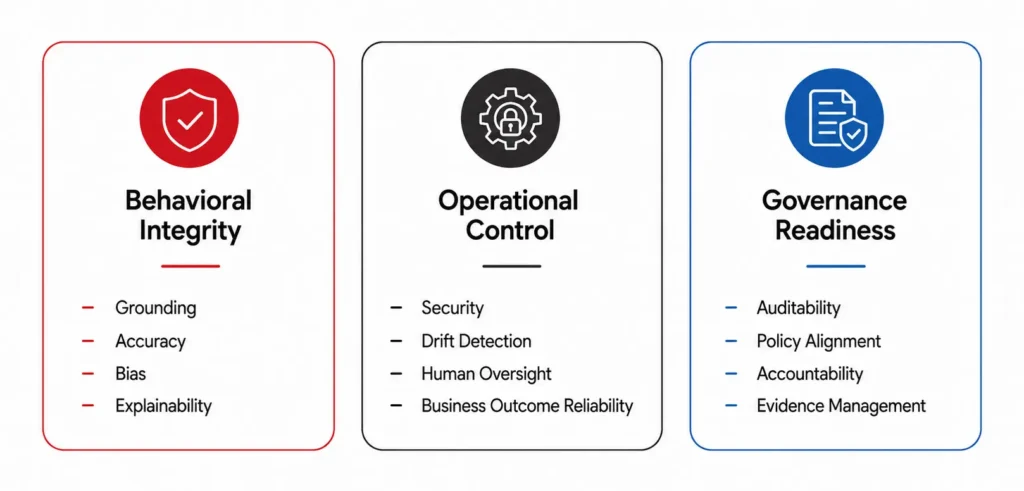
Behavioral Integrity: Does the system produce trustworthy outputs?
- Grounding: Claims are traceable to verified source content.
- Accuracy: Outputs are validated against domain truth, not only general benchmarks.
- Bias: Behavior is profiled across customer segments before disparities become decisions.
- Explainability: Outputs or decisions can be understood by the people accountable for them.
Operational Control: Does the system stay trustworthy over time?
- Security: The system resists prompt injection, adversarial manipulation, and unauthorized access.
- Drift Detection: Monitoring catches behavioral change caused by model, data, or prompt shifts.
- Human Oversight: Clear thresholds define when decisions escalate to people.
- Business Outcome Reliability: The system continues to support the intended business purpose.
Governance Readiness: Can the organization stand behind the system?
- Auditability: Outputs can be traced to inputs, model versions, prompts, data sources, and approvals.
- Policy Alignment: The system follows internal governance, privacy, security, and compliance rules.
- Accountability: Ownership is clear across product, data, security, legal, risk, and business teams.
- Evidence Management: Assurance records are maintained for review, investigation, and regulatory scrutiny.
Deloitte’s 2026 State of AI in the Enterprise report found that only one in five companies has a mature governance model for autonomous AI agents. That matters because AI assurance cannot be left only to data science or QA teams. Legal, risk, security, product, operations, and business leaders must define what acceptable AI behavior means for each use case.
How AI Assurance Helps Leaders Govern Enterprise AI Trust
AI trust will depend on evidence, not intent. A strong AI roadmap is not enough if the enterprise cannot prove that its AI systems are governed, monitored, and safe to scale.
TestingXperts helps enterprises move from AI experimentation to trusted AI operations through assurance practices that cover data, models, prompts, workflows, security, governance, and business outcomes. Our AI assurance approach focuses on four pillars:
- Data governance, quality, lineage, and readiness
- Data privacy, security, and responsible access controls
- Ethical AI validation across bias, explainability, and human oversight
- AI governance practices aligned to enterprise risk, compliance, and audit readiness
TestingXperts helps enterprises maintain model inventories, test datasets, prompt versioning, approval gates, live monitoring, and audit trails. This helps leaders scale AI more responsibly and defend AI-supported decisions when outcomes are challenged.
Conclusion
The AI assurance gap is now a business risk that affects growth, compliance, customer trust, and operational resilience. The questions that will separate responsible AI scaling from uncontrolled AI expansion are:
- Can the organization explain how its AI behaves?
- Can it validate the quality of AI outputs?
- Can it monitor model drift?
- Can it identify bias and protect sensitive data?
- Can it prove audit readiness?
- Can it control AI behavior across changing users, data, prompts, models, and workflows?
An AI assurance readiness assessment can help identify where testing, data validation, governance, monitoring, and audit evidence must mature before AI systems scale further.

VP, AI & QE Transformation
Michael Giacometti is the Vice President of AI and QE Transformation at TestingXperts. With extensive experience in AI-driven quality engineering and partnerships, he leads strategic initiatives that help enterprises enhance software quality and automation. Before joining TestingXperts, Michael held leadership roles in partnerships, AI, and digital assurance, driving innovation and business transformation at organizations like Applause, Qualitest, Cognizant, and Capgemini.
Discover more