Recommended Blogs

UiPath Document Understanding – Testing AI-Powered Document Processing at Enterprise Scale
Table of Content
- Why UiPath Document Understanding Testing Goes Beyond Traditional RPA QA?
- What Should Enterprises Validate Across the UiPath IDP Pipeline?
- Validating Classification and Extraction Accuracy in UiPath Document Understanding
- Testing Human-in-the-Loop Validation and IDP Exception Handling
- Regression Testing and Model Retraining for UiPath AI Center
- Enterprise Best Practices for UiPath Document Understanding Testing
- How Can TestingXperts Assist with UiPath Document Understanding Testing?
- Conclusion
Share On


Enterprise document workflows are no longer simple scanning and indexing tasks. They now feed finance approvals, insurance claims, customer onboarding, healthcare records, procurement workflows, and compliance reporting. UiPath Document Understanding helps enterprises process structured, semi-structured, and unstructured documents through AI-powered classification, extraction, and validation. That makes UiPath Document Understanding testing more important.
A wrong extraction can move bad data into ERP, CRM, claims, billing, or case management systems. The intelligent document processing market was estimated at $2.30 billion in 2024 and is expected to reach $12.35 billion by 2030, according to Grand View Research. This growth signals a clear enterprise shift toward AI-led document automation, but scale also increases the risk of quality issues.
Why UiPath Document Understanding Testing Goes Beyond Traditional RPA QA?
Traditional RPA testing validates predictable workflows. A bot clicks, copies, checks, submits, or updates a system based on defined rules. UiPath Document Understanding testing is different because the pipeline includes AI interpretation.
The testing scope must cover document ingestion, OCR quality, classification results, extracted fields, confidence levels, human review, and downstream RPA execution. UiPath’s Validation Station enables users to review and correct document classification and automatic extraction results, which makes human validation part of the quality model. RPA document processing QA must therefore test both the bot and the document intelligence layer. The real goal is trusted data movement across enterprise systems.
What Should Enterprises Validate Across the UiPath IDP Pipeline?
Testing the UiPath IDP pipeline at enterprise scale requires a full lifecycle view. Each stage can introduce defects that affect business outcomes.
Document Ingestion and Format Readiness
Enterprises should test PDFs, scans, images, emails, attachments, handwritten content, and multi-page documents. They should also validate file sizes, format rules, naming conventions, and the presence of corrupted files and duplicate submissions.
OCR and Pre-Processing Validation
OCR errors can weaken every stage that follows. Test teams should validate image quality, rotation, page order, missing pages, language handling, and field readability.
Classification Accuracy
Document classification model validation checks whether the right document type is identified. This is critical when invoices, purchase orders, claims, tax forms, and identity documents are routed through the same queue.
Extraction Accuracy
Extraction testing verifies that the correct values are captured from the appropriate locations. This includes invoice totals, dates, customer IDs, tax fields, policy numbers, address data, signatures, and table values.
Downstream RPA and Integration Testing
A document pipeline does not end after extraction. QA Team must validate the handoff into ERP, CRM, workflow engines, case tools, and reporting systems.
Validating Classification and Extraction Accuracy in UiPath Document Understanding
UiPath AI document extraction accuracy validation should be measured at the field, document, and process levels. A document may pass at the overall level while still failing on a critical field. For example,
- A wrong invoice total creates financial risk.
- A wrong policy number can delay claims.
- An incorrect customer identifier can cause duplicate records.
These are not small data defects. They are business process failures. UiPath states that its machine learning packages can classify and extract commonly occurring data points from semi-structured or unstructured documents. This includes regular fields, table columns, and classification fields.
Enterprises should validate extraction across structured, semi-structured, and unstructured document sets. Test coverage should include clean documents, low-quality scans, new vendor formats, missing fields, multi-line tables, and unexpected labels.
Accuracy testing should track false positives, false negatives, confidence thresholds, exception rates, and manual correction rates. These metrics help leaders determine whether the IDP pipeline is ready for production-scale deployment.
Testing Human-in-the-Loop Validation and IDP Exception Handling
Human-in-the-loop validation IDP exception handling is not a backup process. It is a core control layer for AI-powered document workflows.
UiPath documentation explains that data extraction validation includes a human review step where knowledge workers can review automatically extracted results and correct them when needed.
Testing must verify reviewer queues, task assignment, correction flows, approval paths, audit logs, and return-to-workflow logic. It should also test low-confidence documents, unreadable scans, missing values, conflicting fields, and duplicate submissions.
Confidence scores need careful handling. UiPath notes that OCR confidence comes from the OCR engine, extraction confidence comes from the extractor, and confidence scores should be used only for guidance. Testing must confirm whether thresholds route documents correctly and whether exceptions reach human reviewers before downstream systems are affected.
Regression Testing and Model Retraining for UiPath AI Center
UiPath AI Center model retraining and testing are essential for long-term IDP reliability. Models may improve after retraining, but they can also change behavior in ways that affect existing document types.
UiPath documentation states that documents validated in Validation Station can be used to improve model performance through retraining. This creates a feedback loop between human correction and model improvement.
Regression testing should compare outputs before and after model changes. Test teams should validate whether retraining improves target fields without reducing accuracy in established document groups.
UiPath’s May 2026 Document Understanding release notes mention a changes counter for annotations or classifications since the last training. They also state that schema or base model changes no longer automatically trigger training, giving users control over when to start a new run.
This makes governance important. Enterprises should test model retraining workflows, approval rules, rollback readiness, version tracking, and production impact before releasing updated models.
Enterprise Best Practices for UiPath Document Understanding Testing
A scalable IDP quality strategy needs more than test cases. It needs governance, data discipline, and process-level ownership.
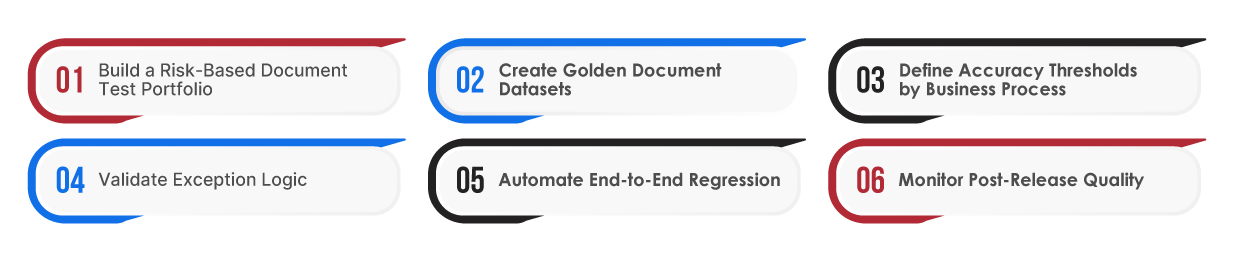
Build a Risk-Based Document Test Portfolio
Prioritize documents by business impact. Claims, invoices, identity records, contracts, and compliance forms typically require more thorough validation than low-risk internal forms.
Create Golden Document Datasets
Maintain approved test datasets for each document type. Include clean, complex, incomplete, and edge-case samples. These datasets become the baseline for regression.
Define Accuracy Thresholds by Business Process
Not every field carries equal risk. A payment amount, policy ID, or patient identifier should have stricter thresholds than a non-critical note field.
Validate Exception Logic
Test what happens when AI confidence drops, required fields are missing, or values conflict. Exception routing must be predictable and auditable.
Automate End-to-End Regression
End-to-end IDP pipeline regression testing should cover ingestion, classification, extraction, human validation, RPA handoff, and final system update.
Monitor Post-Release Quality
Production monitoring should track extraction accuracy, correction rates, exception volume, processing time, and downstream defect trends.
How Can TestingXperts Assist with UiPath Document Understanding Testing?
TestingXperts helps enterprises validate UiPath Document Understanding through AI-led Quality Engineering. Our approach covers the full IDP lifecycle across AI models, RPA workflows, integrations, and human validation. We support intelligent document processing testing through test strategy, document test data design, classification validation, extraction accuracy checks, exception testing, and regression planning. The focus is on business reliability, not only automation pass rates.
Our teams help validate structured and unstructured document extraction testing across enterprise scenarios. This includes edge cases, poor-quality inputs, new templates, multi-system handoffs, and controlled retraining cycles. TestingXperts also helps enterprises build quality governance for UiPath IDP adoption. This includes accuracy benchmarks, release readiness metrics, model change controls, and executive reporting. The outcome is a document automation pipeline that can scale with confidence.
Conclusion
UiPath Document Understanding testing is essential for enterprises that depend on AI-powered document processing. It validates whether classification, extraction, human review, retraining, and downstream automation work as expected.
At enterprise scale, IDP quality is not only a technology concern. It protects process accuracy, compliance confidence, operational speed, and customer trust. Organizations that test the full UiPath IDP pipeline can reduce rework, manage AI risk, and accelerate document-heavy operations with greater release confidence.


Michael Giacometti
VP, AI & QE Transformation
Michael Giacometti is the Vice President of AI and QE Transformation at TestingXperts. With extensive experience in AI-driven quality engineering and partnerships, he leads strategic initiatives that help enterprises enhance software quality and automation. Before joining TestingXperts, Michael held leadership roles in partnerships, AI, and digital assurance, driving innovation and business transformation at organizations like Applause, Qualitest, Cognizant, and Capgemini.
Discover more