

Recommended Blogs

SAP Automation Testing: Build Confidence into Every Release
Table of Content
- What Does SAP Automation Testing Offer?
- Where SAP Automation Testing Breaks Down and Why
- Selecting the Right SAP Test Automation Framework
- Automated SAP Testing Best Practices That Actually Scale
- Continuous Testing in SAP: Embed Quality in the S/4HANA Lifecycle
- How Can TestingXperts Assist with SAP Automation Testing?
- Conclusion
Share On


The enterprise SAP landscape is no longer just an ERP backbone. It has become an operating system connecting finance, procurement, supply chain, manufacturing, HR, customer experience, and analytics. SAP also confirmed that its ECC system will be out of mainstream support in 2027, meaning enterprises that haven’t yet moved to SAP S/4HANA Automation Testing are behind the times and at risk.
But migration isn’t the only pressure. SAP explains in its Hannover Messe 2026 roadmap that AI agents are now working directly in transactional workflows. This means your testing strategy must validate not only deterministic transactions but also AI-driven decisions. Manual testing alone can’t keep up with S/4HANA’s release velocity. Enterprises that invest in SAP Automation Testing will release with confidence in every upgrade cycle.
What Does SAP Automation Testing Offer?
Testing is often treated as an IT topic in the boardroom. However, the benefits of SAP test automation for large organizations aren’t limited to faster testing. It’s also a risk management and cost-reduction lever. As per TestingXperts client engagement data, an automation-first approach delivers these results for enterprises:
- Production errors are reduced, which strengthens both audit readiness and compliance.
- Test scripts, once created, are used in every subsequent release cycle, thereby compounding ROI.
- The time previously spent on repetitive script execution is now devoted to strategic test design.
One important point: The real KPI of SAP Automation Testing is business confidence. Can you claim after any release that the order-to-cash, procure-to-pay, and financial close processes are running as they should? That’s the question automation answers.
Where SAP Automation Testing Breaks Down and Why
Many SAP automation programs launch but fail to sustain. The reasons are structural, not technical. To understand the challenges in SAP automation testing and solutions, look at the following common failure modes:
Brittle Scripts and Maintenance Burden
Every time SAP’s UI changes quarterly, manually maintained test scripts break. Teams then waste time rewriting scripts instead of actually testing. This is where self-healing automation adds the most value.
Complexity of Custom Code
Large enterprises have accumulated years of customizations, integrations, and workarounds in their SAP environment. Standard automation tools don’t immediately recognize these custom objects. Expertise at both the ABAP and Fiori layers is required.
Test Data Management – The Hidden Blocker
Creating realistic, compliant test data, especially in light of GDPR and other data privacy obligations, is a full-time strategic effort. Without the right test data, automation can’t test the right scenarios. This gap results in unexpected failures in production.
Cross-Module Dependencies
In SAP, a small change in one module can quietly impact another. A pricing update in Finance can affect both billing and reporting. Isolated transaction testing doesn’t catch this. Only end-to-end business process testing does.
The Gap Between SAP Knowledge and Automation Expertise
This is one of the biggest practical challenges. It’s rare to have simultaneous expertise in both SAP functional knowledge and automation engineering. Teams often lack one skill set, leading to coverage gaps and execution delays.
Selecting the Right SAP Test Automation Framework
Not all SAP environments are the same, so there’s no one-size-fits-all framework. Here’s a practical decision framework:
SAP Native Test Automation Tool (Cloud ALM)
This is SAP’s built-in solution for SAP S/4HANA Automation Testing, bundled with the S/4HANA Public Cloud Edition. Pre-built test automations are delivered, and post-upgrade tests are automatically triggered. It is ideal for enterprises that largely adopt standard SAP Best Practices and have minimal customizations. If you are in a pure SaaS model, this should be the starting point.
Third-Party Platforms like Tricentis Tosca
In complex environments where migration from ECC to S/4HANA is underway, and there are extensive customizations, third-party platforms offer greater flexibility. These platforms work across all layers of ABAP, Fiori, and SAP BTP and support CI/CD integration. This is a strong choice for enterprises that maintain high levels of customization and manage frequent releases.
Hybrid Approach
Most large enterprises move toward a hybrid model, i.e., SAP-native tools for post-upgrade validation and third-party tools for custom process testing. TestingXperts’ approach is an advanced version of this model, where service virtualization simulates third-party integrations and EDI/B2B partners, so testing doesn’t rely solely on complex live environments.
Automated SAP Testing Best Practices That Actually Scale
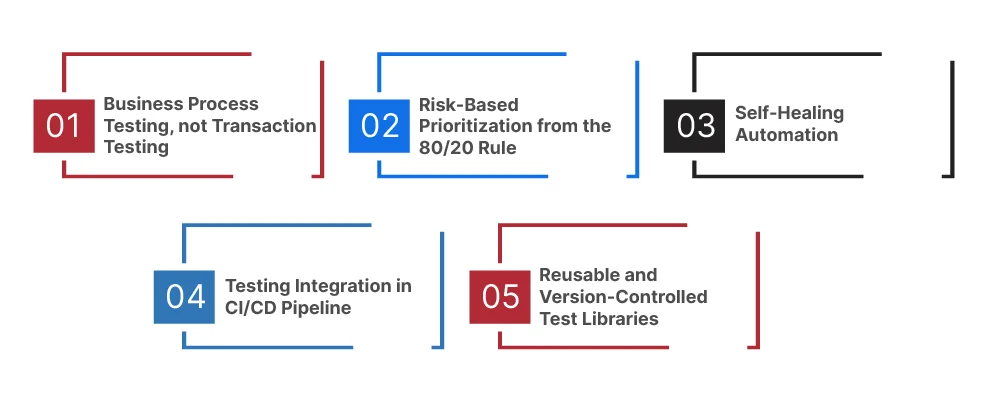 Automated SAP Testing best practices aren’t what’s in the books. They’re what survives in production. Here are the principles that sustain programs.
Business Process Testing, not Transaction Testing
Testing a single transaction gives you a limited picture. Testing a complete business process, such as order-to-cash, ensures the system operates as the business requires. This shift to S/4HANA is non-negotiable.
Risk-Based Prioritization from the 80/20 Rule
Not every process can be tested equally. Identify the 20% of business processes that represent 80% of business value or risk. Critical processes such as finance close, order management, and procurement should receive the most thorough coverage.
Self-Healing Automation
With quarterly SAP releases, scripts that can’t automatically adapt to UI changes become a burden. AI-driven self-healing mechanisms automatically update test assets during change cycles, dramatically reducing maintenance overhead.
Testing Integration in CI/CD Pipeline
Continuous Testing in SAP means that testing isn’t a go-live milestone. It’s a continuous part of the development process. Integrating SAP development, testing, and operations into a unified CI/CD pipeline catches issues early, not at the end of the release cycle.
Reusable and Version-Controlled Test Libraries
Creating test cases from scratch for every SAP release cycle is inefficient. Modular, reusable test assets, designed for ABAP, Fiori, and SAP BTP, are a long-term strategic investment. These assets enable faster and less risky execution with each subsequent upgrade.
Continuous Testing in SAP: Embed Quality in the S/4HANA Lifecycle
The model was old, so test it before release. The model is new, so test it with every change. This shift is the foundation of Continuous Testing in SAP and is the approach that delivers sustainable quality in modern SAP landscapes.
Testing should be embedded in every phase of the SAP Activate methodology:
- Explore testing tools and understand standard test automation in the Explore Phase.
- As configuration progresses in the Realize Phase, run implementation tests and UAT progressively.
- Automatically trigger post-upgrade regression tests in the Run Phase — this is the customer’s responsibility, and the SAP S/4HANA Automation Testing tool largely automates it.
Agentic AI also has a new dimension in 2026. SAP is now deploying its AI agents in the execution layer. The practical implication is that the SAP Test Automation Framework will also need to validate that AI-driven decisions, such as automated order approvals or predictive maintenance triggers, are functioning correctly in accordance with business rules.
How Can TestingXperts Assist with SAP Automation Testing?
With over 15 years of SAP testing experience and a global delivery footprint, TestingXperts is the preferred partner for the enterprises who are actively looking for SAP testing services to scale their business. TestingXperts is recognized as a Leader in both Gartner’s 2025 Market Guide for Application Testing Services and Everest Group’s Quality Engineering PEAK Matrix®.
Our SAP testing capabilities are built on these key pillars:
QXcel: AI-Powered Test Asset Management
QXcel is TestingXperts’ proprietary platform that automatically updates test assets during change cycles. It solves the problem of brittle scripts at the root. Modular, reusable test assets are generated for ABAP, Fiori, and SAP BTP, becoming smarter with each release.
S2S (Simulate to Simplify) Approach
End-to-end testing sometimes slows down the SAP Automation Testing journey because it requires continuous availability of all test scenarios and third-party systems. TestingXperts’ S2S approach simulates third-party integrations and EDI/B2B partners through service virtualization, enabling independent, faster testing without chaotic dependencies.
AI-Driven Regression Packs for S/4HANA Migrations
TestingXperts has developed AI-powered regression packs for SAP S/4HANA migrations, optimized for S/4HANA-specific scenarios. These packs cover everything from data migration validation to cross-module dependency testing and Fiori UX validation.
CI/CD Integration and Continuous Quality Pipeline
TestingXperts integrates SAP development, testing, and operations into a unified CI/CD pipeline. Real-time monitoring, CrewAI-driven anomaly detection, and AIOps together ensure ongoing reliability even after an SAP migration or deployment.
Risk-Based Financial and Compliance Testing
Financial accuracy and audit readiness are cornerstones of enterprise SAP. TestingXperts applies risk-based regression, reconciliation checks, and role validation to ensure compliant financial processes during upgrades.
Conclusion
SAP Automation Testing is no longer a tactical QA initiative. It has become a core capability of SAP modernization, release governance, and enterprise resilience. The right approach includes business risk mapping before selecting a tool. This is followed by framework design, test data readiness, process ownership, CI/CD integration, and measurable reporting. When automation connects to all these layers, every release transforms from guesswork to confidence.
Enterprises that want to transition to SAP faster shouldn’t make quality the release gate. They should make quality the delivery engine. This is the real business value of mature SAP automation. To know how TestingXperts can assist, contact our SAP testing experts now.


Manjeet Kumar
VP, Delivery Quality Engineering
Manjeet Kumar, Vice President at TestingXperts, is a results-driven leader with 19 years of experience in Quality Engineering. Prior to TestingXperts, Manjeet worked with leading brands like HCL Technologies and BirlaSoft. He ensures clients receive best-in-class QA services by optimizing testing strategies, enhancing efficiency, and driving innovation. His passion for building high-performing teams and delivering value-driven solutions empowers businesses to achieve excellence in the evolving digital landscape.
FAQs
Why is automated testing essential for SAP releases in enterprise environments?
Automated testing is essential because SAP changes often affect connected finance, procurement, supply chain, HR, and reporting processes. Manual testing cannot reliably address S/4HANA release velocity, cross-module dependencies, or recurring regressions. Automation helps validate critical workflows such as order-to-cash, procure-to-pay, and financial close before production release.
What are the SAP automation testing best practices that reduce production defects?
- Test complete business processes, not isolated transactions
- Prioritize high-risk workflows such as financial close, order management, and procurement
- Use self-healing automation to reduce script maintenance after SAP UI changes
- Build reusable, version-controlled test libraries
- Integrate testing into CI/CD so defects are found earlier, not at the release end
How does AI improve SAP automation testing outcomes compared to traditional script-based automation?
AI improves SAP automation by reducing the maintenance burden that comes with brittle scripts. Self-healing capabilities can adjust test assets during UI or workflow changes. At the same time, AI-driven regression packs help prioritize scenarios tied to S/4HANA migrations, cross-module dependencies, data validation, and Fiori UX coverage more effectively than static scripts.
How does TestingXperts help enterprises build release confidence into every SAP deployment?
TestingXperts supports SAP release confidence through AI-powered test asset management, service virtualization, S/4HANA regression packs, CI/CD integration, and risk-based financial and compliance testing. Its approach covers ABAP, Fiori, SAP BTP, third-party integrations, EDI/B2B partners, data migration validation, and cross-module dependencies that commonly drive production defects.
Discover more