Get in Touch
⌃

Why AI Agents Need Trusted Data Products Before They Scale

 Last Updated: July 23rd, 2026
 Read Time: 5 minutes
Table of Content
- AI Agents Are Exposing the Limits of Fragmented Enterprise Data
- Why Traditional Data Management Is Not Enough for Agentic AI
- From Data Assets to Trusted Data Products
- What Makes a Data Product AI-Ready
- Why Data Product Assurance Must Come Before AI Agent Scale
- Conclusion
Share On


AI agents are moving quickly from experimentation to enterprise roadmaps, but most organizations are still struggling to scale them into measurable business value. The problem is rarely the model alone.
McKinsey’s 2026 research found that nearly two-thirds of enterprises have experimented with AI agents, but fewer than 10% have scaled them to deliver tangible value. The same research notes that eight in ten companies cite data limitations as a roadblock to scaling agentic AI.
That is the quiet problem behind many agentic AI programs. Agents may be capable, but enterprise data is often not ready for the decisions and actions agents are expected to support. Before scaling AI agents, enterprises need trusted data products that combine content, context, quality, lineage, access control, and governance. Agents cannot reason reliably over unclear definitions, duplicate records, outdated knowledge, broken lineage, or inconsistent access rules.
AI Agents Are Exposing the Limits of Fragmented Enterprise Data
AI agents and copilots do far more than answer simple questions. They retrieve information, reason through it, make recommendations, and increasingly take action. Every one of those steps depends on the data underneath them. When that data is reliable, agents perform well. When it is fragmented, cracks appear quickly.
Most enterprises still run on data spread across disconnected systems. The same business term often means different things in different places. Most enterprises still run on data spread across many disconnected systems. The same term often means different things in different places.
- One system defines a customer one way; another defines it differently.
- Ownership is unclear, so no team is accountable for keeping the data correct.
- Knowledge is duplicated across documents, applications, and repositories.
- Access rules vary by system, creating inconsistent permissions for agents.
An agent working across those systems cannot resolve that conflict without business context. The same McKinsey research noted that data limitations were a major barrier to scale. Agentic AI cannot be trusted when the data foundation remains fragmented. If an agent retrieves the wrong customer record, applies the wrong business definition, or trusts an outdated document, the output may still appear confident. That is the risk enterprise leaders need to manage: AI agents can turn weak data into fast, plausible, and operationally expensive decisions.
Why Traditional Data Management Is Not Enough for Agentic AI
Traditional data management was built for reporting, analytics, and controlled enterprise processes. Those requirements still matter, but AI agents are creating a different operating challenge. An agent may need to combine structured data, unstructured content, business rules, policy documents, and real-time signals. It may also need to coordinate with other tools and agents across a workflow.
Agentic AI needs stronger data architecture, access control, lineage, traceability, and automated governance. Traditional pipelines can support individual reporting or analytics use cases. On their own, they do not create the enterprise-wide trust needed for agentic workflows that retrieve, reason, recommend, and act.
| Traditional Data Need | Agentic AI Data Need |
|---|---|
| Data for reports | Data for decisions and actions |
| Source-system accuracy | Business context and semantic consistency |
| Periodic quality checks | Continuous quality monitoring |
| Department-level ownership | Product-level ownership and accountability |
| Controlled consumption | Governed access for agents and copilots |
| Historical visibility | Real-time relevance and traceability |
From Data Assets to Trusted Data Products
A data asset may be a table, file, dashboard, dataset, or repository. It may be valuable, but it does not always carry the business meaning, ownership, quality rules, lineage, and access controls that AI agents need. A data product adds purpose, ownership, metadata, quality standards, access rules, lineage, defined users, and measurable service expectations.
Google Cloud describes data products as containers that package data, semantics, and governance together. It also positions data products as a foundation for making AI agents reliable enough for production use. The difference between these two mindsets is significant in practice.
| Data as a scattered asset | Data as a trusted product |
|---|---|
| Collected and stored without a clear owner | Owned by a team accountable for its quality |
| Defined differently across systems | Built on one shared, consistent definition |
| Reused rarely and rebuilt for each project | Designed once and reused across many workflows |
| Checked for quality occasionally | Governed by clear and continuous quality rules |
| Hard for agents to find or interpret | Documented and accessible for agents to use |
A trusted data product should answer basic business questions:
- Who owns this data?
- What decision does it support?
- How fresh does it need to be?
- Which systems does it depend on?
- Which rules define its meaning?
- Which users or agents can access it?
- How is quality measured and monitored?
This is the foundation that agentic AI actually needs. Without trusted data products, AI agents become fast consumers of weak enterprise data.
What Makes a Data Product AI-Ready
An AI-ready data product must be accurate, complete, current, governed, traceable, and easy for agents to use within approved boundaries. Before an agent relies on a data product, leaders should be able to confirm the following:
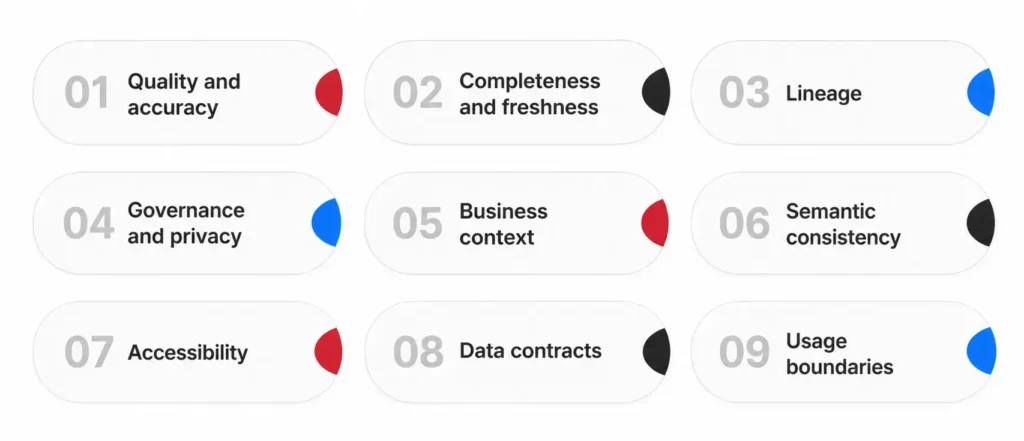
- Quality and accuracy: The data is correct and verified against trusted sources.
- Completeness and freshness: Important fields are filled, and the data stays current.
- Lineage: Every value can be traced back to its source.
- Governance and privacy: Access is controlled, and sensitive data is protected.
- Business context: The data carries the meaning agents need to use it correctly.
- Semantic consistency: The same terms mean the same thing across every system.
- Accessibility: Agents and copilots can reach the data through stable connections.
- Data contracts: Expectations for schema, freshness, quality, access, and usage are clearly defined.
- Usage boundaries: Agents know which actions, decisions, and data uses are permitted.
Enterprises have data lakes, warehouses, catalogs, reports, and governance policies, yet agents still struggle because the data is not packaged around business use and trusted consumption. AI-ready data products turn enterprise data from a passive resource into a reliable operating input.
Why Data Product Assurance Must Come Before AI Agent Scale
An AI agent can only be as reliable as the data it uses. If that data is incomplete, inconsistent, poorly governed, or untested, the agent can create risk at business speed. Enterprises should not scale AI agents before validating the data products behind them. Data product assurance helps confirm that the data feeding agent is accurate, governed, traceable, accessible, and fit for real decisions.
TestingXperts supports this readiness through data quality management and testing services that validate the data foundation behind AI agents. Our capabilities include:
- Data quality validation across pipelines, repositories, and target systems
- Automated lineage and reconciliation checks
- Validation rules for completeness, accuracy, freshness, and consistency
- Compliance monitoring and governance checks
- AI-based testing for data patterns, anomalies, and risk signals
- Data annotation and test data preparation where required
- Security, privacy, and threat validation for sensitive data use
We also validate the pipelines that move and transform data across systems, assure reports and dashboards used by decision teams, and assess whether enterprise data is genuinely ready for AI and agentic workflows. Paired with agentic AI services, this helps enterprises scale trusted agents on a tested data foundation, not an assumed one.
Conclusion
AI agents will not scale on fragmented or untrusted data. No model, however capable, can compensate for a weak data foundation. The enterprises that move faster with AI will be the ones whose data is reusable, governed, accessible, traceable, and continuously assured. The real work ahead is not only acquiring new AI capabilities. It is earning trust in the data those capabilities depend on. Trusted data products give enterprises a stronger foundation for scaling AI agents with confidence. They help turn scattered data into governed, reusable, and agent-ready inputs for enterprise decisions and workflows.

VP and Global Head Data & AI Practice
Results-oriented Data Analytics & AI Specialist with 24+ years of experience in multiple roles, including Practice Leader with P&L ownership. Expert in building Data Analytics practices, defining market strategies, and leading large-scale transformation initiatives. Skilled in Business Intelligence, Data Engineering, Cloud platforms (Azure, AWS, GCP), AI/ML, and Data Governance, with a strong focus on customer-centric solutions and strategic alliances.
Discover more