Recommended Blogs

What Makes a Software Release Truly Ready for Production?

 Last Updated: May 21st, 2026
 Read Time: 4 minutes
Table of Content
- Production Readiness Goes Beyond Functional Testing
- Why Production Readiness Has Become More Difficult
- The Shift Towards Release Confidence
- What Enterprises Should Evaluate Before Every Release
- Release Confidence as a Business Capability
- How TestingXperts Supports Production Readiness
- Conclusion
Share On


Software releases move faster than ever, but release speed alone does not guarantee production readiness. An application may pass functional testing and still create performance issues, integration failures, security risks, or operational disruption once real users interact with it.
Modern enterprise systems are highly distributed, connected across APIs, cloud environments, third-party platforms, and business-critical workflows. As delivery cycles accelerate, determining whether software is truly ready for production becomes far more complex than validating test execution results.
Production readiness is no longer just a technical checkpoint. It is a business decision backed by operational evidence, risk visibility, and release confidence.
Production Readiness Goes Beyond Functional Testing
Many organizations still associate release readiness with passing regression tests or resolving critical defects. While those signals remain important, they represent only one part of the picture of production readiness.
A release can appear stable in test environments while carrying hidden operational risks. Performance bottlenecks may emerge under real transaction volumes. Downstream integrations may behave differently in production. Security controls, data dependencies, or infrastructure configurations may introduce issues that were not visible earlier in the lifecycle.
This is why modern enterprises evaluate production readiness across multiple dimensions, including:
- Application stability and performance
- Critical business workflow coverage
- Security and compliance validation
- Infrastructure and environment readiness
- API and integration reliability
- Deployment and rollback preparedness
- Observability and monitoring readiness
The objective is not to eliminate every possible risk. The objective is to understand whether the remaining risks are visible, measurable, and acceptable before software reaches users.
Why Production Readiness Has Become More Difficult
Production environments have become significantly more dynamic over the last few years. Cloud-native architectures, microservices, AI-enabled systems, and continuous delivery pipelines have increased both release frequency and system complexity.
In many enterprises, a single release may affect multiple interconnected systems across business units, regions, or customer-facing channels. Even small changes can create unexpected operational impact when dependencies are not fully understood.
At the same time, release approvals often rely on fragmented information spread across testing dashboards, monitoring tools, deployment reports, and manual status updates. Teams may have visibility into individual quality signals but lack a unified view of overall release risk.
This creates a common enterprise challenge. Organizations can release software quickly, but they struggle to determine whether a release is genuinely ready for production use.
The Shift Towards Release Confidence
To address this challenge, enterprises are moving beyond isolated testing activities toward structured release confidence models.
Release confidence focuses on assessing production readiness using evidence collected throughout the software delivery lifecycle. Instead of treating release decisions as last-minute approvals, teams continuously evaluate operational stability, testing outcomes, deployment risks, and business impact before software goes live.
This approach brings together insights from quality engineering, automation, performance testing, security validation, observability, and operational governance into a more unified readiness assessment process.
The shift matters because modern software delivery depends as much on decision quality as delivery speed. A faster pipeline loses value if organizations cannot confidently determine whether software is safe to release.
What Enterprises Should Evaluate Before Every Release
Production readiness assessments typically focus on a set of measurable release indicators. These signals help teams determine whether the application performs reliably in real-world conditions.
Some of the most important indicators include:
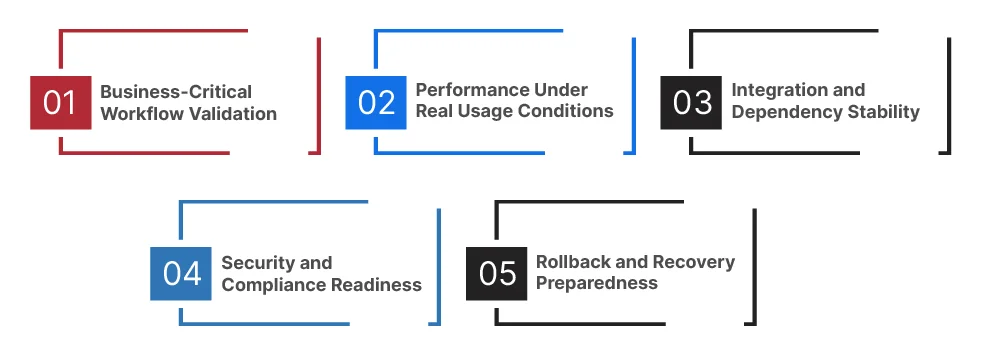
Business-Critical Workflow Validation
Testing should prioritize user journeys that directly affect customer experience, revenue, and operations. Passing low-impact scenarios provides limited value if core workflows remain unstable.
Performance Under Real Usage Conditions
Applications should be validated against realistic traffic patterns, transaction loads, and scaling conditions to identify performance bottlenecks before deployment.
Integration and Dependency Stability
Modern systems depend heavily on APIs, third-party services, and interconnected platforms. Teams must assess whether integrations behave consistently across production-like environments.
Security and Compliance Readiness
Security validation should be integrated into release readiness rather than treated as a separate activity. Enterprises also need evidence for auditability and compliance reporting.
Rollback and Recovery Preparedness
Production readiness includes the ability to recover quickly if issues emerge after deployment. Rollback strategies, monitoring visibility, and incident response readiness all contribute to release confidence.
Release Confidence as a Business Capability
Production readiness is increasingly becoming a strategic business capability rather than a purely technical process.
Organizations that build structured release confidence practices gain clearer visibility into deployment risks, stronger operational resilience, and more predictable release outcomes. Teams spend less time relying on assumptions or fragmented approvals and more time making evidence-driven release decisions.
This is where Release Confidence as a Service (RCaaS) is gaining attention. RCaaS helps enterprises assess production readiness by leveraging continuous quality signals, operational insights, and risk-based governance models throughout the delivery lifecycle.
As software becomes more central to customer experience and business operations, enterprises need more than faster deployments. They need confidence that the software will perform reliably once it reaches production.
How TestingXperts Supports Production Readiness
TestingXperts helps enterprises strengthen production readiness through quality engineering, continuous testing, performance validation, security assurance, and AI-led quality intelligence. By combining release governance with operational risk visibility, TestingXperts enables organizations to make more informed release decisions across complex software delivery environments.
Its approach focuses on evaluating business-critical workflows, deployment risks, integration stability, and real-world reliability before software reaches production. This helps enterprises improve release predictability, operational resilience, and customer experience across modern digital platforms.
Conclusion
A software release is not truly ready for production because testing is complete. It is ready when organizations have sufficient evidence to understand operational risks, validate business-critical workflows, and assess real-world reliability before users are affected.
As enterprise systems become more complex, production readiness requires a broader view of quality, stability, security, and operational resilience. Release confidence helps organizations move from assumption-based approvals to evidence-driven release decisions.
Enterprises that strengthen production readiness practices are better positioned to deliver software with greater predictability, customer trust, and operational confidence.

VP, AI & QE Transformation
Michael Giacometti is the Vice President of AI and QE Transformation at TestingXperts. With extensive experience in AI-driven quality engineering and partnerships, he leads strategic initiatives that help enterprises enhance software quality and automation. Before joining TestingXperts, Michael held leadership roles in partnerships, AI, and digital assurance, driving innovation and business transformation at organizations like Applause, Qualitest, Cognizant, and Capgemini.
Discover more