The QA for enterprises is rapidly evolving. In an era of multi‑agent systems (MAS), the autonomous, collaborative AI agents are rewriting the rules of QA. Despite this shift, many QA teams continue to rely on traditional automation: which consists of rigid scripts, brittle frameworks, and linear workflows. These methods struggle with scale, adaptivity, and contextual decision-making. As a result, the enterprises face the missed defects, slow-release cycles, and fractured team morale.
MAS address these challenges by dividing tasks, coordinating actions, and adapting in real time to tackle the complexity that linear automation simply can’t handle. It frees teams to focus on strategy and insight rather than brittle execution.
What Are Multi-Agent Systems and Why Do They Matter?
Multi-agent systems consist of autonomous agents, the self-directed entities that study their environment, make decisions, and interact with other agents to achieve shared goals. These agents are already executing test cases, analyzing results, and coordinating adaptive quality assurance (QA) strategies in real-world systems. What sets MAS apart is its ability to replicate real-world problem-solving. Think of each agent as a specialist. Some focus on UI validation, some on API health, while others coordinate workflows. This modular, decentralized approach drives three critical advantages:
Agents make decisions without constant oversight, enabling faster, 24/7 test operations.
Agents share data and insights dynamically, making testing systems smarter and more resilient.
MAS adapts to changing codebases, environments, or test priorities in real time.
In practical QA settings, MAS can cover the full lifecycle: an agent reads requirements, another generates test cases, and others execute and monitor results. Instead of managing scripts and silos, teams orchestrate intelligent systems, and test automation becomes adaptive, collaborative, and radically scalable.
Traditional Test Automation Challenges
Test automation was once known for faster releases, fewer bugs, and consistent outcomes. But in practice, many organizations have hit a wall. While popular, tools like Selenium and Cypress introduced a new complexity.
Instead of accelerating delivery, test automation often became a maintenance bottleneck. Scripts needed constant updates, and a minor UI tweak could break dozens of tests. QA engineers found themselves spending more time fixing automation than writing new tests.
Key pain points include:
Static locators and brittle test flows cause frequent failures when applications evolve even slightly.
As suites grow, so do execution times. Long-running tests delay development, especially in CI/CD pipelines.
Managing large suites, diverse environments, and datasets becomes unwieldy over time.
Writing and maintaining scripts demands coding expertise, which not every tester has.
Studies show QA teams can spend up to 50% of their time maintaining existing tests rather than focusing on quality improvements.
Despite their benefits, these traditional frameworks can’t keep up with today’s rapid development cycles. As software complexity grows, the limitations of linear and static automation become more apparent.
Core Principles and Capabilities of Multi-Agent Systems
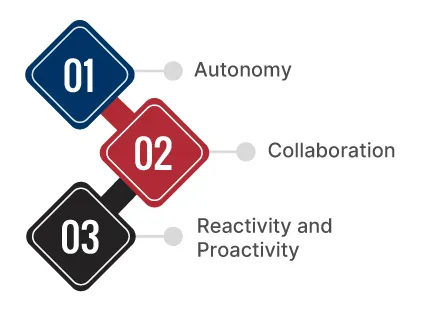
What makes Multi-Agent Systems (MAS) more than just another tech innovation in QA is not the technology alone, but the principles behind it. Traditional automation relies on rigid rules, while MAS thrives on independence, adaptability, and collaboration.
Autonomy:
Each agent in the system acts without waiting for step-by-step instructions. Consider a regression test agent scanning for code changes at night while another monitors API health in parallel. Both operate independently yet contribute to the same quality goal.
Collaboration:
In legacy test suites, scripts don’t “talk” to each other. MAS, on the other hand, exchanges data in real time. If a UI agent detects a broken workflow, it can alert a backend agent to probe for related API failures. This web-like cooperation ensures broader coverage with fewer blind spots.
Reactivity and Proactivity:
Agents don’t just react to changes; they anticipate them. For example, when a requirement is updated in Jira, a proactive agent can draft new test scenarios automatically, while a reactive one adapts running tests to reflect the change.
Then come the capabilities that give MAS staying power: scalability through easy addition of new agents, resilience when one fails and others take over, and continuous learning as agents refine their logic based on past results. Together, these principles make a multi-agent system feel less like a tool and more like a living ecosystem for QA.
Transforming Test Automation Pipelines with Multi-Agent System
Modern QA pipelines are built to support continuous integration and delivery, but traditional automation often becomes the weakest link. Scripts are fragile, environments are unpredictable, and reporting is fragmented. Multi-agent systems (MAS) change that equation by weaving intelligence and autonomy directly into the pipeline.
Instead of a rigid sequence of tasks, MAS introduces a network of agents, each accountable for a specific responsibility. A source control integration agent identifies new code pushes, triggering a test-design agent to generate fresh cases. In parallel, an execution agent validates functional and non-functional aspects, while an environment agent keeps infrastructure stable and responsive. At the end of the cycle, a reporting agent consolidates results and feeds them back instantly to the development team.
The difference lies in adaptability. If a UI element shifts, the UI agent adjusts its selectors without waiting for human intervention. If performance degrades under load, monitoring agents flag it in real time, prompting additional diagnostic tests. These interactions create a continuous feedback loop.
For organizations under pressure to deliver faster releases, MAS turns test automation pipelines into resilient, scalable systems capable of matching the speed of modern DevOps while maintaining uncompromising quality.
Future Trends in Multi-Agent Automation
Trends in multi-agent systems are directly linked to improvements in AI, machine learning, and DevOps. As software delivery speeds up, MAS is changing experimental frameworks into automation systems that may be used in production.
What’s next
AI-powered learning agents that improve test coverage based on patterns of past defects.
ML-powered anomaly detection replacing static assertions with behavior-based validation.
More integration of DevOps, where agents start, change, and scale tests right in CI/CD pipelines.
Self-healing automation is when agents automatically update workflows, data, and locators.
For businesses that want to automate things in the long run, MAS means moving from scripted execution to adaptive quality engineering.
When Should Enterprises Adopt Multi-Agent Automation?
Not every business needs MAS right away. But when automation gets to a certain point, old systems have a hard time keeping up.
When MAS becomes useful.
Test suites get too big to keep up with by hand.
There are numerous releases every day.
Different teams use the same automation infrastructure.
Failures happen a lot, yet it’s hard to find out why they happen.
This is where having experience with implementation is important. To design agent roles, coordination logic, and governance structures, you need more than just understanding tools.
Why Select Tx for Multi-Agent System QA?
Adopting Multi-Agent Systems is about rethinking how QA fits into the development pipeline. Many enterprises struggle to move from proof-of-concept to scaled adoption because they lack expertise, frameworks, and an integration strategy. Here’s how Tx help in upscaling your test automation process:
Proven Expertise in Next-Gen Automation:
We leverage intelligent test automation by blending AI-driven approaches with enterprise-grade practices. Our teams have hands-on experience designing MAS-based frameworks that handle complex industry testing environments.
End-to-End Implementation Support:
We ensure seamless deployment without disrupting your workflows by setting up specialized agents to integrate monitoring and reporting modules into CI/CD pipelines.
Scalable and Customizable Solutions:
We build modular MAS architectures tailored to client needs, whether the priority is faster regression cycles, deeper exploratory testing, or resilient performance validation.
At TestingXperts, one of the leading agentic AI testing companies, multi-agent systems are part of how we future-proof QA strategies for our clients. By choosing TestingXperts for AI testing services, enterprises gain a partner who understands the technology, challenges, and transformation needed to stay competitive.
Conclusion
The software industry is advancing at a pace that traditional automation can no longer keep up with. Multi-agent systems (MAS) are redefining how quality is engineered in the age of rapid releases and complex applications. With intelligent agents working collaboratively, QA teams gain adaptability, faster feedback, and the resilience to support enterprise-scale DevOps. With deep expertise, proven frameworks, and measurable client successes, Tx helps enterprises unlock the full potential of MAS. From streamlining regression cycles to embedding intelligence into CI/CD pipelines, we ensure QA is no longer a bottleneck but a driver of business agility. Contact Tx today and take the lead in building future-ready, resilient test automation.
Manjeet Kumar, Vice President at TestingXperts, is a results-driven leader with 19 years of experience in Quality Engineering. Prior to TestingXperts, Manjeet worked with leading brands like HCL Technologies and BirlaSoft. He ensures clients receive best-in-class QA services by optimizing testing strategies, enhancing efficiency, and driving innovation. His passion for building high-performing teams and delivering value-driven solutions empowers businesses to achieve excellence in the evolving digital landscape.
FAQs
How can multi-agent systems optimize large-scale QA automation?
Multi-agent systems split QA tasks across independent agents, which lets tests run at the same time, get feedback faster, and change coverage as needed. This reduces the time required to run tests, facilitates bug detection, and minimizes the need for personnel to engage with large-scale automation suites.
Which industries benefit most from multi-agent testing?
Industries that have complicated, frequent releases get the most out of it. This includes banking and fintech, healthcare, telecom, retail, and SaaS platforms, where scalability, stability, and the need for quick change are always there.
How do these systems integrate with existing automation frameworks?
Most of the time, MAS is built on top of other frameworks, such as Selenium, API tools, and performance platforms. Agents handle the creation, execution, and analysis of tests while leveraging existing assets to protect previous automation efforts.
What ROI can we expect from adopting multi-agent systems?
Most of the time, organizations observe faster release cycles, less time spent on test maintenance, and earlier defect detection. The ROI increases when there is less manual work, fewer faults that go undetected, and greater utilization of CI/CD infrastructure.
How do multi-agent systems improve scalability and error detection?
Adding agents instead of making monolithic suites bigger is what makes things scalable. Error detection improves because more than one agent checks behavior from diverse points of view, making the system more comprehensive and reducing the likelihood of concealed failures.