Recommended Blogs

In-House vs Outsourced QA: A CTO’s Quality Engineering Decision Framework

 Last Updated: July 20th, 2026
 Read Time: 6 minutes
Table of Content
- In-House vs Outsourced QA: What the Choice Really Controls
- A CTO’s Decision Framework for In-House vs Outsourced QA
- Cost Comparison: In-House vs Outsourced QA
- When to Outsource Software Testing and When to Keep It In-House
- How Do I Choose a QE Outsourcing Partner?
- How TestingXperts Helps Enterprises Build the Right QE Operating Model
- Conclusion
Share On


The decision between in-house and outsourced QA is not simply about staffing. It determines how an enterprise manages release risk, specialist skills, governance, quality accountability, and scale.
Application portfolios now include cloud platforms, enterprise applications, APIs, data products, and AI-enabled workflows. Quality Engineering must cover that complexity without slowing delivery. The right model depends on business criticality, internal maturity, demand patterns, and the level of control required.
Key Takeaways
- The right quality engineering model depends on business risk, internal capability, release complexity, governance needs, and how quickly demand changes.
- In-house teams offer stronger product context and control, while outsourcing adds specialist expertise, independent assurance, and flexible capacity for changing workloads.
- A hybrid model often gives CTOs the best balance by retaining strategic ownership internally and using external partners for scale and specialization.
- Cost comparisons should include recruitment, tooling, training, governance, rework, release delays, production defects, and the business impact of poor quality.
In-House vs Outsourced QA: What the Choice Really Controls
The QA operating model affects capability growth, quality standards, accountability, and confidence in release decisions. Research and Markets has projected that outsourced software testing services will reach $70.42 billion in 2026 and continue to grow through 2030. The message is clear: external QE capacity is a mainstream enterprise operating choice, not an emergency response.
What an In-House QE Model Offers
The internal team offers intimate product knowledge, direct access to engineering, and greater control over priorities. It works well for organizations that depend on proprietary architecture, sensitive intellectual property, or specialized business rules. Ownership also includes fixed costs for recruitment, training, tools, environments, and automation maintenance. Capacity can get out of step when demand for release is volatile.
What an Outsourced QE Model Offers
Outsourcing gives you access to broader skills, flexible capacity, specialized testing disciplines, and mature governance. It can accelerate performance, security, accessibility, automation, data, and AI assurance.
The danger is not outsourcing itself. The danger is in selecting a provider that provides resources but does not own the outcomes. A mature model will define accountability, decision rights, service levels, quality metrics, and transition controls.
Why Managed Testing Services Differ from Staff Augmentation
Staff augmentation adds people to the client’s delivery structure, but the client continues to own the operating model, governance, reporting, and improvement roadmap.
Managed testing services are different. They shift responsibility for test strategy, execution, reporting, governance, and continuous improvement to a QE partner under defined outcomes.
That difference matters when comparing managed testing services vs in-house QA. CTOs should not compare only headcounts. They should compare operating accountability.
A CTO’s Decision Framework for In-House vs Outsourced QA
A structured decision prevents the long-term quality model from being shaped by short-term cost pressure.
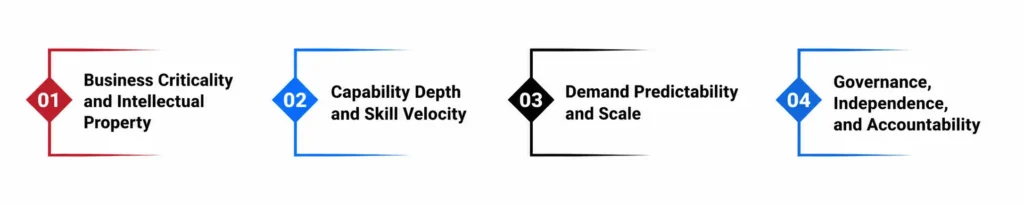
Business Criticality and Intellectual Property
Keep strategic ownership in-house when testing requires intimate knowledge of proprietary algorithms, product differentiation, or confidential decision logic. External specialists can still support execution with defined controls on access.
If you need quality across common enterprise platforms, cross-browser coverage, regression testing, performance, security, or large integration estates, then outsourcing is more appropriate. Repeatable methods and specialist depth help these areas.
Capability Depth and Skill Velocity
Can the internal team develop the necessary skills at roadmap speed? Today’s QE includes continuous testing, AI-assisted automation, data validation, security, observability, and AI assurance. When you try to build all capabilities in-house, you hire slowly and end up with piecemeal expertise. A partner offers specialist access. Internal leaders retain risk and release authority.
Demand Predictability and Scale
A permanent internal team works well when the product portfolio is stable and release demand is predictable. The economic case changes when testing demand rises and falls sharply.
Major transformations, ERP programs, cloud migrations, regulatory deadlines, and seasonal releases often create testing peaks. Outsourcing gives enterprises elastic capacity without carrying permanent bench cost when demand falls.
Governance, Independence, and Accountability
Internal teams collaborate closely, but proximity can water down independent challenges. Product deadlines may influence defect severity, coverage decisions, or release recommendations. External QE partners can also offer independent validation and standards across the portfolio. However, such independence is only useful if governance remains transparent. CTOs should insist on shared dashboards, escalation paths, audit evidence, and clear acceptance criteria.
Cost Comparison: In-House vs Outsourced QA
The real comparison is not internal salary versus vendor rate. CTOs should compare total quality cost, including the cost of defects, delayed releases, rework, tool ownership, environment maintenance, automation upkeep, governance, and production failures.
A cost comparison in-house vs outsourced should assess total quality cost, not salaries alone.
| Cost Area | In-House Model | Outsourced or Managed Model |
| Talent | Recruitment, retention, training | Contracted access to specialist skills |
| Capacity | Fixed team cost | Adjustable delivery capacity |
| Tooling | Enterprise-funded licenses and upkeep | Shared or provider-managed tooling |
| Governance | Built and maintained internally | Defined within the engagement |
| Improvement | Depends on internal investment | Contracted roadmap and service reviews |
| Transition risk | Lower for established teams | Requires controlled knowledge transfer |
A low-cost model is not always a lower-risk model. The right model should reduce the total cost of quality, not only the cost of testing effort.
When to Outsource Software Testing and When to Keep It In-House
Outsourcing should solve a defined operating problem, not serve as a generic cost action. In these situations, outsourcing can improve quality only when the partner brings governance, domain understanding, automation maturity, and clear outcome ownership. Enterprises should first assess capability gaps, workload variability, release risk, and governance maturity. The decision should strengthen quality ownership while improving access to specialist skills and scalable delivery capacity.
When to Outsource Software Testing
Outsourcing is appropriate when release demand exceeds internal capacity, or specialist skills are difficult to maintain. It also helps when quality practices vary across teams and regions. It also fits enterprises needing independent assurance, global coverage, automation expansion, or a managed QE transition.
Common triggers include:
- Repeated production defects despite rising test effort
- Slow regression cycles that delay business releases
- Limited performance, security, accessibility, or AI testing skills
- High contractor dependence without consistent governance
- Major ERP, cloud, data, or application modernization programs
- Leadership pressure for clearer release-readiness evidence
When an In-House Team Remains the Better Choice
An internal model may be stronger when the product is highly specialized, release demand is stable, and the organization already has mature QE leadership.
It also works when strict data restrictions limit external access, or when knowledge quality forms part of the company’s competitive advantage.
Should I Outsource Quality Engineering or Build In-House?
Many enterprises should do both. A hybrid model retains product knowledge, risk ownership, and release authority internally while using a partner for specialist execution and scale.
This model works best when responsibilities are explicit. Internal leaders should own business risk, architecture context, and acceptance decisions. The partner should own agreed delivery outcomes, capability growth, and operational reporting.
How Do I Choose a QE Outsourcing Partner?
Evidence, operational maturity, and cultural fit should be tested in QE partner selection. CTOs should ask:
- Will the provider own the results or provide the resources?
- How are knowledge transfer and transition risks managed?
- Can the partner provide functional and non-functional assurance?
- How will AI be governed in testing workflows?
- What metrics will indicate release confidence and business value?
- Can the model work globally and still be accountable?
A trustworthy QE partner links technical measures to production risk, critical defects, release readiness, cost of quality, and business value.
How TestingXperts Helps Enterprises Build the Right QE Operating Model
TestingXperts helps enterprises design and run Quality Engineering models that balance internal ownership with external scale, specialist expertise, and measurable accountability.
Build the Right Model Before Transferring Delivery
A successful outsourcing program begins with assessment, operating model design, governance, and transition planning. TestingXperts helps determine which capabilities should remain internal and which can move to managed delivery.
This prevents enterprises from transferring unclear processes, unstable automation, incomplete documentation, or weak accountability into an outsourced model.
Add AI-Led QE Without Losing Human Control
TestingXperts brings AI-led Quality Engineering across automation, performance, security, accessibility, data, enterprise applications, and AI-enabled systems.
Our approach helps enterprises extend internal capability while keeping human oversight, domain judgment, and release authority clearly defined.
Establish Global Governance and Release Confidence
A strong QE partner should be an independent quality authority, not a downstream test factory. TestingXperts supports managed delivery, governance frameworks, dedicated testing capacity, and outcome-based engagement models for enterprise programs.
The goal is not simply to test at lower cost. It is to improve release decisions, strengthen measurable accountability, and engineer quality across the software lifecycle.
Conclusion
For CTOs comparing in-house and outsourced QA, the best model depends on business risk, capability requirements, governance needs, and demand variability.
In-house teams provide product context and control. Outsourcing provides specialist depth, independent assurance, and scalable execution. For many enterprises, a hybrid model creates the strongest outcome by keeping strategic ownership internal while using a QE partner for capability depth and delivery scale.
The decision should not be framed as internal versus external alone. It should be framed around how the enterprise can build a Quality Engineering model that improves release confidence, accountability, and business outcomes.

VP, Delivery Quality Engineering
Manjeet Kumar, Vice President at TestingXperts, is a results-driven leader with 19 years of experience in Quality Engineering. Prior to TestingXperts, Manjeet worked with leading brands like HCL Technologies and BirlaSoft. He ensures clients receive best-in-class QA services by optimizing testing strategies, enhancing efficiency, and driving innovation. His passion for building high-performing teams and delivering value-driven solutions empowers businesses to achieve excellence in the evolving digital landscape.
Discover more