

Recommended Blogs

Post
The Power Move You’re Missing: Data Quality Testing for AI Leadership
Table of Content
- Unlocking AI Leadership: The Role of Data Quality Testing
- The Hidden Risks of Ignoring Data Quality in AI
- Building a Strong Data Foundation: Why Quality Matters
- How Data Quality Testing Drives AI Innovation and Scalability
- Beyond Compliance: Data Quality Testing as a Strategic Asset
- Why TestingXperts: Partnering to Achieve AI Leadership with Data Quality
- Conclusion
Share On


A major industry survey in 2026 found that 42% of organizations reported that more than half of their AI projects are behind schedule, not operating properly, or failing, primarily because the data isn’t available. This is a big deal. It’s a significant cost in terms of time, money, and losing an edge over the competition.
This is your wake-up call if you want to be an AI leader: even the most ambitious AI goals could fail without strict data quality testing and corporate data quality management. An organized way of improving data quality makes sure that AI projects are established on a solid basis.
What this truly implies is that businesses need to have a clear, methodical way to develop reliable, high-quality data foundations before they put AI at the center.
Unlocking AI Leadership: The Role of Data Quality Testing
What does data quality testing do for enterprises building Artificial Intelligence and Machine Learning solutions? It does a lot:
- Validates data integrity, verifying that data points are accurate, complete, and trustworthy for training or inference. Strong data accuracy at this stage prevents early distortions in model training.
- Detects inconsistent data, missing values, outdated data, or duplicate records and highlights hidden data errors that quietly degrade model performance.
- Enables continuous monitoring to ensure that data evolves in pipelines, hybrid/cloud environments or across sources; the quality remains high. Using effective data quality tools makes this monitoring scalable and actionable.
- Supports data governance and compliance, especially in regulated industries where data lineage, traceability, and audit-ready processes matter.
Empowers enterprise data teams with the power to keep data quality standards high, push for better data management, and make sure that data systems are in line with AI goals.
The Hidden Risks of Ignoring Data Quality in AI
Ignoring the quality of your data is like building a skyscraper on an unsteady base. When businesses don’t test and govern, they typically run into problems like these:
- AI models that operate well in development but fall apart in production because the data is not accurate, weakening overall data accuracy and model stability. One important cause for this failure is that bad data gets into pipelines without anyone noticing.
- There is a higher chance of making erroneous forecasts, getting skewed results, or getting unreliable insights, especially when historical data is noisy, inconsistent, or missing. Most of the time, these problems come from poor quality data that was never checked early on in the process.
- Operational risks include not following rules, having problems with regulations, or not having enough data governance. This is especially true when data access to, data collection, and data management are not controlled. In regulated situations, data inaccuracies can lead to higher audit costs and serious company risks.
- Wasting resources in developing ML models or AI systems that don’t work because the inputs are wrong. When these systems continually get bad data, teams end up treating the symptoms instead of the real problem.
- Eroded trust: when models fail or give incorrect results over and over again, stakeholders lose faith in AI-driven data quality judgments, which makes it harder for AI to be adopted in the future. Poor data quality that continually comes up in AI workflows is one of the quickest ways to lose trust.
Poor data quality hurts more than one project. It can throw off whole AI plans.
Building a Strong Data Foundation: Why Quality Matters
Here’s how putting data quality first turns being ready for AI into a strategic advantage:
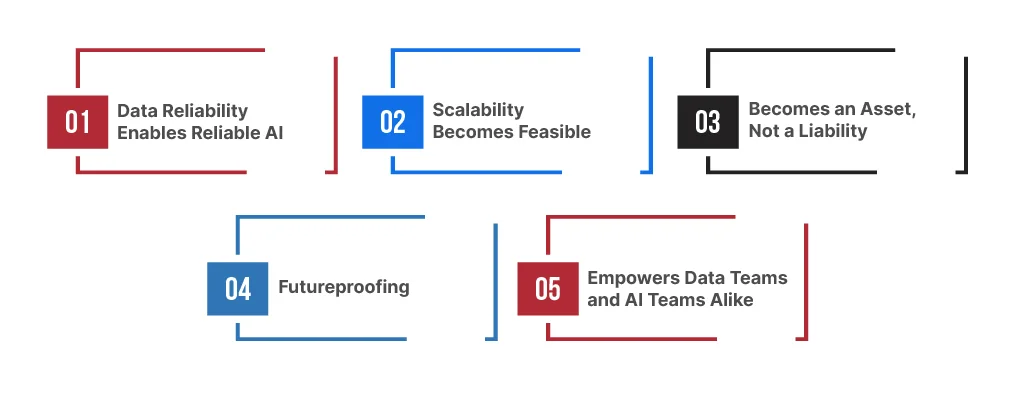
Data Reliability Enables Reliable AI
Machine learning algorithms learn the right patterns and don’t overfit noise or anomalies when they have accurate data. High data accuracy ensures the model can confidently learn without noise interfering.
Scalability Becomes Feasible
With business data quality management and data quality checks in place, companies can move from pilot projects to larger AI implementations without having to worry about the quality of the data getting worse over time.
Data Becomes an Asset, Not a Liability
Good data management, data governance, and constant validation keep datasets trustworthy data that remains useful for AI projects, analytics, reporting, and compliance. Regular work to improve the quality of data keeps this trust in all areas of the organization.
Futureproofing
A strong data foundation and data observability help keep models accurate as data changes. For example, new data sources, hybrid cloud environments, changes in how data is collected, or making fake data.
Empowers Data Teams and AI Teams Alike
Data engineers, data scientists, ML modelers, and analysts all work with the same high-quality dataset. This reduces friction and accelerates development cycles.
How Data Quality Testing Drives AI Innovation and Scalability
Let’s go over what happens when businesses include data quality testing in their Artificial Intelligence lifecycle:

Data Ingestion & Preparation
When data comes from different places, like old systems, cloud databases, third-party feeds, and historical archives, it is automatically processed. Automated data validation, cleansing, and de-duplication ensure that only accurate, consistent, and non-redundant data gets into the system.
Data Governance & Observability
By keeping track of data lineage, metadata, data quality metrics, and quality indicators, teams can always see where their data came from and how healthy it is. This helps with compliance, audits, and trust in data across all corporate activities.
Training And Model Development
When models are trained in high-quality, verified data, they learn real patterns instead of noise. That makes models that are more accurate, fair, and stable.
Continuous Monitoring Post-Deployment
Ongoing data quality checks identify problems like missing values, strange distributions, or data that is changing as new data comes in. AI for data quality can do these tests automatically and let teams know about possible problems before they happen.
Feedback Loops And Model Governance
Data teams can send insights back to modelers or data engineers when they have established data quality measurements and validation in place. This makes data pipelines better, enhances ETL operations, or changes the way data is collected.
This framework makes checking data quality testing a key part of AI at scale, along with preparing data, governing it, training it, monitoring it, and giving feedback.
Beyond Compliance: Data Quality Testing as a Strategic Asset
Many enterprises still view data quality testing and data governance as compliance or risk-avenue: necessary, but secondary. That’s shortsighted. What if data quality becomes a business driver?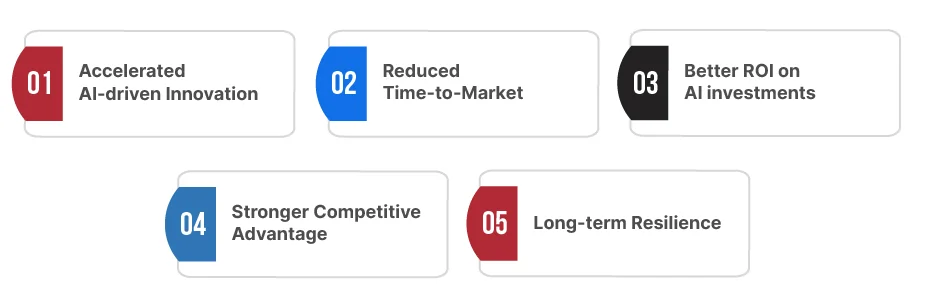
Accelerated AI-driven Innovation:
Clean, validated, well-governed data gives AI teams the freedom to experiment, iterate, and innovate. They spend less time cleaning data and more time building. Sophisticated data quality tools enable teams to focus on innovation rather than correction.
Reduced Time-to-Market:
With reliable data pipelines and continuous monitoring, launching new AI capabilities or scaling existing ones becomes faster and less risky.
Better ROI on AI investments:
High data quality reduces failed projects, improves model reliability, lowers rework costs; collectively improving ROI.
Stronger Competitive Advantage:
Organizations that treat data as a strategic asset invest in data quality, governance, and observability. These organizations can derive insights, automate processes, and create smarter AI-driven products before competitors.
Long-term Resilience:
As data volumes grow, requirements change; regulations evolve, robust data quality practices make the enterprise resilient.
Data quality testing isn’t just about compliance. It’s about building a data-driven enterprise that uses data as capital for growth.
Why TestingXperts: Partnering to Achieve AI Leadership with Data Quality
This is when a partner like TestingXperts comes in handy. Businesses that want to include data quality testing and governance in their AI strategy typically run across problems such not having enough resources, not having standardized processes, and not having the right technologies for continuous quality assurance in data pipelines.
TestingXperts has a lot of experience in QA services, automation, and data. We assist businesses:
- Set up data quality management systems that work with the needs of AI and machine learning.
- Across cloud, hybrid, or on-premises environments, automate data validation, cleaning, finding anomalies, and getting rid of duplicate data. We use AI-powered data quality tools to make these procedures faster and easier to scale.
- Set up data governance, data lineage tracking, and compliance systems to make sure that data quality requirements, access controls, and auditability are always met.
- Keep an eye on things all the time and make sure that quality stays the same while data changes. Our solutions use AI to check data quality and find and fix problems in complicated settings.
- Provide advice and consulting on best practices, quality measurements, and strategies that are specific to AI preparation, enterprise data systems, and business processes.
Working with TestingXperts will offer you the structure and discipline you need to see data as a strategic advantage instead of a messy result.
Conclusion
AI initiatives thrive or fail not on how sophisticated the algorithms are, but on how solid the data foundation is. The 2026 reality is stark: nearly half of AI projects falter due to poor data readiness. That’s a wake-up call.
If you want AI leadership marked by consistency, scalability, reliability, and trust, you need to invest in data quality testing services. You also need strong data governance and enterprise data quality management for AI from the ground up.
Treat data as strategic capital. Build robust systems for data validation, data cleansing, observability, and continuous monitoring.
With the right mindset and the right partner, your AI and ML initiatives won’t just be experiments. They’ll become engines of value, power innovation, growth, and competitive edge.


Manjeet Kumar
VP, Delivery Quality Engineering
Manjeet Kumar, Vice President at TestingXperts, is a results-driven leader with 19 years of experience in Quality Engineering. Prior to TestingXperts, Manjeet worked with leading brands like HCL Technologies and BirlaSoft. He ensures clients receive best-in-class QA services by optimizing testing strategies, enhancing efficiency, and driving innovation. His passion for building high-performing teams and delivering value-driven solutions empowers businesses to achieve excellence in the evolving digital landscape.
Discover more