Recommended Blogs

Why Cyber Security Testing Must Move Beyond Point-in-Time Assessments

 Last Updated: July 24th, 2026
 Read Time: 6 minutes
Table of Content
- Why Point-in-Time Cyber Security Testing No Longer Matches Enterprise Risk
- What Enterprise Cyber Security Testing Must Cover Today
- How AI Changes Application, API, Cloud, and Identity Risk
- How to Build a Continuous Cyber Security Testing Model
- How TestingXperts Helps Enterprises Strengthen Cyber Security Testing
- Conclusion
Share On


Cyber security testing cannot remain a point-in-time assessment when enterprise applications, APIs, identities, cloud services, integrations, third-party dependencies, and AI-enabled features are changing continuously.
Attackers are also using AI to accelerate reconnaissance, analyze code, improve social engineering, and adapt attack paths more quickly. The result is a shorter window between system change and potential exposure.
The leadership question is no longer whether a periodic assessment can find vulnerabilities. The question is whether cyber security testing can identify exploitable risk before the next release, configuration change, identity update, or third-party integration reaches production.
Key Takeaways
- Annual cyber security testing leaves long periods of exposure, allowing vulnerabilities introduced through releases, cloud changes, APIs, or AI features to remain undetected until attackers exploit them.
- AI is enabling faster and more sophisticated cyberattacks, making continuous security validation essential for detecting exploitable risks before they impact business operations.
- Effective cyber security testing must cover applications, APIs, identities, cloud configurations, and AI workflows to uncover attack paths across today’s interconnected enterprise environments.
- Combining automated security checks with expert-led adversarial testing helps organizations reduce exploitable risks, accelerate remediation, and strengthen release confidence through continuous assurance.
Why Point-in-Time Cyber Security Testing No Longer Matches Enterprise Risk
The Attacker Now Works Between Releases
Annual security reviews were designed for slower change cycles. Frequent deployments, cloud configuration changes, API updates, and SaaS integrations fuel today’s enterprises. Every change can open a new way into a system that has already passed assessment.
AI accelerates the attacker’s research cycle. It takes less manual effort for threat actors to examine open-source code, create convincing lures, compare familiar vulnerabilities, and test variations. Google and Microsoft have reported an increase in the use of AI for technical reconnaissance, targeting, phishing, and operational support.
According to the World Economic Forum’s Global Cybersecurity Outlook 2026, 87% of respondents said that AI-related vulnerabilities were the fastest-growing cyber risk. That’s important because the frequency of testing today affects how long a vulnerability can be exploited.
Annual Testing Creates a False Finish Line
Annual testing can provide a useful snapshot of the environment at one point in time. It cannot confirm whether security controls remain effective after the next code release, cloud change, API exposure, identity update, or vendor integration.
That gap is especially risky for public-facing applications. IBM’s 2026 X-Force Threat Intelligence Index found that exploitation of public-facing applications became the most common initial access vector, increasing 44% from the previous year.
Annual testing usually produces a report, a remediation plan, and a temporary sense of closure. Continuous cyber security testing creates a more current view of whether critical applications, APIs, identities, cloud controls, and AI workflows can withstand realistic attacks today.
What Enterprise Cyber Security Testing Must Cover Today
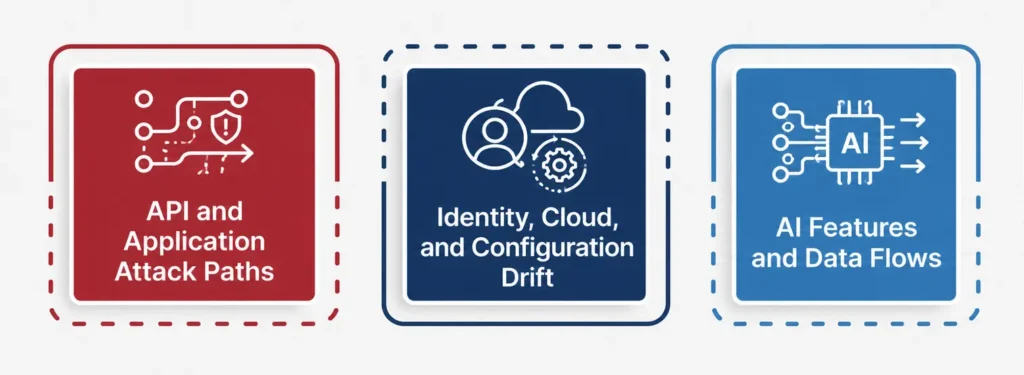
API and Application Attack Paths
Enterprise application security testing must follow complete business journeys, not isolated screens. For example, a payment workflow might go through a web interface, an API gateway, an identity provider, a data service, and a third-party platform.
Testing should cover session handling, authentication, authorization, input validation, business logic, exposure, and abuse of sensitive data. API security is a special concern since services can expose business functions directly. They may also lack the visible controls that a user interface provides.
A good cybersecurity testing company will test controls across roles, regions, devices, and abnormal transaction sequences. This approach links technical findings to fraud exposure, customer impact, operational disruption, and compliance risk.
Identity, Cloud, and Configuration Drift
Identity has become a common control plane for enterprise environments. Different policies can grant access to human users, service accounts, workloads, agents, and external partners.
Security testing services should validate privilege boundaries, token handling, role changes, inactive accounts, conditional access, and machine identities. The goal is to ensure that access remains appropriate following organizational and technical change.
Cloud environments introduce another layer of risk. Infrastructure policies, storage permissions, secrets, network rules and deployment templates can all drift from approved baselines. Continuous validation should catch the drift before it becomes an exploitable condition.
AI Features and Data Flows
Enterprise AI creates new attack paths beyond traditional application testing. Models can be connected to sensitive data, external tools, retrieval systems, APIs, and automated actions.
Cyber security testing services should test prompt injection, malicious tool use, data leakage, insecure model access, poisoned context, and weak approval controls. Testing should also evaluate the consequences of an AI feature triggering an unsafe or incorrect action.
The goal is not to think of AI as a stand-alone security program. AI-enabled workflows should have the same enterprise risk model as applications, identities, data, and infrastructure.
How AI Changes Application, API, Cloud, and Identity Risk
AI does not create a separate security problem. It accelerates existing risks across applications, APIs, cloud environments, and identity systems.
Application and API Exposure
AI can help attackers discover vulnerabilities, test variations, and analyze exposed APIs more efficiently. Security testing should validate authentication, authorization, business logic, session handling, and API interactions across real business flows.
Cloud Misconfiguration Risk
AI-assisted reconnaissance can make exposed storage, weak infrastructure policies, and misconfigured cloud resources easier to find and exploit. Continuous testing helps detect configuration drift before it becomes an exploitable condition.
Identity and Access Risk
AI-enabled applications rely on users, service accounts, machine identities, agents, and third-party integrations. Testing must validate privilege boundaries, token handling, inactive accounts, conditional access, and machine identity controls.
How to Build a Continuous Cyber Security Testing Model
Test on Change, Not Only on the Calendar
Modern testing uses risk-based triggers. Security validation should be performed when teams release code, change infrastructure, expose an API, change identity policies, or connect with a new third party.
Not every change needs to be that profound. Automated checks can detect common weaknesses and policy failures. Higher risk releases may require targeted penetration testing, threat modeling, or adversarial review.
This model ties security efforts to actual exposure. It also provides leaders with better evidence for release decisions because testing is based on the current system, not last year’s architecture.
Combine Automation with Human Adversarial Thinking
Automation increases speed and repeatability. It can scan code, dependencies, configurations, APIs, containers, and infrastructure definitions through the delivery process.
Business logic abuse, chained attack paths, privilege escalation, social engineering, and complex authorization failures still require human intervention. These weaknesses often need context, creativity, and an understanding of how enterprise processes create value.
The strongest cyber security testing model uses both approaches. Automation provides frequent and broad coverage. Experienced security practitioners then examine the attack paths most likely to cause material business harm.
Measure Exploitable Risk and Remediation Speed
Security dashboards should support executive decision-making. A long list of findings does not show whether the enterprise is safer.
Useful measures include:
- Critical exposure by business service
- Remediation time
- Recurring weakness patterns
- Release-related risk
- Post-fix validation status
- Exploitability and business impact
- Security control coverage across applications, APIs, cloud, identity, and AI workflows
Reporting should also distinguish theoretical weaknesses from exploitable pathways. Repeated findings across teams or platforms often point to a design, governance, or engineering problem, not only a single coding error.
How TestingXperts Helps Enterprises Strengthen Cyber Security Testing
TestingXperts helps enterprises move from periodic security reviews to continuous, risk-led cyber assurance. Our approach connects cyber security testing services with release decisions, operational resilience, compliance, and enterprise Quality Engineering.
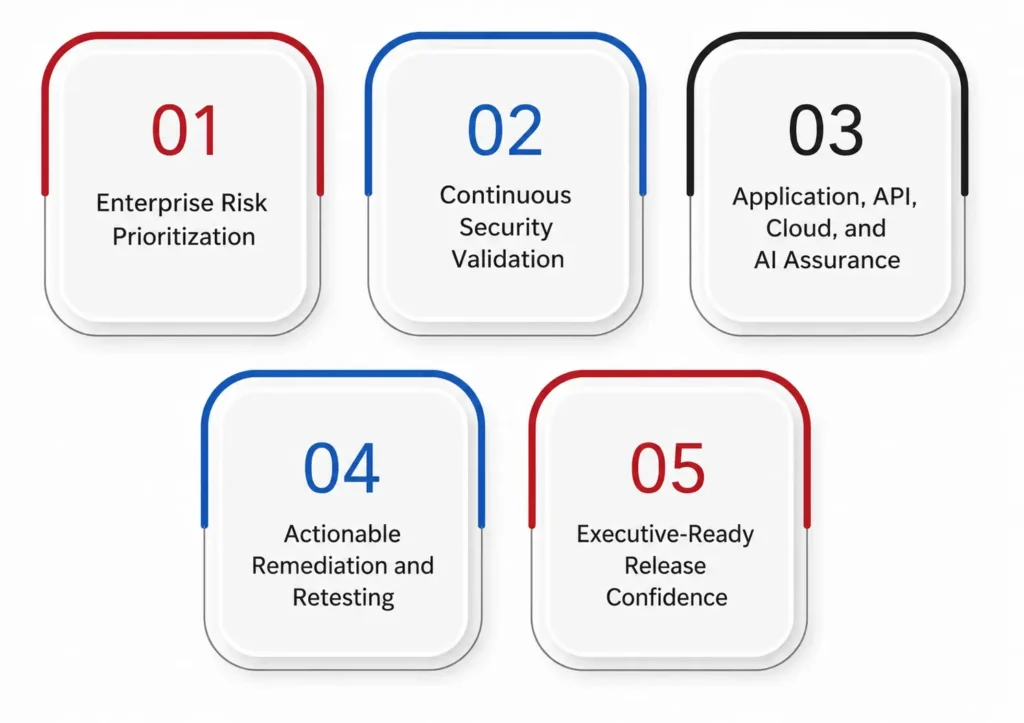
Enterprise Risk Prioritization
TestingXperts starts with the enterprise risk landscape, not a generic test checklist. We identify critical applications, sensitive data flows, privileged roles, exposed APIs, cloud dependencies, AI-enabled workflows, and high-impact integrations. Testing depth is then aligned with the financial, regulatory, operational, and customer impact of a successful attack.
Continuous Security Validation
TestingXperts embeds security validation into DevSecOps pipelines and release workflows. Automated checks run earlier and more often, while security specialists investigate complex attack paths, business logic weaknesses, privilege escalation, configuration drift, and AI workflow risks before changes reach production.
Application, API, Cloud, and AI Assurance
TestingXperts provides application security testing, API security testing, cloud security validation, vulnerability assessment, penetration testing, and compliance-focused assurance. This integrated approach helps enterprises understand how vulnerabilities interact across systems, identities, infrastructure, third-party services, and AI-enabled features.
Actionable Remediation and Retesting
TestingXperts translates findings into remediation priorities based on exploitability and business impact. Teams receive clear guidance, defect validation, and post-fix retesting to confirm whether corrective action has reduced exposure.
Executive-Ready Release Confidence
TestingXperts connects cyber assurance with broader Quality Engineering to improve release confidence. Leaders gain clearer evidence on exploitable risk, remediation progress, and readiness across critical business services.
Conclusion
AI has accelerated exploitation, but many security programs still depend on annual testing cycles. That timing gap creates exposure between releases, cloud changes, API updates, identity changes, third-party integrations, and AI feature rollouts.
Continuous cyber security testing helps close that gap. It validates applications, APIs, identities, cloud controls, and AI workflows as they change, giving leaders a more current view of exploitable risk.
For enterprises moving faster with digital and AI-enabled systems, cyber security testing must become part of release confidence. The goal is not only to find vulnerabilities. It is to prove that critical business services can change without creating unacceptable security exposure.

Associate Director
Yuvraj Singh is an accomplished Associate Director of Delivery, renowned for leading strategic quality assurance initiatives that consistently deliver outstanding software outcomes across global markets. With deep expertise in both Property & Casualty (P&C) and Life & Annuities (L&A) insurance domains, Yuvraj excels at bridging the gap between complex business objectives and flawless execution.
FAQs
How often should an enterprise perform Cyber Security testing?
Testing is after risk and change. Automated checks should run continuously through delivery, while deeper assessments should run around major releases, architecture changes, critical integrations, or emerging threats.
Can automated security testing replace penetration testing?
No. Automation gets you frequent coverage of known patterns and policy failures. Human penetration testing is still needed to address chained attacks, abuse of business logic, and context-dependent weaknesses.
What should enterprises expect from security testing services?
Enterprises should expect risk-based planning, full attack-surface coverage, realistic adversarial testing, clear remediation guidance, retesting, and executive reporting tied to business services.
Discover more