


Recommended Blogs

Post
AI Prompt Engineering: How It Works and Why It’s Needed
Table of Content
- What is Prompt Engineering, and How Does It Work?
- How Does it Work?
- Importance of Prompt Engineering
- 5 Use Cases of Prompt Engineering
- Where Prompt Engineering Makes a Real Difference in Many Industries
- What Are the Best Practices for Effective AI Prompting?
- Benefits of Prompt Engineering
- Why Partner with Tx for Prompt Engineering Services?
- Summary
Share On


How people interact with technology is rapidly changing, and AI is at the forefront of tech innovation. Recent innovations in the AI realm involve companies training their machines to think, learn, and interact like humans. Among the advancements in areas like GenAI, one innovation that is gaining popularity is AI prompt engineering.
Consider a user conversing with the machine in which he/she provides a prompt or cue, and the machine provides output with relevant actions or data. That’s the core of prompt engineering. It allows businesses to draft the right instructions/questions to train their AI models like LLMs and deliver correct outcomes. When working with language models, one must thoroughly understand prompt engineering.
Let’s look at the technical complexities of prompt engineering and its significance in the AI ecosystem.
What is Prompt Engineering, and How Does It Work?
Before starting with prompt engineering, let’s get a brief about how GenAI systems generate outputs. These systems generate specific outputs based on the prompt’s quality. Prompt engineering allows GenAI models to better analyze and comprehend simple technical queries and provide better responses. Remember, a good prompt will yield a good result.
GenAI utilizes different prompt engineering techniques to learn from huge datasets, minimize confusion and biases, and deliver accurate outcomes. The prompt engineers create queries to assist GenAI models in understanding language complexities and query/user intent. That’s why providing a high-quality, data-driven, and thorough prompt is necessary to improve the quality of AI-generated results (images, text, code, data summaries, etc.).
Businesses need to follow a detailed approach to draft prompts that allow them to connect raw data with accurate AI-generated outputs. They can fine-tune prompts to improve the relevancy and quality of GenAI outputs and resolve user queries. This will reduce manual intervention in reviewing and post-editing, saving effort and time in delivering the required results.
How Does it Work?
It involves a step-by-step approach involving several key tasks:
Step-1: Demystifying Problem:
The first step involves understanding the problem statement. It includes analyzing the model’s expected functionalities and understanding the complexities and structure of the task. The functionalities include question-answering tasks, sentimental analysis, text generation, etc. Understanding the problem involves identifying limitations/challenges, such as cultural references, slang, or region-specific language, which the model might not be familiar with. It would help in predicting how the model would react to different prompts.
Step-2: Drafting Initial Prompt:
This step involves composing the initial instructions to guide the language model in delivering the expected outcome per problem analysis. It offers clear and concise instructions to the language model and acts as a path to expect desired results. A well-structured initial prompt would allow businesses to utilize the full capabilities of their AI models and produce high-quality and task-related outcomes.
Step-3: Analyzing and Evaluating the Response:
The third step is analyzing and evaluating the model’s response to understand the effectiveness of the drafted prompt and how well the AI model can interpret it. In this step, the prompt engineers assess whether the model’s output aligns with the intended goal. If it does not meet the expected outcome, they must identify the problem areas: accuracy, context, relevance, or completeness. Evaluating the outcomes is necessary for prompt engineering as it helps improve the prompt drafting process.
Step-4: Repeating and Improving the Prompt:
This step involves improving the prompt’s effectiveness by following the iterating and refining stages. It helps identify flaws in the model output and rectify the misalignment between the output and the desired goal. This involves multiple rounds of iteration and refinements in prompt engineering to fine-tune the language to communicate with LLMs effectively.
Step-5: Testing the Prompt:
This step requires businesses to test the prompt’s effectiveness on different models. It helps gain in-depth insights into the refined prompt’s generalizability and robustness. Different models have different architecture and training methods that facilitate their response to a prompt. By running prompt testing across varying models, businesses can gain insights and better understand how their characteristics affect the response and whether the prompt requires further refinement.
Step-6: Scaling the Prompt:
After refining and testing, the next step is scaling the prompt. This final step involves extending the usage of the implemented prompt across multiple tasks, automation levels, or contexts. Prompt scaling reflects the successful development and implementation of an effective prompt.
Importance of Prompt Engineering
Since GenAI’s launch, prompt engineering has significantly bridged the gap between end users and LLMs. It assists in identifying templates and scripts that users can customize to get the desired results from language models. Businesses experiment with different inputs to build a prompt library that they can resume in multiple scenarios. Prompt engineering assists in making AI applications more effective and efficient. It offers the following benefits:
-
- It gives businesses control over user interactions with AI systems. With effective prompts, they can refine the AI model’s output and present it in the necessary format. They can also prevent users from misusing AI.
-
- It allows AI tools to deliver relevant responses while avoiding trial-and-error instances. Users can obtain desired outcomes without worrying about biases.
- It helps improve AI model quality and enables businesses to create more flexible AI tools. They can create prompts with neutral instructions while focusing on broad patterns and logical links.
5 Use Cases of Prompt Engineering
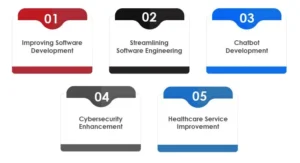
Prompt engineering solutions are utilized in complex AI systems to improve the UX of LLMs. Let’s take a look at some of its use cases:
Improving Software Development:
Prompt engineering utilizes AI models to generate code snippets and offer solutions for programming obstacles. It can save time in software development and assist businesses in coding tasks.
Streamlining Software Engineering:
GenAI systems are trained using multiple programming languages. Using prompt engineering, businesses can streamline code snippet generation and simplify complex tasks. They can craft model-specific prompts to automate coding, design API integrations, debug errors, and create API-based workflows. It will help them reduce manual involvement, optimize resource allocation, and manage data pipelines.
Chatbot Development:
Prompt engineering enables AI chatbots to generate relevant and logical responses during real-time conversations. Businesses can ensure their AI chatbot understands user queries and offers relevant outputs using quality prompts.
Cybersecurity Enhancement:
Businesses can utilize prompt engineering techniques to develop and test security mechanisms. They can utilize GenAI to simulate cyberattacks to understand and design better security strategies. They can also create AI model prompts to identify software vulnerabilities.
Healthcare Service Improvement:
In the healthcare sector, prompt engineering techniques can assist AI systems in summarizing medical data and crafting a recommended treatment plan. Using quality prompts, AI models can effectively process patient data and offer detailed and accurate insights into health conditions and preventive measures.
Where Prompt Engineering Makes a Real Difference in Many Industries
Prompt engineering may be used in more than just chat interfaces. It is useful wherever AI systems need to understand intent, context, and limits appropriately.
Chatbots and Virtual Assistants
Structured prompts assist chatbots figure out what users want, keep the conversation going, and give the same answer in all situations. This reduces irrelevant responses and makes it easier for customer care and internal service bots to resolve issues on the first contact.
Generative AI for Content and Code
Prompt engineering sets the tone, format, limits, and depth for text, images, and code production. Well-written prompts reduce hallucinations, reduce rework, and ensure outputs meet brand, compliance, or technical standards.
Predictive Analytics and Decision Support
Prompts help AI systems summarize trends, explain predictions, and show how sure they are. This makes it easier for business and operations teams to trust and act on AI-driven insights.
What Are the Best Practices for Effective AI Prompting?
Discipline is more important than originality when it comes to effective AI prompting. These methods assist teams go from trying things out to getting reliable results.
Use Prompt Templates for Repeatability
By defining the role, task, constraints, and output format, templates make the structure the same for everyone. This means that prompts can be used by more than one team, which makes outcomes more consistent.
Use Iterative Refinement Instead of One-Time Drafting
Prompts should change based on what they don’t cover. Small changes to the context, examples, or limits can frequently make a big difference in how accurate and useful something is.
Evaluate Prompts Using Clear Metrics
Keep track of things like how accurate the responses are, the relevancy score, the rework rate, and the time saved. Teams can figure out which prompting tactics really work by measuring outcomes.
When you have a lot of prompts, it gets harder to keep track of their quality. TestingXperts helps businesses by making sure that prompts work the same way across models, setting key performance indicators (KPIs) for rapid review, and making sure that outputs are consistent, ethical, and ready for production when AI systems change.
Benefits of Prompt Engineering
By creating quality prompts, businesses can improve CX, facilitate data-driven decisions, and streamline their processes accurately. It will enable businesses to use AI tools and solutions more effectively, allowing them to stay competitive in the changing digital marketplace. Here are some of the business benefits of prompt engineering:
-
- Businesses can ensure the accuracy and relevancy of their AI model output as it fulfills their goals. Quality prompts allow AI systems to identify complexities, effectively decode data, and offer deep insights. This will minimize errors and upscale the quality of outcomes.
-
- Businesses need to ensure the implementation of ethical AI practices when working with AI systems. Prompt engineering assists businesses in mitigating biases and ensuring prompt fairness within AI systems. When working with prompt design, they can incorporate ethical considerations and develop responsible AI systems.
-
- Prompt engineering allows businesses to extract valuable and actionable insights faster from huge data sets. This allows them to make informed decisions and respond to market trends. Such AI-driven insights enable businesses to remain competitive and drive business growth.
- Efficiency is key to reducing costs and ensuring optimal resource allocation. Prompt engineering helps create efficient AI systems by optimizing resource allocation and reducing unnecessary computation.
Why Partner with Tx for Prompt Engineering Services?
Businesses need to refine their prompts to communicate better with AI and enhance the accuracy and relevance of AI responses. This could lead to better decision-making, improved CX, and automation of complex tasks. At Tx, we assist businesses in fine-tuning these interactions with our prompt engineering services. Our tailored AI testing solutions and expert guidance will ensure your AI systems respond relevantly to your requirements. Tx’s prompt engineering services cover the following:
-
- Maximizing relevancy and accuracy of AI responses by utilizing advanced linguistic analysis and user feedback loops.
-
- Developing and optimizing prompts in multiple languages to ensure global applicability and cultural relevance.
-
- Improve prompts according to user interactions and system performance.
-
- Enabling AI systems to understand and respond to complex user queries with precision.
Summary
The AI tech domain is huge, complex, and rapidly evolving. This field needs a key like prompt engineering to unlock the full capabilities of AI models (like LLMs). These models increasingly integrate with business operations and people’s lives, making effective communication necessary. Whether it is customer support using a chatbot, assistance with daily tasks via voice assistant, or a group of researchers using AI tools, interactions depend on the quality of the prompts. As a leading digital engineering services provider, Tx can assist you with prompt engineering projects. To know more, contact our experts now.


Anuj Kumar
Sr Test Manager
With 10 years of experience in automation development and testing, He has led the creation of innovative solutions that enhance software delivery and product quality. Skilled in UiPath, Katalon, Selenium, and Appium, with a strong focus on CI/CD. Extensive expertise in RPA, including custom UiPath solutions like screenshot comparison libraries and advanced drag-and-drop simulations, tailored to complex project needs.
FAQs
How can prompt engineering improve AI model performance?
Prompt engineering makes things work better by making inputs less confusing and making sure that model replies match precise goals. AI systems can give more accurate, relevant, and consistent results without having to retrain the model if they have clear instructions, limits, and examples.
Which industries benefit most from structured prompt engineering?
Industries that have a lot of decisions to make or are very sensitive to compliance benefit the most. This includes BFSI, healthcare, retail, software engineering, and customer service, where being right, being able to explain things, and being consistent are very important.
How do we measure the effectiveness of prompts in AI systems?
Metrics including output accuracy, relevance, response consistency, reduction in manual edits, and task completion time are used to quantify effectiveness. Comparing data before and after prompt optimization gives obvious clues about performance.
What ROI can enterprises expect from optimized AI prompting strategies?
Businesses usually experience a return on investment (ROI) in the form of faster turnaround times, less work, and more reliable output. The best results come from using AI more without having to pay more or have more people watch over it.
Discover more