

Recommended Blogs

Post
Why is Performance Testing Critical for AI-Driven Healthcare Platforms?
Table of Content
- Why Performance Testing Matters for AI Healthcare Platforms
- Unique Performance Challenges in AI Healthcare Systems
- Key Components of AI Healthcare Performance Testing
- Best Practices for Testing AI-Driven Healthcare Platforms
- Role of Specialized Healthcare Performance Testing Services
- Emerging Trends in AI Healthcare Testing
- How TestingXperts Ensures Reliability in AI-Driven Healthcare Platforms
- Conclusion
Share On


Artificial intelligence is quickly becoming a key part of modern healthcare platforms. It powers apps like medical image analysis, predictive diagnostics, remote patient monitoring, and smart clinical procedures. According to the World Health Organization, artificial intelligence holds significant potential to improve healthcare delivery, including enhancing diagnostics, supporting clinical care, and strengthening health system management.
Any delay or instability in the system can make it hard to make clinical choices. This is why AI healthcare performance testing is so important. It ensures that AI-powered healthcare platforms remain dependable, scalable, and responsive in real-world medical settings.
Why Performance Testing Matters for AI Healthcare Platforms
Healthcare AI technologies analyze diagnostic images, estimate patient risk, conduct telemedicine communications, and automatically write medical documents. These applications frequently handle large amounts of both organized and unstructured data.
If you don’t test things thoroughly, you could run into a lot of problems:
- Slow model inference affecting real-time clinical decisions
- System crashes during peak patient load
- Latency in data processing from IoT medical devices
- Inconsistent performance across distributed healthcare systems
Testing AI-driven healthcare technologies early in the development cycle helps find these problems. It ensures that systems run the same way, no matter how busy they are or how complex the clinical situation is.
In healthcare, performance isn’t just about how fast you can do something. It directly affects patient safety, clinician productivity, and operational efficiency.
Unique Performance Challenges in AI Healthcare Systems
AI healthcare platforms face performance challenges that conventional software systems seldom encounter.
1. High Data Volume and Complexity
Electronic health records, medical imaging, genomic information, and device telemetry are just some of the huge volumes of data that healthcare settings create. To process this data quickly, you need good infrastructure and AI models that work well.
2. Real-Time Decision Requirements
Many AI systems work in places where time is important, such as emergency rooms or remote patient monitoring. Delays in model inference or system responsiveness may influence treatment decisions.
3. Integration with Legacy Healthcare Systems
AI platforms commonly work with hospital information systems, lab systems, and electronic health record (EHR) systems. These integrations make testing AI healthcare applications more complicated and require thorough performance validation.
Performance testing shows that AI systems may be trusted to work as expected.
Key Components of AI Healthcare Performance Testing
To do effective AI healthcare performance testing, you need a structured way to look at both the system’s performance and the AI model’s efficiency.
Model Inference Performance
AI models must process healthcare data quickly while maintaining reliable outcomes. AI model performance testing focuses on validating how models behave under different operational conditions.
- Run controlled inference tests using real or simulated healthcare datasets to measure response time and model output stability.
- Simulate varying workloads to observe how the model performs when handling multiple prediction requests simultaneously.
- Evaluate infrastructure usage by monitoring CPU, GPU, and memory consumption during model execution.
- Perform scalability testing to confirm the model continues performing reliably as data volume and user demand increase.
These tests ensure that diagnostic or predictive models perform acceptably in a clinical setting.
Data Processing Performance
Healthcare AI systems frequently handle streaming data from medical devices or substantial collections of clinical records. Testing checks:
- Data ingestion speed
- Processing throughput
- Data pipeline stability
This helps make sure that real-time monitoring systems stay reliable when workloads are at their highest.
System Load and Stress Testing
Healthcare platforms face hard-to-forecast demand, especially during public health crises or during busy hospital hours.
Load testing puts a large number of users on the system to see how it performs under normal peak loads. Stress testing pushes systems beyond their normal limits to identify potential failure points.
Both methods are necessary for improving the functioning of the healthcare system.
API and Integration Testing
APIs are crucial to AI healthcare platforms because they enable systems to communicate with one another. Performance testing verifies that these integrations are responsive and stable, ensuring that data flows smoothly between apps.
Best Practices for Testing AI-Driven Healthcare Platforms
To ensure AI works well in healthcare, organizations should follow a few best practices.
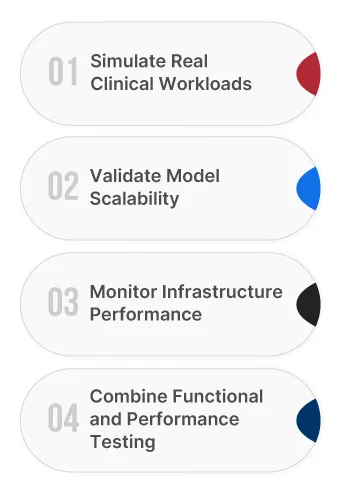
Simulate Real Clinical Workloads
Testing environments should mimic real-world healthcare situations, encompassing concurrent patient inquiries, imaging uploads, and device data streams. This makes sure that performance metrics are based on real-world conditions.
Validate Model Scalability
AI models must scale effectively as data volume grows. Performance tests should assess how models behave when they must handle more data and more inference requests.
Monitor Infrastructure Performance
Cloud infrastructure or hybrid environments are often used for AI workloads. To keep the system stable, you need to track how well it works, how long it takes to connect to the network, and how much of its resources it uses.
Combine Functional and Performance Testing
You shouldn’t do performance testing by itself. To ensure that system performance doesn’t impact model accuracy or clinical results, it should be linked to healthcare AI validation processes.
Role of Specialized Healthcare Performance Testing Services
Many healthcare businesses depend on professional healthcare performance testing services to ensure AI systems meet industry standards.
Most of the time, these services include:
- End-to-end system performance testing
- AI model performance benchmarking
- Infrastructure and cloud scalability testing
- Security and compliance validation
- Continuous monitoring and optimization
By using domain-specific knowledge, companies can find performance issues early and make systems more reliable before they are deployed.
Emerging Trends in AI Healthcare Testing
AI healthcare systems are changing quickly, and so are the ways we measure their performance.
Edge AI and Remote Monitoring
AI processing is becoming closer to the source of the data as wearable medical gadgets and remote patient monitoring systems become more common. Now, performance testing must consider both cloud and edge contexts.
Continuous AI Testing
Healthcare AI models often get new datasets to train on. Continuous testing processes help ensure that upgrades don’t slow down performance.
AI Observability
Advanced monitoring tools are making it easier to see how models behave, how well systems work, and how infrastructure is being used. This makes it easier to optimize the healthcare system’s long-term functioning.
How TestingXperts Ensures Reliability in AI-Driven Healthcare Platforms
Ensuring reliability in AI healthcare systems requires strong testing frameworks, domain expertise, and continuous validation. TestingXperts supports healthcare organizations with structured testing strategies designed for AI driven platforms.
- Comprehensive AI healthcare performance testing to evaluate system scalability, response time, and stability under real clinical workloads.
- AI model performance testing to validate inference speed, model behavior, and consistency across large healthcare datasets.
- End-to-end AI healthcare software testing covering APIs, integrations, data pipelines, and infrastructure performance.
- Healthcare AI validation aligned with industry regulations and compliance requirements.
- Healthcare system performance optimization through continuous monitoring, performance benchmarking, and proactive issue detection.
Conclusion
AI-powered healthcare platforms must deliver continuous performance, scalability, and reliability to support essential medical workflows. This means that AI healthcare performance testing is necessary to ensure the system is stable, the model is efficient, and it performs well in the real world under clinical workloads.
Companies can improve healthcare AI validation and system performance by using the appropriate software testing techniques. TestingXperts helps healthcare providers and tech teams ensure AI healthcare software testing and performance validation are accurate, enabling digital healthcare platforms to grow and work well.


Michael Giacometti
VP, AI & QE Transformation
Michael Giacometti is the Vice President of AI and QE Transformation at TestingXperts. With extensive experience in AI-driven quality engineering and partnerships, he leads strategic initiatives that help enterprises enhance software quality and automation. Before joining TestingXperts, Michael held leadership roles in partnerships, AI, and digital assurance, driving innovation and business transformation at organizations like Applause, Qualitest, Cognizant, and Capgemini.
FAQs
How do healthcare performance testing services ensure scalability for AI-driven platforms?
Healthcare performance testing services simulate real-world workloads, validate infrastructure capacity, and assess system behavior under peak demand. This helps ensure AI models and platforms scale efficiently without compromising speed, stability, or clinical performance during high patient volumes.
What are the best approaches for testing AI-driven healthcare platforms in real-world scenarios?
Effective approaches focus on replicating real clinical environments using production-like data, concurrent user simulations, and device integrations. Combining performance, functional, and AI validation testing ensures systems behave consistently under realistic workloads and unpredictable healthcare conditions.
Why is AI testing in healthcare essential for patient safety and system reliability?
AI testing ensures that systems deliver accurate outputs, consistent performance, and timely responses. In healthcare, even minor delays or incorrect predictions can impact patient outcomes, making rigorous testing critical for maintaining trust, safety, and operational reliability.
What challenges should organizations expect when implementing AI testing in healthcare environments?
- Managing complex and high-volume healthcare data
- Integrating with legacy systems like EHRs
- Ensuring real-time processing capabilities
- Maintaining compliance with strict regulations
- Validating both model accuracy and system performance simultaneously
How does AI model performance testing impact diagnostic accuracy and response time?
AI model performance testing evaluates how quickly and consistently models process data under different loads. It helps identify latency issues, optimize inference speed, and ensure reliable outputs, directly influencing diagnostic accuracy and timely clinical decision-making.
What are the compliance considerations during AI healthcare software testing?
Testing must align with regulations like HIPAA, GDPR, and healthcare-specific standards. This includes data privacy, security validation, audit trails, and model transparency, ensuring AI systems operate ethically while protecting sensitive patient information.
How can TestingXperts improve scalability and response time for AI-powered healthcare systems?
TestingXperts enhances AI healthcare platforms through end-to-end performance testing, model benchmarking, and infrastructure optimization. By simulating real workloads and continuously monitoring systems, it helps organizations achieve faster response times, better scalability, and consistent performance in critical healthcare environments.
Discover more