Get in Touch
⌃

The Hidden Cost of Moving Every ADF Pipeline in a Microsoft Fabric Migration

 Last Updated: July 22nd, 2026
 Read Time: 5 minutes
Table of Content
- Why Pipeline Count Is the Wrong Starting Point for Fabric Migration
- What Is Hiding Inside the Pipeline Estate
- How to Decide What Should Move to Microsoft Fabric
- What Executives Need Before Funding Migration
- How TestingXperts Helps Enterprises Rationalize ADF-to-Fabric Migration
- Conclusion
Share On


The hidden cost of Microsoft Fabric migration often starts before any technical work begins. It starts when enterprises assume every existing ADF pipeline deserves to move. Count the Azure Data Factory (ADF) pipelines, estimate the effort required to move each one, and use the total to define the migration budget. That calculation is easy to understand, yet it is also where many migration programs begin to overpay.
An ADF estate is rarely a clean representation of current business requirements. It is the result of years of releases, temporary fixes, acquisitions, changing reporting needs, architecture decisions, and operational workarounds. Every pipeline may still technically exist, but that does not mean it still creates value.
The better question is not, “How many pipelines do we need to migrate?” It is, “Which pipelines deserve to exist in the Microsoft Fabric environment at all?”
Why Pipeline Count Is the Wrong Starting Point for Fabric Migration
Pipeline count is a measure of the current estate. It is not a reliable measure of the future platform the enterprise needs. A pipeline may remain deployed long after its purpose disappears. A working trigger or valid code does not prove that the business still consumes its output. Similarly, it creates other assumptions as well:
- Every pipeline supports an active business requirement.
- Every output is still consumed.
- No two pipelines perform overlapping functions.
- Existing transformation logic remains appropriate.
- The current integration pattern should be recreated in Fabric.
- The cost of retaining a pipeline is lower than the cost of redesigning or retiring it.
The organization may change the underlying technology, but it will still carry the same duplication, dependencies, fragile logic, and maintenance overhead. The move from ADF to Fabric is an opportunity to simplify governance, standardize patterns, and use new platform capabilities. Microsoft’s assessment-led migration approach helps teams understand technical readiness. Enterprises should extend that assessment with business-value rationalization: catalog existing assets, identify high-value workloads, and remove unnecessary scope before conversion begins.
Without rationalization, Fabric migration can become a platform upgrade that preserves the same duplication, dependency risk, and maintenance burden in a new environment.
What Is Hiding Inside the Pipeline Estate
A detailed assessment usually reveals that pipelines do not fall into a simple “migrate” or “do not migrate” choice. They generally fall into several different categories.
- Unused pipelines: These pipelines remain deployed but no longer support an active process. Their schedules may have been disabled, their outputs may no longer be consumed, or the original business owner may have moved on. Migrating them creates costs without restoring business value.
- Duplicate pipelines: Different teams may have created pipelines that ingest the same source data or apply similar transformation logic. This commonly happens when ownership is distributed across business units, vendors, or project teams. Moving every duplicate pipeline into Fabric preserves unnecessary data movement and support effort.
- Legacy pipelines: Some pipelines support reports, applications, or processes that are scheduled for retirement. Others may exist only because an older platform requires a particular integration pattern. These pipelines should be evaluated against the target business architecture rather than automatically preserved.
- Low-value pipelines: A pipeline may still run successfully but provide limited value relative to its operating and maintenance costs.
- Business-critical redesign candidates: Some pipelines are essential, but their current design is too fragile, expensive, or difficult to govern. These should not be migrated as-is. They should be redesigned around the target Fabric architecture.
Some pipelines remain essential, but their architecture may not survive the migration. Fabric migration should preserve required outcomes, not every past implementation decision.
How to Decide What Should Move to Microsoft Fabric
Microsoft’s built-in upgrade assessment helps evaluate ADF pipeline readiness and activity compatibility before migration to Fabric. It can surface readiness categories such as Ready, Needs review, and Not compatible. These statuses are useful, but they answer a technical question. They do not determine whether a pipeline still creates business value or whether the current design should be preserved.
A strong migration assessment should combine two lenses: technical compatibility and business disposition.
| Decision | When It Applies | Executive Question |
|---|---|---|
| Retire | The pipeline is unused, obsolete, or supports a retired process | What business impact would removal create? |
| Consolidate | Multiple pipelines perform overlapping functions | Can a single governing pattern replace multiple assets? |
| Retain temporarily | Dependencies or capability constraints prevent an immediate move | What condition and date will trigger reassessment? |
| Rebuild | The business process remains valid, but the architecture does not | What target design reduces cost and operational risk? |
| Migrate | The pipeline is valuable, compatible, distinct, and efficient | What evidence supports direct migration? |
| Replace | A Fabric-native capability removes the need for custom workflow logic | Can the target platform provide the outcome with fewer components? |
The decision should be based on evidence rather than technical compatibility alone. Each pipeline should be evaluated against:
- Business value and accountable ownership
- Usage frequency and seasonality
- Data criticality and regulatory importance
- Upstream and downstream dependencies
- Failure rate and recovery effort
- Maintenance demand
- Technical debt and design complexity
- Security exposure
- Functional duplication
- Fabric-native alternatives
- Migration and validation cost
An enterprise assessment must also establish whether the pipeline remains commercially and operationally relevant.
What Executives Need Before Funding Migration
Executives should not fund migration scope until each pipeline has a clear disposition and target-state rationale. The fastest way to reduce Fabric migration cost is not to accelerate pipeline conversion. It is to reduce the number of pipelines that require conversion. Executives need evidence that the program’s scope reflects business value. Before approving the migration baseline, enterprises should require:
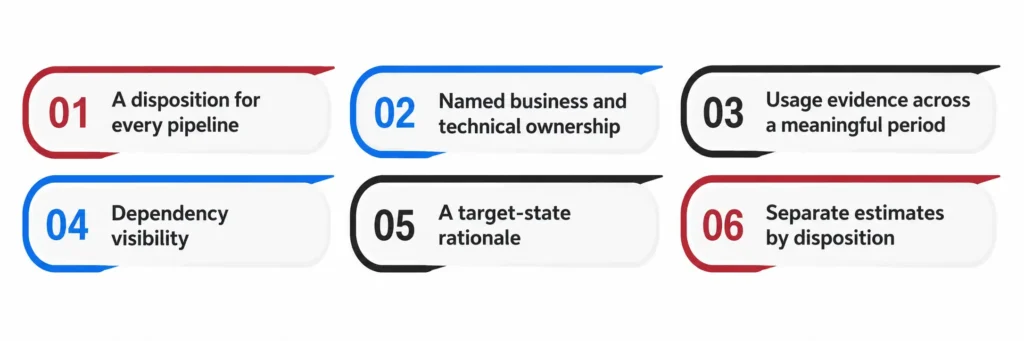
- A disposition for every pipeline: Retire, consolidate, retain, rebuild, migrate, or replace.
- Named business and technical ownership: Unowned assets need investigation rather than automatic inclusion.
- Usage evidence across a meaningful period: Seasonal workloads require longer observation than frequent workloads.
- Dependency visibility: Removal decisions must consider reports, models, applications, files, APIs, and operational processes.
- A target-state rationale: Architecture teams should explain why each selected workload belongs to Fabric.
- Separate estimates by disposition: Direct migration, redesign, consolidation, and retirement require different effort models.
How TestingXperts Helps Enterprises Rationalize ADF-to-Fabric Migration
TestingXperts approaches ADF-to-Fabric migration as a data platform modernization program, not a technical transfer exercise.
We begin by identifying which ADF workloads still create business value before unnecessary pipelines increase Fabric adoption cost. Our assessment and engineering capabilities help enterprises with:
- ADF inventory, usage, ownership, and dependency analysis
- Duplicate, obsolete, and low-value pipeline identification
- Technical debt and maintainability assessment
- Fabric compatibility and remediation analysis
- OneLake target architecture planning
- Pipeline, ETL, and data warehouse redesign
- Migration testing, reconciliation, and validation
- Cost, capacity, and release-readiness planning
This approach connects Cloud Data Engineering, ETL and Data Warehouse, Data and Analytics, and Data Testing around a single objective: preserving business value without making the migration complex.
Want to identify the ADF pipelines that you do not need to migrate? TestingXperts focused assessment can show which pipelines should move, which require redesign, and which should leave the estate before Fabric implementation begins.
Conclusion
An ADF-to-Fabric migration should not begin with a commitment to move every pipeline. It should begin with a clear view of what the enterprise no longer needs to carry. Before estimating the cost of migrating the full ADF estate, leaders should ask one question: What would we choose to build if the existing pipeline count were not dictating the answer? That answer can remove unnecessary scope before it becomes migration cost, operational expense, or another generation of technical debt.

SVP, Enterprise Sales
With over 20 years of experience, Jatin Molri drives enterprise sales and strategic growth at Tx. He specializes in AI-powered Quality Engineering, DevOps, Data Governance, Digital Transformation, and Enterprise Solutions. His expertise spans business strategy, sales leadership, account management, and channel partnerships, helping enterprises accelerate innovation and achieve business success.
FAQs
Discover more