Recommended Blogs

Is your Data Quality Debt Turning AI Investments into Business Risk

 Last Updated: July 9th, 2026
 Read Time: 5 minutes
Table of Content
- Why Data Quality Debt Has Become an AI Business Risk
- Why AI Programs Fail Before the Model Is Even Tested
- How Data Quality Debt Becomes AI Debt
- What Enterprises Must Validate Before Scaling AI
- Building the Data Assurance Layer for Trusted AI
- Conclusion
Share On


Enterprise AI does not fail only because the model is weak. It often fails because the business feeds it data that was never ready for enterprise decision-making. Consider a familiar enterprise scenario:
- A customer service AI assistant confidently quotes the warranty terms for a discontinued product because the knowledge base was never purged.
- A credit decision engine underwrites applicants from one region because a legacy system recorded incomes in a different format.
- A supply chain forecast misses a demand spike because two source systems define “order date” differently.
In each case, the model may appear to perform as designed. The deeper issue is that the data it consumed was not ready for the decision it was asked to support. This is the hidden risk sitting inside most enterprise AI programs. Years of accumulated data quality debt, including inconsistent definitions, stale records, undocumented transformations, and ungoverned sources, may have created inaccurate dashboards, reporting disputes, and manual reconciliation. But in many cases, the damage stayed contained because humans still interpreted the output before decisions were made.
When fed into AI systems, that same debt now shapes customer interactions, automated decisions, and compliance outcomes. The underlying data problems are the same one’s enterprises have had for years. What has changed is the scale of damage they can now cause.
Why Data Quality Debt Has Become an AI Business Risk
For years, poor data quality has been treated as an analytics issue. A mismatched field or a duplicated record produced an incorrect number in a report, and an experienced manager usually caught it before it caused harm. The impact radius was contained because a human review sat between the data and the decision.
In AI-driven systems, the same issue can influence a recommendation, trigger a workflow, shape a customer interaction, or affect a compliance-sensitive decision. Decision engines fed inconsistent inputs make inconsistent judgments, then apply them at machine speed and scale. The same data defect that once produced a single incorrect report cell can now affect thousands of customer interactions, workflow decisions, and regulatory submissions before anyone detects a pattern.
This is why data quality debt has moved from operational concern to an AI business risk. CIO’s June 2026 analysis of AI debt identifies data debt, including quality issues, manual pipeline steps, and pipelines lacking observability, as one of the most dangerous forms of AI debt. The reason is simple: data errors no longer stay contained inside reports. They cascade through models, pipelines, and downstream decisions.
Why AI Programs Fail Before the Model Is Even Tested
Many AI programs focus too much attention on model selection. Teams compare platforms, test prompts, choose architecture, and build pilots before asking whether the data foundation can support trusted outcomes. That is where the risk begins.
IBM describes AI data quality as extending beyond traditional measures of accuracy, completeness, and reliability. For AI systems, quality also includes representativeness, bias, label accuracy, and noise, all of which can directly affect model behavior.
However, when AI moves into production, it meets the enterprise data reality:
- Systems do not agree with each other.
- Data definitions vary by region or function.
- Knowledge bases contain outdated documents.
- Customer records are incomplete.
- Business rules are hidden inside legacy workflows.
- Ownership is spread across teams.
- Compliance controls are not consistently applied.
The model is often blamed when the deeper issue is data debt. Governance is partial, so nobody can say which datasets are authoritative and which are abandoned copies.
“AI does not fix data problems. It finds them, amplifies them, and attaches business consequences to them.”
How Data Quality Debt Becomes AI Debt
Data quality debt converts into AI debt the moment flawed data enters an AI system. The conversion is dangerous because the resulting errors are harder to detect. They surface as apparent outputs rather than obvious failures and are harder to reverse because retraining models and rebuilding knowledge bases cost far more than correcting a source record.
AI debt is the operational, governance, and remediation burden created when AI systems are built on data, rules, or knowledge sources that cannot be trusted at scale.
The conversion happens differently in each layer of the AI stack:
| Where Flawed Data Enters | How the Risk Materializes |
|---|---|
| Model training data | Biases and errors are learned as patterns; correcting them requires costly retraining, not a data fix. |
| RAG knowledge bases | Outdated or contradictory documents are retrieved and presented as authoritative answers to customers and employees. |
| Decision engines | Inconsistent inputs produce inconsistent rulings on credit, claims, pricing, or eligibility, creating fairness and compliance exposure. |
| Automation workflows | Bad data triggers real actions like incorrect orders, misdirected communications, wrongly escalated cases, at machine speed. |
This is why data quality debt is dangerous. It does not stay inside the data estate. It moves into operating decisions.
What Enterprises Must Validate Before Scaling AI
Scaling AI responsibly means validating the data foundation with the same severity applied to the models themselves. Before expanding any AI system’s scope, enterprises should be able to demonstrate evidence across eight dimensions:
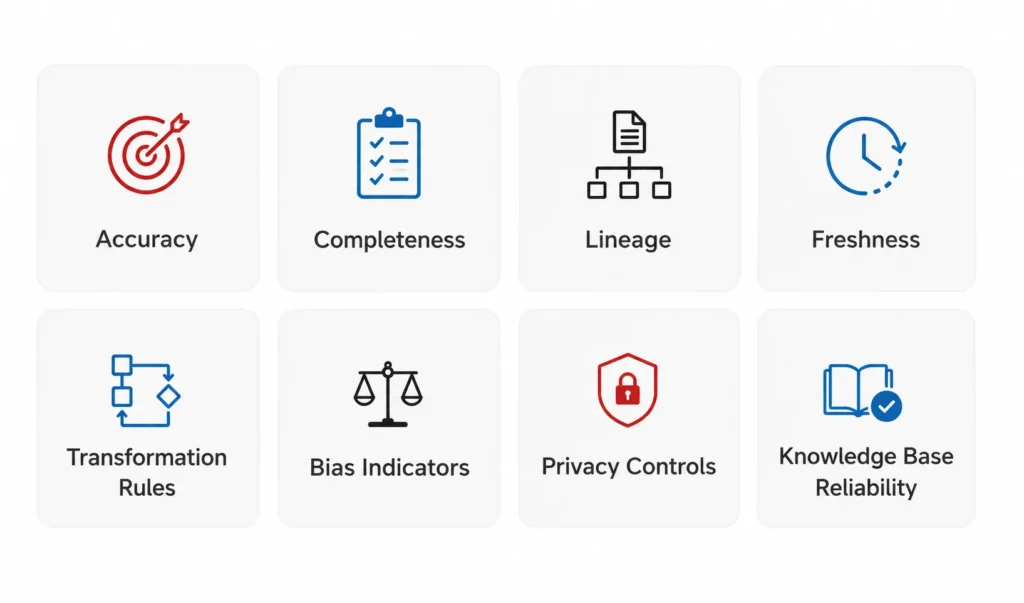
- Accuracy: Data values are verified against authoritative sources, not assumed correctly because they loaded without error.
- Completeness: Gaps and null-heavy fields are identified, and their downstream effect on model behavior is understood.
- Lineage: Every input feeding a model or knowledge base can be traced to its origin, including each transformation applied along the way.
- Freshness: Datasets carry defined refresh requirements, and stale data is flagged before it reaches AI systems, not discovered after.
- Transformation Rules: Pipeline logic is documented, tested, and monitored for drift, so identical source data cannot silently produce divergent outputs.
- Bias Indicators: Training and input data are profiled for skews across customer segments, geographies, and demographics before those skews become model behavior.
- Privacy Controls: Sensitive data is classified, masked, and access-governed across every environment AI systems touch, including test and retrieval layers.
- Knowledge Base Reliability: The documents grounding RAG systems are current, deduplicated, and free of contradictory versions.
Data quality cannot be treated as a one-time cleanup before AI deployment. It must become a continuous assurance layer.
Building the Data Assurance Layer for Trusted AI
Model selection, prompt engineering, and agent orchestration all matter, but none of them can compensate for an untrusted data foundation. Enterprises that scale AI on unvalidated data are not accelerating transformation; they are automating their existing data problems.
Building that foundation requires more than one-time data cleanup. It requires continuous validation across data pipelines, storage layers, analytics environments, knowledge bases, and AI workflows.
At TestingXperts, our data quality management and testing practice helps enterprises identify where data quality debt can become AI risk. We validate the controls, transformations, lineage, privacy rules, and data behaviors that AI systems depend on before they scale.
We cover the areas where data quality debt often becomes AI risk:
- ETL, data lake, and data warehouse testing to validate ingestion, transformation, schema integrity, and reporting accuracy
- Data integrity and validation services to check accuracy, completeness, format, consistency, and business-rule alignment
- Data analytics and BI testing to validate dashboards, reporting logic, and real-time decision outputs
- Automated data lineage and traceability checks across AI workflows and downstream systems
- Privacy, PII detection, compliance monitoring, and governance validation across production and test environments
- AI-ready data quality automation within CI/CD pipelines to support continuous validation
TestingXperts also supports AI-powered data governance, PII detection, and end-to-end data quality automation within CI/CD pipelines. Enterprises gain cleaner inputs, stronger traceability, better compliance control, and more reliable AI behavior. That is the foundation required for responsible AI scale.
Conclusion
Data quality debt is the one form of AI risk that predates every AI investment on your roadmap, and it compounds silently until an AI system makes it visible. Four questions will indicate where your organization stands:
- For our highest-priority AI use case, can we trace every data input back to a verified, governed source?
- When source data changes or degrades, would we know before our AI systems do?
- Have we profiled our training and knowledge base data for bias, staleness, and contradiction, or only for volume?
- If a regulator questioned an AI-driven decision tomorrow, could we produce the data evidence behind it?
Explore TestingXperts’ data quality management and testing services and get in touch with our experts to check the AI-readiness of your data foundation.

VP and Global Head Data & AI Practice
Results-oriented Data Analytics & AI Specialist with 24+ years of experience in multiple roles, including Practice Leader with P&L ownership. Expert in building Data Analytics practices, defining market strategies, and leading large-scale transformation initiatives. Skilled in Business Intelligence, Data Engineering, Cloud platforms (Azure, AWS, GCP), AI/ML, and Data Governance, with a strong focus on customer-centric solutions and strategic alliances.
Discover more