

Recommended Blogs

Why Data Pipelines Need Continuous Validation to Build Release Confidence
Table of Content
- Why Continuous Validation Matters for Pipeline Health
- Release Confidence: Redefining Data Pipeline QA
- Core Practices for Continuous Data Pipeline Validation
- Tools and Platforms Enabling Effective Pipeline QA
- Business Outcomes of Continuous Data Pipeline Validation
- How Can TestingXperts Assist with Continuous Data Pipeline Validation?
- Conclusion
Share On


Enterprise decisions increasingly depend on data pipelines that move information across cloud platforms, ETL workflows, analytics environments, and AI systems. As these ecosystems expand, even small changes in schemas, transformations, or integrations can create downstream failures that impact reporting accuracy, customer insights, regulatory compliance, and AI-driven decisions.
The challenge is that modern data failures are often silent. Pipelines continue to run successfully while delivering inaccurate, incomplete, or outdated data to downstream systems. By the time the issue is identified, dashboards have been consumed, business decisions have been made, and the impact can extend across multiple business functions.
Traditional QA approaches struggle to keep pace with the speed and complexity of modern data delivery. Release Confidence addresses this challenge by enabling Data QE teams to continuously validate pipeline health, detect issues early, and provide ongoing confidence that business-critical data remains accurate, reliable, and available across every release.
Why Continuous Validation Matters for Pipeline Health
Traditional QA approaches, often periodic or manual, cannot keep pace with the velocity of modern data pipelines. Even minor changes in source schemas, upstream systems, or ETL logic can propagate unnoticed across analytics platforms, AI models, and operational reporting.
This creates what we call the Confidence Gap; the difference between a pipeline that executes successfully and confidence that the data it produces is accurate, complete, timely, and fit for business use. Closing this gap requires continuous validation rather than relying solely on pre-release testing or periodic quality checks.
Continuous validation embeds quality checks directly into the data pipeline. By continuously monitoring transformations, schema conformity, data freshness, and business rules, organizations can identify anomalies before they affect downstream consumers or critical business decisions.
Beyond operational reliability, continuous validation strengthens executive confidence. Business leaders can rely on dashboards, reports, and AI-driven insights knowing that the underlying data has been continuously validated, reducing the need for manual verification and accelerating trusted decision-making.
Release Confidence: Redefining Data Pipeline QA
Release Confidence shifts Data QE from reactive problem-solving to proactive assurance. Rather than validating whether a pipeline simply executes successfully, it focuses on continuously validating whether the pipeline continues to produce trusted business outcomes after every change.
The approach combines automated validation, regression testing, schema monitoring, anomaly detection, and business-rule verification to continuously evaluate pipeline health. Instead of treating data quality as a periodic checkpoint, Release Confidence makes it an ongoing operational capability.
This shifts QA beyond technical validation. Teams no longer evaluate only whether data moves successfully through the pipeline, but whether the resulting data can be trusted for reporting, analytics, AI models, regulatory compliance, and operational decision-making. In doing so, Release Confidence aligns Data QE with enterprise governance, business risk, and executive confidence.
Core Practices for Continuous Data Pipeline Validation
Automated Data Quality Monitoring
Automated monitoring ensures that data quality is continuously evaluated rather than periodically reviewed. Every dataset is validated against predefined business and technical rules, including completeness, consistency, uniqueness, accuracy, and freshness. By identifying anomalies as they occur, organizations can prevent downstream reporting errors and maintain confidence in enterprise data.
For instance, in financial services, missing transaction records or delayed balance updates can result in regulatory non-compliance and fines. Automated monitoring validates every batch and streaming event against defined rules, maintaining compliance and operational integrity.
Regression Testing Across Pipelines
Every pipeline change introduces the possibility of unintended downstream impact. Whether the change involves a new source system, schema modification, or transformation logic update, continuous regression testing validates that historical business rules and data quality expectations continue to hold true across every release.
Teams often maintain reusable regression packs covering historical data scenarios, cross-module integrations, and business-critical workflows. Regression testing across pipelines reduces the risk of silent failures and ensures that analytics, dashboards, and machine learning models operate as intended after each change.
Schema Drift and SLA Monitoring
Schema drift is one of the most common causes of silent pipeline failures. Changes in upstream structures, field types, or expected formats can propagate through downstream systems without immediate visibility. Continuous validation detects these deviations early while simultaneously monitoring pipeline SLAs to ensure data arrives accurately, completely, and on time.
Monitoring SLAs ensures data arrives on time and in the expected format. Delays, missing records, or format inconsistencies are flagged automatically. This proactive oversight allows teams to maintain operational continuity even as pipelines evolve, scaling to meet enterprise demands without compromising quality.
Tools and Platforms Enabling Effective Pipeline QA
Continuous validation is enabled by a combination of data quality frameworks, observability platforms, automated validation, and anomaly detection capabilities. While individual technologies address specific aspects of pipeline health, they are most effective when implemented as part of a broader Release Confidence strategy that continuously governs data reliability.
| Capability | Purpose | Business Impact |
|---|---|---|
| Great Expectations and Soda Core | Codify validation rules and automate data quality checks across pipelines. | Standardizes validation processes and reduces manual testing effort. |
| Data Observability Tools | Provide visibility into data quality, lineage, schema changes, and transformation metrics. | Enables real-time monitoring of pipeline health and faster root-cause analysis. |
| Reusable Validation Rules | Apply consistent quality checks across multiple pipelines and environments. | Improves governance while reducing maintenance overhead. |
| Observability Dashboards | Track trends, anomalies, SLA adherence, and pipeline performance metrics. | Gives engineers and business teams immediate insight into operational health. |
| Automated Alerting | Detect issues such as unexpected null values, duplicate records, outliers, and missing batches. | Accelerates remediation and prevents downstream business impact. |
| Anomaly Detection | Identifies unusual patterns and behaviors beyond predefined rules. | Detects hidden risks that traditional validation approaches may miss. |
| Production Safeguards | Combine monitoring, alerting, and automated checks across deployments. | Strengthens Release Confidence and ensures reliable data delivery at scale. |
Business Outcomes of Continuous Data Pipeline Validation
Continuous data pipeline validation delivers benefits that extend well beyond engineering efficiency. By continuously validating pipeline health and data integrity, organizations strengthen Release Confidence, reduce operational uncertainty, and improve trust in enterprise data used for analytics, AI, compliance, and strategic decision-making.
The following outcomes are commonly achieved through continuous validation practices:
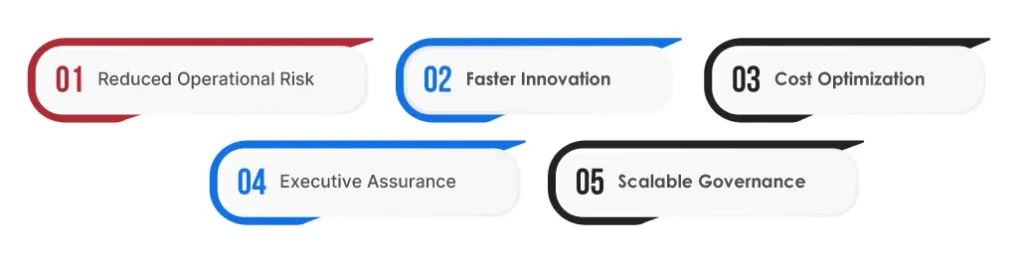
- Reduced Operational Risk: Early detection of data anomalies prevents errors from reaching business users or critical reports.
- Faster Innovation: Engineers spend less time on firefighting and more time on high-value initiatives, such as AI modeling and predictive analytics.
- Cost Optimization: Preventing late-stage defects reduces rework, downtime, and remediation expenses.
- Executive Assurance: Decision-makers can trust enterprise data, accelerating strategic decisions without manual verification.
- Scalable Governance: Multi-region and multi-cloud pipelines maintain quality standards consistently, enabling enterprises to expand without increasing operational risk.
Organizations adopting these practices see measurable improvements in pipeline reliability, analytics accuracy, and executive confidence, reinforcing data as a strategic asset.
How Can TestingXperts Assist with Continuous Data Pipeline Validation?
TestingXperts helps enterprises establish Release Confidence across modern data ecosystems by combining deep Quality Engineering expertise, automation, continuous validation, and enterprise governance practices. Our approach goes beyond validating whether pipelines execute successfully. It continuously validates whether the data produced can be trusted for business-critical decisions.
- End-to-End Pipeline QA: From data ingestion to consumption, we cover all stages with consistent validation.
- Automated Monitoring and Regression Packs: Pre-built assets for recurring validation, adaptable to specific enterprise pipelines.
- Anomaly Detection and Alerting: Real-time monitoring, integrated with operational workflows, enables rapid remediation.
- Tool Expertise: Implementation and optimization of Great Expectations, Soda Core, and observability platforms aligned with industry best practices.
By embedding continuous validation into enterprise data pipelines, TestingXperts ensures data integrity, operational resilience, and executive confidence.
Conclusion
Continuous data pipeline validation transforms QA from a reactive checkpoint into a continuous assurance capability. As enterprises become increasingly dependent on analytics, AI, and real-time decision-making, validating that pipelines execute successfully is no longer enough. Organizations must also continuously validate that the data produced remains accurate, reliable, and trustworthy.
Release Confidence enables this shift by embedding continuous validation, automated quality controls, and governance throughout the data pipeline lifecycle. The result is greater operational resilience, stronger executive confidence, and higher trust in enterprise data.
TestingXperts combines deep Quality Engineering expertise, advanced automation, and proven validation frameworks to help enterprises build reliable, scalable, and trusted data pipelines. As modern enterprises accelerate data-driven transformation, Release Confidence is becoming a foundational capability for maintaining data trust and enabling confident business decisions.


Michael Giacometti
VP, AI & QE Transformation
Michael Giacometti is the Vice President of AI and QE Transformation at TestingXperts. With extensive experience in AI-driven quality engineering and partnerships, he leads strategic initiatives that help enterprises enhance software quality and automation. Before joining TestingXperts, Michael held leadership roles in partnerships, AI, and digital assurance, driving innovation and business transformation at organizations like Applause, Qualitest, Cognizant, and Capgemini.
Discover more