Recommended Blogs

How to Build QA Quality Gates That Reduce Enterprise Release Risk
Table of Content
- Why Quality Gates Fail
- Map Signals to Release Risk
- Stabilize Automation Evidence
- Build AI-Governed QA
- How TestingXperts Assists
- Turning Automation Into Release Control
Share On


Why Quality Gates Fail
Quality gates are meant to protect release decisions; however, in many enterprises, they become another pipeline checkbox. Automated tests run at every build, static checks produce reports, dashboards show pass percentages, and teams still need manual calls before release approval.The problem is not the existence of gates. The problem is that many gates are not connected to business risk.
The DORA Report notes that AI adoption can improve individual productivity, flow, and job satisfaction, but it can also negatively affect software delivery stability and throughput when engineering fundamentals are weak. DORA also emphasizes that strong testing practices remain critical. That finding is important for enterprises adopting AI-assisted development, self-healing automation, and agentic QA workflows. Faster activity does not automatically create safer releases.
A weak quality gate usually has one or more technical flaws:
- It measures test volume instead of release risk.
- It treats all test failures with equal urgency.
- It lacks stable test data and environment control.
- It ignores business-critical workflow coverage.
- It reports pass rates without defect trend context.
- It allows AI-generated assets without review rules.
Technical scenario: An enterprise CI/CD pipeline runs automated tests on every build. Release managers still delay approval because failures are noisy, test data changes between runs, API mocks are outdated, and quality gates are not tied to critical payment, onboarding, or compliance workflows. The pipeline is active, but the release evidence is weak.
A quality gate should answer one question clearly: Is the release risk acceptable for the business workflow being changed?
Map Signals to Release Risk
Quality gates work only when technical signals are mapped to release risk. A failed unit test, a contract mismatch, a flaky UI script, a performance degradation, and a security warning should not be treated as the same type of evidence. Each signal needs a risk meaning, an owner, a threshold, and a decision rule.
Enterprises should begin by mapping critical business workflows. For a banking platform, that may include login, account summary, payments, transaction history, fraud alerts, and regulatory reporting. For healthcare, it may include appointment scheduling, eligibility checks, claims submission, patient data access, and audit trails. For retail, it may include search, cart, payment, order status, refunds, and inventory sync.
Once workflows are mapped, QA teams can define evidence layers:
| Evidence Layer | Technical Signal | Release Meaning |
|---|---|---|
| Code quality | Unit tests and static checks | Change is technically sound |
| API reliability | Contract and integration tests | Services can exchange valid data |
| Workflow coverage | Functional and regression tests | Critical journeys still work |
| Data readiness | Test data checks and masking controls | Validation data is stable and safe |
| Performance baseline | Load and response-time checks | Service can handle the expected demand |
| Governance signal | Defect trend and gate exception review | Leaders understand residual risk |
This mapping also improves AI-led QA. AI-assisted test design can suggest cases, predict defect-prone areas, or detect anomaly patterns. Those outputs become useful only when they are tied to approved risk categories and reviewed by responsible owners.
Warning signs: A gate is weak when teams override it frequently, when failures are unexplained, when dashboards show green despite production incidents, or when leaders cannot see which business workflows are protected.
Stabilize Automation Evidence
Automation is often blamed when quality gates fail, but the deeper issue is usually evidence stability. A test suite cannot support release control if it produces random failures, depends on unstable environments, uses unmanaged data, or lacks ownership. Enterprise teams need to distinguish between automation execution and automation evidence.
Stable evidence requires engineering discipline across framework design, test data, environment readiness, pipeline orchestration, and failure analysis. It also requires a clear rule for what happens when a gate fails. If every failure becomes a manual debate, the gate is not mature enough to guide release decisions.
Automation evidence checklist:
- Test cases map to critical business workflows.
- Flaky tests are quarantined and remediated quickly.
- Test data is versioned, masked, and reusable.
- API dependencies are validated through contract checks.
- Environment readiness is checked before execution.
- Failures are classified by root cause and risk level.
- AI-suggested tests go through human review.
- Dashboards show trends, not only current pass rates.
Enterprises using AI should add one more control layer.
AI-generated test cases, synthetic data, defect clusters, and predictive risk scores need traceability. Teams should know which model or tool generated the signal, which data was used, whether sensitive information was exposed, and who approved the recommendation.
The business value is direct. Stable automation evidence reduces approval delays, improves release predictability, protects automation investments, and provides executives with a clearer view of residual risk.
Build AI-Governed QA
AI can improve QA productivity, but ungoverned AI can also create new risks. McKinsey’s 2025 State of AI survey reports that 51 percent of respondents from organizations using AI have seen at least one negative consequence from AI use, with AI inaccuracy among the most reported issues. For QA leaders, this reinforces a practical point: AI-led quality practices need governance, not blind adoption.
AI-governed QA should define where AI can assist, where human review is required, and how outputs are validated.
Common AI-assisted QA use cases include test case generation, test impact analysis, defect clustering, anomaly detection, self-healing automation suggestions, risk-based regression selection, synthetic data generation, and release report summarization. Each use case should have an approved control model.
AI-governed QA model:
| AI Use Case | Required Control | Implementation Value |
|---|---|---|
| Test generation | Human review and coverage mapping | Prevents irrelevant or duplicate tests |
| Defect clustering | Defect owner validation | Improves trend analysis accuracy |
| Test impact analysis | Change traceability checks | Aligns regression with code changes |
| Self-healing scripts | Pull request review | Prevents silent locator drift |
| Synthetic test data | Privacy and masking review | Reduces data exposure risk |
| Release summaries | Evidence link validation | Keeps reporting auditable |
This model keeps AI practical. It allows QA teams to use AI for pattern recognition, analysis, and acceleration while preserving accountability. It also gives CIOs and CTOs a defensible position when boards or auditors ask how AI is being used in software delivery.
How TestingXperts Assists
Enterprise-quality gates are difficult to implement because they span tools, teams, and decision rights. TestingXperts helps organizations connect automation evidence, release workflows, AI-led insight, and governance into a practical operating model.
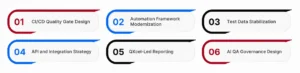
- CI/CD Quality Gate Design: TestingXperts defines pipeline checks with a clear release meaning. Gate rules can include unit coverage, API contract validation, regression health, performance thresholds, environment readiness, and exception workflows.
- Automation Framework Modernization: TestingXperts reviews automation architecture, flaky execution patterns, locator strategy, test data dependencies, and reporting gaps. The goal is to make automation stable enough to support release control.
- Test Data Stabilization: TestingXperts helps improve test data readiness through masking, reusable datasets, environment controls, and data refresh practices. This reduces false failures and protects sensitive information.
- API and Integration Strategy: TestingXperts strengthens validation across service dependencies, contracts, message flows, and third-party integrations. This is critical for distributed enterprise platforms where UI testing alone is too slow and incomplete.
- QXcel-Led Reporting: QXcel helps turn quality signals into roadmap-ready insights. It supports maturity assessment, risk prioritization, automation readiness, and governance reporting without removing human decision ownership.
- AI QA Governance Design: TestingXperts helps define human-in-the-loop review, AI output validation, prompt and data controls, and AI-assisted reporting safeguards. This gives leaders a controlled way to use AI in QA.
For teams improving enterprise quality gates, TestingXperts’ software QA consulting services help connect technical evidence with business release confidence. Talk to our testing expert about software QA consulting.
Turning Automation Into Release Control
Quality gates should not exist to slow teams down. They should reduce uncertainty at the point where release decisions carry business risk. That requires more than automation volume. It requires stable evidence, workflow-level coverage, AI governance, and reporting that leaders can use.
The technical model is straightforward. Map critical business workflows. Define risk-based evidence layers. Stabilize automation and data. Use AI to assist analysis under human review. Connect every gate to a decision rule, an owner, and a measurable outcome.
This is where QA consulting becomes valuable. A partner can assess current gates, identify evidence gaps, modernize automation practices, and help build a governance model that works across teams. TestingXperts supports this through QXcel-led consulting, CI/CD quality gate design, AI-governed QA guidance, and release evidence improvement. For enterprise leaders, the goal is not simply faster pipelines. The goal is release control that scales with software complexity, AI adoption, and business risk.


Manjeet Kumar
VP, Delivery Quality Engineering
Manjeet Kumar, Vice President at TestingXperts, is a results-driven leader with 19 years of experience in Quality Engineering. Prior to TestingXperts, Manjeet worked with leading brands like HCL Technologies and BirlaSoft. He ensures clients receive best-in-class QA services by optimizing testing strategies, enhancing efficiency, and driving innovation. His passion for building high-performing teams and delivering value-driven solutions empowers businesses to achieve excellence in the evolving digital landscape.
Discover more