Recommended Blogs

How to Choose a Software QA Consulting Company Without Increasing Release Risk
Table of Content
- Why Diagnose QA Challenges Before Choosing a QA Consulting Company?
- Evaluating the Operating Depth of a Software QA Consulting Company
- QA Consulting Company Vendor Scorecard for Enterprise Buyers
- How TestingXperts Supports Software QA Consulting and QA Maturity Improvement?
- Conclusion: Choosing the Right QA Partner With Confidence
Share On


Enterprise technology leaders are under pressure to release faster, adopt AI responsibly, and reduce business risk. According to McKinsey’s 2025 State of AI survey, 88 percent of respondents report regular AI use in at least one business function, but only about one-third say their companies have begun scaling AI programs. That gap matters to QA leaders because AI adoption increases delivery speed, data complexity, application changes, and model-related risks.
Software QA consulting is no longer only about testing more. It is about helping leaders understand whether release evidence is reliable enough to support business decisions.
Enterprises need to know whether critical workflows are tested, whether automation is stable, whether AI-assisted quality signals are governed, and whether production risk is visible before customers are affected.
A strong QA consulting company should help answer four executive questions:
- Are we testing the application areas that carry the highest business risk?
- Is automation reducing release effort, or is it only increasing maintenance?
- Can leaders trust QA dashboards during release approvals?
- Are AI-led testing practices controlled, explainable, and auditable?
The right partner brings structure to these questions. The wrong partner adds more test activity without improving release decisions.
Why Diagnose QA Challenges Before Choosing a QA Consulting Company?
Many enterprises begin the search for QA testing consulting after a visible delivery issue. A release slips. A production defect reaches a key customer. An automation suite becomes too unstable to trust. A regulatory review exposes weak testing evidence. These incidents are important, but they are often symptoms of a deeper operating problem.
The real problem may be fragmented test ownership, unclear coverage, inconsistent release gates, poor test data, duplicate regression effort, or weak automation architecture. In AI-enabled delivery environments, the problem may also include uncontrolled AI-generated tests, limited review of synthetic test data, weak prompt governance, or unclear accountability for AI-assisted quality decisions.
Enterprise scenario: A global organization has several product teams using different automation tools. Dashboards show thousands of automated tests per cycle. Yet release managers still delay approvals because failures are noisy, test data is unstable, and business-critical workflows are not mapped to release risk. The organization is testing heavily, but it is not producing trusted release evidence. Before selecting a QA consulting company, leaders should define the root issue.
Diagnostic questions to ask internally:
- Which releases create the highest customer or revenue risk?
- Which defects caused the greatest operational impact?
- Which test suites are trusted by release managers?
- Where does automation maintenance consume the most effort?
- Which dashboards influence go or no-go decisions?
- Where is AI used in test design, analysis, or reporting?
This diagnostic view helps prevent a common mistake: hiring a partner to expand execution when the enterprise actually needs QA governance, automation review, and risk-based strategy.
Evaluating the Operating Depth of a Software QA Consulting Company
A QA consulting company should bring more than skilled testers. Enterprise buyers need a partner that understands operating models, technical architecture, toolchain integration, QA governance, release cadence, and executive reporting. This is especially important for large organizations with multiple products, delivery squads, vendors, and compliance obligations.
Operating depth can be evaluated across three layers. The first is assessment quality. The partner should inspect test assets, defect trends, automation reliability, release gates, reporting flows, and stakeholder expectations. The second is engineering credibility. The partner should understand automation architecture, CI/CD integration, API validation, test data control, non-functional testing, and AI-led quality analytics. The third is change adoption. The partner should translate findings into a roadmap that internal teams can execute.
What to evaluate in a QA consulting partner:
| Evaluation Area | What Strong Looks Like | Business Relevance |
|---|---|---|
| QA maturity review | Process, tools, assets, and governance assessed together | Shows where QA risk originates |
| Automation advisory | Stability, coverage, maintainability, and ROI reviewed | Reduces wasted automation spend |
| AI governance | Human review, explainability, and data controls defined | Reduces uncontrolled AI risk |
| Release reporting | Quality signals tied to business-critical workflows | Improves executive release decisions |
| Roadmap design | Actions sequenced by risk, effort, and value | Converts assessment into execution |
Warning signs include generic maturity models, tool-first recommendations, unclear ownership, and reports that do not connect QA gaps to business outcomes. A credible consulting partner should explain how every recommendation affects release confidence, cost, risk, speed, or customer trust.
QA Consulting Company Vendor Scorecard for Enterprise Buyers
Vendor selection becomes easier when leaders use a structured scorecard instead of relying on brand familiarity or proposal language. A scorecard helps procurement, IT, QA, and business stakeholders compare providers against the same criteria. It also reduces the risk of choosing a partner that looks strong in delivery capacity but weak in consulting depth.
The scorecard should give weight to consulting fit, engineering fit, AI readiness, governance maturity, and measurement discipline. It should also test whether the partner can support global operating models across time zones, business units, and regulatory expectations.
QA consulting vendor scorecard:
| Criterion | Buyer Question | Business Relevance | Score |
|---|---|---|---|
| QA maturity expertise | Can the partner assess process, tools, and evidence? | Identifies root causes of release risk | 1-5 |
| Automation ROI review | Can the partner separate useful automation from waste? | Protects automation investment | 1-5 |
| AI-led QA capability | Can the partner govern AI-assisted testing safely? | Supports AI adoption without blind trust | 1-5 |
| Toolchain compatibility | Can the partner work with current systems? | Reduces migration cost and disruption | 1-5 |
| Release governance | Can recommendations support go or no-go decisions? | Improves executive confidence | 1-5 |
| Roadmap execution | Can the partner support pilot and scale planning? | Moves consulting from report to result | 1-5 |
Use the scorecard during vendor calls. Ask each provider to show how they would assess your current QA state, how they would prioritize risks, and how they would measure improvement. Strong QA consulting firms will welcome this level of scrutiny because it provides them with a clearer path to defining value.
How TestingXperts Supports Software QA Consulting and QA Maturity Improvement?
Enterprise QA improvement is difficult because most organizations are not starting from a blank slate. They already have tools, teams, automation assets, release calendars, vendor commitments, and reporting habits. TestingXperts helps leaders assess that reality and convert it into a practical improvement plan.
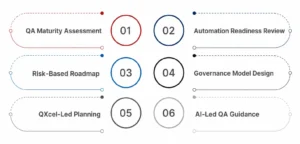
- QA Maturity Assessment: TestingXperts reviews QA processes, test assets, automation health, defect patterns, release controls, and reporting gaps.
The assessment identifies where QA risk is structural and where targeted changes can improve release confidence. - Automation Readiness Review: TestingXperts evaluates framework stability, flaky tests, coverage gaps, maintenance drag, and the value of the regression cycle.
The goal is to identify where automation reduces risk and where it increases effort without clear return. - Risk-Based Roadmap: TestingXperts prioritizes improvements by business impact, release urgency, application criticality, and remediation effort.
This helps leaders focus investment on changes that improve decision control. - Governance Model Design: TestingXperts helps define quality gates, release evidence expectations, escalation paths, reporting cadence, and ownership across QA, engineering, product, and business stakeholders.
- QXcel-Led Planning: QXcel provides a structured way to assess QA maturity, identify coverage gaps, review automation readiness, and build a measurable roadmap. It supports a consulting model that stays focused on business risk rather than generic QA activity.
- AI-Led QA Guidance: TestingXperts helps teams apply AI-assisted test design, predictive defect analysis, anomaly detection, self-healing automation concepts, and QA reporting intelligence under human governance.
This allows AI to support quality decisions without replacing accountability.
For enterprise teams evaluating QA partners, TestingXperts’ software QA consulting services provide a structured path to assess risk, prioritize improvements, and strengthen release confidence. Talk to an Expert about QA consulting services.
Conclusion: Choosing the Right QA Partner With Confidence
Choosing a QA consulting company is a business decision, not only a testing decision. The partner must help leaders reduce release uncertainty, improve the value of automation, govern AI use, and convert QA data into trusted decision signals.
The strongest providers will not begin by selling more execution.They will begin by asking where quality risk affects revenue, customer trust, compliance, and operational continuity. They will assess your existing QA model before recommending changes. They will also show how improvement will be measured through release speed, defect leakage, regression effort, automation stability, and governance maturity.
For CIOs, CTOs, CEOs, and COOs, the goal is not to expand the QA function. The goal is a QA model that helps the enterprise release with confidence. TestingXperts supports that goal through QXcel-led QA consulting, AI-aware quality governance, automation advisory, and release-focused improvement planning.
Use the scorecard, challenge generic claims, and ask every provider how their recommendations will improve release decisions. That is where QA consulting becomes a board-relevant investment instead of another delivery expense.


Michael Giacometti
VP, AI & QE Transformation
Michael Giacometti is the Vice President of AI and QE Transformation at TestingXperts. With extensive experience in AI-driven quality engineering and partnerships, he leads strategic initiatives that help enterprises enhance software quality and automation. Before joining TestingXperts, Michael held leadership roles in partnerships, AI, and digital assurance, driving innovation and business transformation at organizations like Applause, Qualitest, Cognizant, and Capgemini.
Discover more