Recommended Blogs

IoT Testing for Smart Grid Systems: The QA Strategy Energy Leaders Need in 2026

 Last Updated: June 2nd, 2026
 Read Time: 5 minutes
Table of Content
- Why Smart Grid Reliability Needs a Stronger QA Strategy in 2026
- Quality Now Sits Between IT And OT
- Where Smart Grid Risk Builds Across IoT, SCADA, and Smart Meters
- What IoT Testing for Smart Grid Systems Must Validate
- Why Real-Time Data Quality Testing Utilities Cannot Be Treated as Back-End QA
- Modernization Approaches Compared: Replace, Integrate, or Validate in Phases
- How Energy Leaders Should Choose the Right Testing Model
- How Can Testingxperts Assist With Embedded Software Testing Services?
- Conclusion
Share On


Smart grids do not fail in one dramatic moment. They usually fail through small gaps across devices, firmware, telemetry, integrations, and control systems. That is why IoT testing for smart grid systems now matters beyond conventional software QA.
The pressure is rising as grid digitalization moves closer to field operations. The International Energy Agency says distribution accounts for around 75% of grid-related digital infrastructure investment, including smart meters, sensors, substations, feeders, and transformers.
For energy leaders, the question is no longer whether smart grid modernization should continue. The sharper question is whether quality engineering can protect reliability as modernization continues.
Why Smart Grid Reliability Needs a Stronger QA Strategy in 2026
Utilities are connecting more field assets to enterprise systems than ever before. Smart meters, grid sensors, DER platforms, mobile workforce tools, and customer portals now exchange operational data constantly.
That connectivity creates value, but it also changes the reliability equation. A defect in one interface can affect billing, outage detection, load forecasting, or field response.
Quality Now Sits Between IT And OT
Traditional QA often focused on applications, workflows, and regression cycles. Smart grid QA must also validate device behavior, communication paths, data accuracy, and control responses.
NIST has long emphasized that smart grid devices and systems need rigorous conformance and interoperability testing. Its smart grid framework links testing directly with interoperability and cybersecurity needs.
Energy utility software QA now needs a broader operating model. It must cover software releases, firmware updates, network conditions, and field realities together.
Where Smart Grid Risk Builds Across IoT, SCADA, and Smart Meters
Risk rarely stays within a single smart grid component. It moves across devices, platforms, communication protocols, and business processes.
Smart meters may report inaccurate interval readings due to firmware defects or network instability. SCADA screens may show delayed telemetry because integration logic cannot handle event bursts.
Common risk zones utilities should test
Utility leaders should pay closer attention to these areas:
- Smart meter firmware behavior during upgrades, outages, and reconnections
- SCADA system testing across alarms, command execution, and operator workflows
- API validation between AMI, OMS, MDMS, billing, and analytics platforms
- Security validation across gateways, field devices, cloud services, and user access
- Data quality checks for interval reads, voltage events, outage signals, and tamper events
These risks can look technical at first. Yet their business impact reaches customers, regulators, field teams, and the revenue assurance team.
TestingXperts highlights similar grid reliability concerns across SCADA, DER, OMS, smart meters, and cloud services. Its energy grid testing perspective also stresses rollback validation during software and firmware updates.
What IoT Testing for Smart Grid Systems Must Validate
IoT testing for smart grid systems must validate behavior across the complete connected environment. Testing only the application layer leaves major operational blind spots.
A practical QA strategy starts with device behavior and then expands to communication, integration, security, performance, and operational recovery.
Core Validation Areas
Energy leaders should expect QA teams to cover these layers:
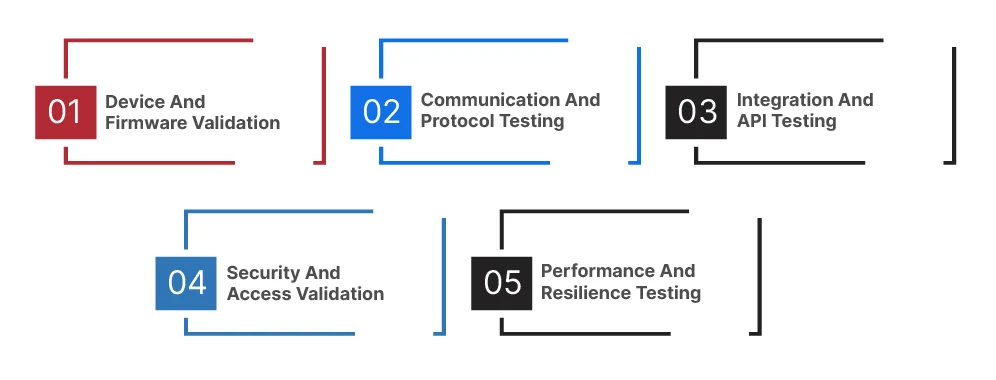
Device And Firmware Validation
Validate boot behavior, memory handling, power recovery, configuration changes, and firmware update paths.
Communication And Protocol Testing
Test communication stability across cellular, RF mesh, Wi-Fi, Ethernet, and utility-specific network conditions.
Integration And API Testing
Validate data exchange between AMI, SCADA, OMS, DERMS, MDMS, billing, and customer systems.
Security And Access Validation
Test authentication, authorization, encryption, certificate handling, and privileged access paths.
Performance And Resilience Testing
Simulate peak events, meter storms, outage surges, and degraded network conditions.
IoT device validation energy programs should also include negative testing. Devices must behave safely when inputs are incomplete, delayed, duplicated, or corrupted.
Why Real-Time Data Quality Testing Utilities Cannot Be Treated as Back-End QA
Real-time data quality testing utilities cannot sit at the end of delivery. Grid operations depend on fast, accurate, and trusted data from distributed assets.
A delayed outage signal can slow restoration planning. A duplicated meter event can distort analytics or trigger unnecessary field investigation.
Data Quality Testing Must Reflect Operational Timing
Smart grid data quality testing should validate more than database accuracy. It should test latency, sequencing, completeness, reconciliation, and event prioritization.
For example, a meter outage event must align with transformer, feeder, and customer impact data. That relationship matters when operators make restoration decisions.
Utilities also need stronger validation for streaming data and event-driven architectures. These environments behave differently during outages than during routine business cycles.
Data quality testing should include threshold events, missing packets, timestamp drift, retries, and message duplication. These issues often appear only when systems operate under stress.
Smart grid reliability depends on trust in telemetry. When operators stop trusting data, modernization loses credibility inside the utility.
Modernization Approaches Compared: Replace, Integrate, or Validate in Phases
Modernization choices affect QA strategy as much as architecture. A replacement program needs a different testing depth than an integration-led modernization path.
Energy leaders often face three practical options. Each option carries different costs, risks, and delivery implications.

Replace Legacy Platforms
A replacement provides teams with a cleaner architecture and newer capabilities. It also introduces migration risk, user adoption pressure, and parallel-run complexity.
This path fits utilities with aging platforms, heavy customization, and limited vendor support. QA must focus on migration accuracy, process continuity, and regression coverage.
Integrate Around Existing Systems
Layered integration protects prior investments while adding new capabilities. It can reduce disruption, but it may increase interface complexity.
This model suits utilities with stable core systems and urgent modernization needs. QA should prioritize API testing, data reconciliation, and cross-system workflow validation.
Validate In Phases
Phased validation reduces operational risk by proving capability in controlled increments. It works well for smart meter rollouts, DER programs, and SCADA upgrades.
The trade-off is a slower, more visible transformation. Still, phased validation often improves confidence across IT, OT, and business teams.
How Energy Leaders Should Choose the Right Testing Model
The right testing model depends on grid maturity, delivery pressure, and operational exposure. A single QA model rarely fits every utility program.
CIOs and CTOs should connect testing choices to business risk. That avoids both under-testing critical flows and over-testing low-risk components.
A Practical Decision Framework
- Choose automation-led regression testing when releases are frequent and workflows are stable. This works well for billing, portals, MDMS workflows, and integration regression.
- Choose performance and resilience testing when event volume can spike quickly. This applies to outage events, meter reads, reconnect requests, and demand response signals.
- Choose security-led validation when field devices, APIs, or remote access channels expand. This is essential for gateways, SCADA integrations, cloud platforms, and privileged users.
- Choose managed QA support when internal teams face capacity constraints. This helps utilities keep release velocity without reducing validation discipline.
- Choose field-simulation testing when device behavior depends on network variability. Smart meter testing services should include signal drops, power loss, retries, and firmware rollback.
The best model often combines several approaches. Smart grid QA works best when teams test based on operational consequence, not only application ownership.
How Can Testingxperts Assist With Embedded Software Testing Services?
TestingXperts supports energy and utilities teams with QA services designed for complex digital and operational environments. Its energy and utilities practice focuses on quality across business processes, decision-making, customer experience, and resource utilization.
For smart grid programs, TestingXperts can help validate embedded software, IoT devices, smart meters, SCADA integrations, APIs, data pipelines, and enterprise applications. This includes functional testing, test automation, performance testing, security testing, data quality testing, and regression coverage.
Its IoT testing services combine device labs, automation frameworks, and validation of the connected ecosystem. Teams can validate sensors, gateways, mobile applications, edge devices, and cloud back ends together.
TestingXperts can also support QA for energy sector modernization programs where IT and OT teams need shared confidence. That includes release validation, firmware update testing, interoperability checks, and real-time data quality assurance.
Conclusion
IoT testing for smart grid systems is becoming a strategic reliability discipline for energy utilities. It protects modernization programs from hidden failures across devices, data, networks, and control systems.
The strongest QA strategies connect technical validation with operational consequence. That means testing what can affect customers, field teams, regulators, and grid reliability.
Energy leaders entering 2026 need QA models that match the complexity of connected infrastructure. IoT testing for smart grid systems should become part of modernization governance, not a final checkpoint.

VP, Delivery Quality Engineering
Manjeet Kumar, Vice President at TestingXperts, is a results-driven leader with 19 years of experience in Quality Engineering. Prior to TestingXperts, Manjeet worked with leading brands like HCL Technologies and BirlaSoft. He ensures clients receive best-in-class QA services by optimizing testing strategies, enhancing efficiency, and driving innovation. His passion for building high-performing teams and delivering value-driven solutions empowers businesses to achieve excellence in the evolving digital landscape.
Discover more