Most TCoE programs fail early because organizations underestimate the operational and cultural complexity of running a testing center.
Tool-first TCoE strategies amplify inefficiencies when testing processes, ownership, and governance are not clearly defined.
Over-standardization without flexibility slows agile and DevOps teams and weakens overall testing effectiveness.
Skills gaps, change resistance, and lack of knowledge sharing are bigger barriers to TCoE success than technology limitations.
TCoEs deliver value only when success is measured through business-aligned metrics, not testing activity counts.
Sustainable TCoEs are built through phased execution, strong leadership ownership, and process-first implementation supported by experienced partners.
Most enterprises set up a Test Center of Excellence to bring consistency and control to testing. Many still struggle to see sustained value from it.
The issue is rarely tooling or budget. TCoE failures usually stem from unclear ownership, over-standardization, lack of enforcement and execution models that don’t align with how modern delivery teams work. Understanding where TCoE programs break down is essential before attempting to scale or reset them.
Why TCoE Implementation Is More Complex Than It Appears
A Test Center of Excellence is more than just a group of QA people in one place. It changes how testing works in every part of the business. It explains how testing goals fit with business value, how testing resources are shared, how quality standards are upheld, and how testing work fits in with development and business teams.
This is where many TCoE common mistakes begin.
People sometimes try to use old ways of thinking in new agile environments. They want to standardize processes. However, they don’t consider things like fast release cycles, working with people from different departments, old systems, and new testing methods like continuous testing, exploratory testing, and AI-driven testing solutions.
Even a well-funded TCoE can have trouble getting executives to support it or showing quantitative results if it doesn’t carefully assess the tools, testing methods, test environments, and the firm’s dedication.
1. Lack of Clear Ownership and Decision Authority
Unclear ownership is one of the first things that can stop a TCoE from being successful. When executive management doesn’t make it obvious who oversees making decisions, priorities get mixed up.
Testing teams have to wait for approval. Each team still tests in its own way. Business stakeholders lose faith when it is not clear who is responsible.
A good TCoE needs:
Clear support from the top.
Set rules for those who oversee testing and quality control.
Making sure that the QA, development, and business teams are all on the same page.
Without this, a testing center becomes more of a suggestion than a real thing, and Testing Center of Excellence failures are sure to happen.
2. Tool-Led Setups Without Process Readiness
Many companies start their TCoE journey by spending heavily on test automation tools, automation frameworks, or performance testing platforms. This makes sense, yet it’s one of the most typical mistakes people make when putting up a TCoE.
3. Tools Don’t Fix Broken Testing Processes
When test planning, test cases, test metrics, and feedback loops aren’t consistent. Automation makes things worse. Automated testing doesn’t add value when there isn’t enough test coverage or when testing isn’t linked to the development cycle.
This is where TCoE Setup Services come in. They assist businesses figuring out the order of process maturity before they start automating tests on a large scale.
4. Over-Standardization That Slows Agile and DevOps Teams
Standardization is important, but too much control is bad.
Many testing centers have strict rules for standardized testing that slow down release cycles, especially in agile settings. Individual teams have a hard time changing how they test based on how complicated the product is, how risky it is, or how hard the business is.
A strong TCoE sets limits, not strict regulations. It keeps things consistent while giving testing teams the freedom to make changes, which leads to ongoing improvement instead of roadblocks.
5. Skills Gaps and Change Resistance
Most of the time, when a TCoE arrangement fails, it’s because of people, not technology.
Companies don’t realize how important it is to have skilled workers who know how to do current software testing, security testing, test automation frameworks, and AI-driven testing. At the same time, manual testing teams are worried about losing their jobs, while development teams don’t want to be overseen from one spot.
Adoption stops when people don’t share expertise, get training, or show commitment to the entire organization. Teams have a hard time accepting new testing efforts, and the TCoE doesn’t reach its full potential.
TCoE Testing Metrics That Fail to Reflect ROI
Another big mistake that the Testing Center of Excellence makes is measuring the wrong results.
A lot of testing centers monitors:
Number of tests run
Time to run the test
Percentages of automation
These numbers don’t show how good the product is, how well the company manages risk, or how valuable the firm is.
Test Center of Excellences that do well focus on:
Reducing the amount of defect leaking
Test coverage for important workflows
Confidence in the release
Cost-effective use of testing resources
When test metrics match up with business problems, executives automatically agree.
TCoE Metrics That Reflect Actual Quality Outcomes
Metric
What It Tracks
Business Relevance
Defect Escape Rate
Issues detected in production or late test stages
Higher escape rates signal weak early testing and increase incident risk and fix costs
Feedback Turnaround Time
How quickly test results reach teams after code changes
Delayed feedback slows decisions, adds rework, and makes delivery timelines less reliable
Test Pipeline Reliability
Stability and consistency of automated test execution
Unreliable pipelines erode trust in release signals and delay deployments
Critical Flow Coverage
Validation of high-impact, business-critical user journeys
Gaps here raise the risk of failures that directly affect revenue or customers
Release Readiness Confidence
Clarity and risk awareness at release decision points
Low confidence leads to last-minute testing and overly cautious releases
Why Tool-First TCoE Strategies Fail to Scale
Strategies that put tools first, fall apart when they get too big because they don’t take context into account.
Companies often add new automation technologies to old ones, legacy systems, and testing processes that aren’t very good. This makes maintenance more difficult, slows down test execution time, and breaks up quality assurance efforts.
Even the best AI-driven testing tools won’t give you long-term benefit if you don’t have a clear TCoE framework that sets testing goals, governance, and integration with the software development lifecycle.
To scale TCoE testing, you need to follow the right steps.
How High-Performing TCoEs Address These Challenges
Successful TCoEs do things very differently.
They begin with:
A thorough assessment of existing testing methodologies and procedures
Alignment between delivery teams, upper management, and important stakeholders
Clear ownership and the power to make decisions
They make testing processes the same in the most important places, but they let people do them in different ways. They invest in test automation after ensuring that test planning, test environments, and Quality Assurance processes are stable. They build continuous testing and feedback loops for both business and development teams.
Most significantly, they see the TCoE as a center of excellence and not as a way to monitor things.
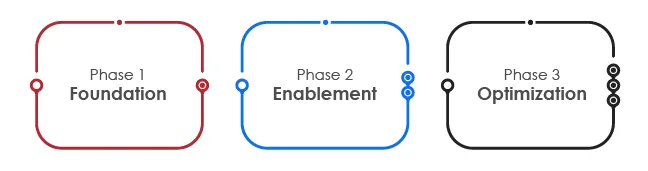
Building a Scalable TCoE: A Practical Execution Blueprint
A scalable TCoE changes over time.
Phase 1: Foundation
Set goals for testing and standards for quality.
Set up governance and support from the top.
Make sure that testing functions the same way for all teams.
Phase 2: Enablement
Standardized testing processes when differences impact quality.
Giving QA teams more skills and letting them share knowledge.
Adding automation frameworks step by step.
Phase 3: Optimization
Add automated testing, performance testing, and security testing.
Use AI-driven testing to cover more tests and save money.
Measure and analyse results that are important to the business.
Before putting the approach into use across the whole organization, many companies start with a pilot project to test it.
How Enterprises Work with TestingXperts to Build Sustainable TCoEs
Businesses usually cooperate with TestingXperts to lower risk, speed up the learning process, and avoid having to redo work that costs a lot of money during. This partnership is all about doing things.
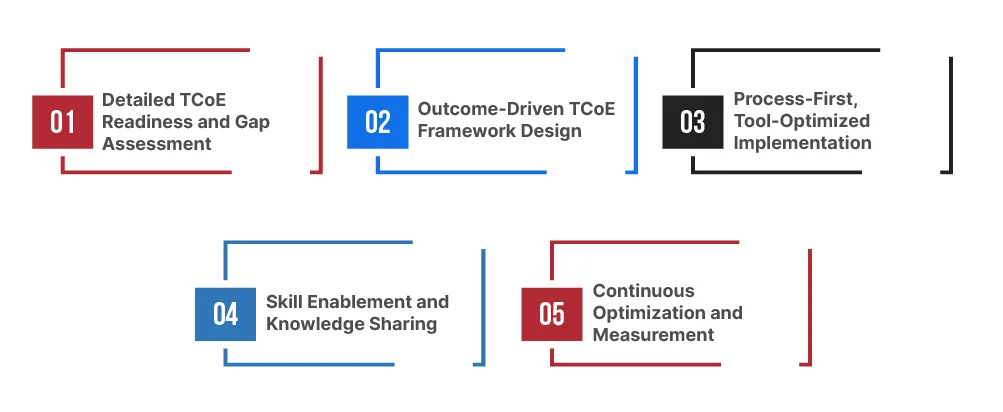
TestingXperts helps TCoE models that are long-lasting in important ways:
1. Detailed TCoE Readiness and Gap Assessment
Looking at current testing methods, tools, skills, and the maturity of the organization to find gaps that commonly lead to early TCoE setup failures.
2. Outcome-Driven TCoE Framework Design
Setting up governance, operating models, and standardized testing processes that are in line with business value, not merely testing speed.
3. Process-First, Tool-Optimized Implementation
Helping businesses make their testing processes and workflows more stable before they start using test automation, performance testing, and AI-driven testing solutions on a larger scale.
4. Skill Enablement and Knowledge Sharing
Structured enablement programs help testing teams learn new skills, which lowers resistance to change and builds the organization’s long-term ability.
5. Continuous Optimization and Measurement
Setting up useful test metrics, feedback loops, and models for ongoing improvement to make sure the TCoE keeps up with the needs of the business and technology.
Conclusion
A Test Center of Excellence works best when it is set up to be a long-term solution. Most of the time, the Testing Center of Excellence fails because they hurry through things, put tools ahead of procedures, and don’t think about how hard it is to alter an organization.
Companies that take explicit ownership, realistic sequencing, and measurable objectives into account while implementing TCoE are likely to see long-lasting benefits in software quality, consistency, and scalability.
If your company wants to set up or stabilize a TCoE, engaging with an experienced partner like TestingXperts can help you avoid common mistakes and create a TCoE that really helps your business. Get in touch with TestingXperts to find out how mature your existing testing is and how to make it better.
Experienced Director- Quality Assurance with a demonstrated history of working in the information technology and services industry. Skilled in Requirements Analysis, Agile Methodologies, Test Automation, Mobile Applications, and Test Management. Strong quality assurance professional with a Bachelor of Engineering - BE focused in Electrical, Electronics and Communications Engineering from Model Institute of Engineering and Technology.
FAQs
What is a testing center of excellence?
A Testing Center of Excellence (TCoE) is a centralized or federated model that defines testing strategy, standards, governance, and shared capabilities. Its goal is to improve quality, consistency, and cost efficiency across all applications and delivery teams.
When should you choose a testing center of excellence model?
You should adopt a TCoE when testing is fragmented across teams, quality varies between products, costs are rising, or governance is unclear. It’s especially effective in large enterprises scaling agile, DevOps, or multi-vendor delivery models.
What are the best practices for building a testing center of excellence?
Define clear ownership and executive sponsorship
Standardize where it impacts quality, not speed
Align testing metrics to business outcomes
Enable skills, not just tools
Evolve the TCoE in phases, not all at once
How to create a testing center of excellence (TCoE)?
Access current testing maturity, tools, skills, and delivery constraints.
Define governance, ownership, and business-aligned quality goals.
Standardize core testing processes where consistency impacts quality.
Enable teams through training, knowledge sharing, and role clarity.
Introduce automation gradually and track success using business-focused metrics.