Recommended Blogs

Avoid Costly Picks: Selecting the Right Salesforce Testing Partner for Maximum ROI
Table of Content
- Why Is Choosing the Right Salesforce Testing Partner Important?
- An Executive Checklist for Salesforce Testing Partner Evaluation
- How Can You Ensure Functional and Non‑Functional Testing Coverage?
- Commercial and Contractual Safeguards to Mitigate Risk
- TestingXperts’ Expertise in Salesforce Testing: Your Strategic Advantage
- Conclusion
Share On


For enterprises, Salesforce is one of the most popular customer success platforms. That’s why it’s critical to select the right Salesforce testing and implementation partner carefully. It will become a backbone for revenue, service, and customer data. However, according to CISQ research, the cost of poor software quality has grown to at least $2.41 trillion, highlighting the quality gaps that lead to rework, outages, and security exposure. Leaders must consider quality engineering as a dependable activity for achieving a better return on investment in CRM.
Why Is Choosing the Right Salesforce Testing Partner Important?
The majority of organizations have never established in-house Salesforce QA teams. They prefer to outsource it to a professional testing service provider. However, selecting reliable Salesforce testing partners takes time to research and deliberate. Even a thorough implementation can have defects that affect Salesforce adoption and regulatory posture. In simple terms, a Salesforce testing partner affects ROI in three ways:
- Speed up defect discovery before go-live, improve release time, and decrease change fatigue.
- Address defects in access controls, automation, or integrations to secure customer data and core processes.
- Improve quality control to reduce recurring costs, streamline data cleanup, and minimize reactive fixes.
Enterprises should understand that Salesforce testing is not just about finding bugs. It ensures that your platform delivers intended outcomes under a real operating environment. That’s why choosing the Salesforce testing provider must be based on capabilities, not empty promises.
An Executive Checklist for Salesforce Testing Partner Evaluation
Your Salesforce partner evaluation checklist must be evidence-based. Always ask for delivered business results, not just assurances. Let’s take a quick look at the checklist for evaluating your Salesforce QA partner:
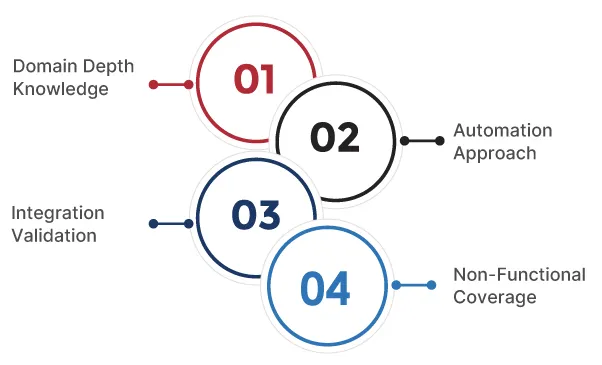
Domain Depth Knowledge:
Must have expertise across Sales Cloud, Service Cloud, Experience Cloud, CPQ, and marketing integrations. The vendor must have streamlined testing flows, apex triggers, approval processes, and validation rules. You must ask for a test strategy demo and an anonymized defect taxonomy from the potential vendor.
Automation Approach:
The test automation approach must have defined ROI, CI/CD alignment, and maintainability standards. Your potential Salesforce automation testing partner must have a working plan to manage metadata volatility across sandboxes. Ask for a framework overview, a sample sprint plan, and governance metrics.
Integration Validation:
Your integration coverage must include APIs, ETL tools, ERP systems, billing systems, marketing automation platforms, and data platforms. The QA services provider must implement a robust mocking strategy and end-to-end reconciliation controls to validate integration between components. Ask for an integration test plan, API test examples, and a reconciliation approach.
Non-Functional Coverage:
A right Salesforce consulting partner must be able to assist with performance testing for peak usage, integration, and concurrency constraints. It must be able to perform cybersecurity testing and reliability testing to check failure scenarios, sharing/permission rules, and error-handling behaviors.
Other factors include quality governance and reporting, certifications and credibility checks, post-implementation support for Salesforce testing, data migration, and quality controls. Using this checklist for selecting Salesforce testing providers will help you assess their QA maturity level and determine if it aligns with your business model.
How Can You Ensure Functional and Non‑Functional Testing Coverage?
One point that enterprises often overlook is the capability of QA partners in terms of functional and non-functional test coverage. When assessing a Salesforce partner’s technical skills, make sure to analyze the following areas:
Functional Coverage for Business Outcomes:
A credible Salesforce implementation partner should be able to test and validate across:
- Regression coverage aligned to release trains and hotfix patterns
- Lead-to-cash and case-to-resolution journeys
- Integrations and handoffs to ERP, CPQ, data platforms, or marketing automation
- Data migration checks
- Approval processes, flows, and validation rules
Non-Functional Coverage for Enterprise Protection:
Your Salesforce Implementation ROI will depend on non-functional test coverage, which includes:
- Performance and scalability testing to validate the performance of batch job operations and integrations under stress.
- Cybersecurity and access control testing to validate profiles and set permission and sharing rules.
- Reliability and resilience testing to validate integrations and handle errors.
- Observability testing to confirm alerts, monitoring, and logs for incident response.
Commercial and Contractual Safeguards to Mitigate Risk
The success of your Salesforce implementation depends on the accountability and safeguards used during each stage. One must start by defining the scope of the business processes (lead-to-cash, key integrations, and case management). Then check which environments need to be tested and what the definition of your “release-ready ” is. After that, list the exact outputs you expect by choosing the Salesforce testing provider (test strategy, test cases, automation, execution reports, and release sign-off).
Next, define accountability and decision-making. This includes:
- Severity definitions
- Triage frequency
- Clear ownership between the Salesforce implementation partner and the testing team
- Escalation paths
Your executive reporting should highlight residual risks, readiness status, and open critical issues. This will keep the Salesforce partner’s evaluation outcomes focused.
Finally, protect ROI through commercial controls and continuity guardrails. Leverage change-control terms to ensure transparency in pricing for the contract period. Specify ownership for automation code, documentation, and test assets, and include an existing and transition clause. This would reduce dependency and support post-implementation support for Salesforce testing.
TestingXperts’ Expertise in Salesforce Testing: Your Strategic Advantage
Salesforce is a critical CRM platform that integrates with every component of your organization. However, its implementation brings critical complexity. At TestingXperts, our Salesforce testing services ensure every Salesforce customization, flow, integration, and cloud is engineered for scalability, performance, and compliance. Our Salesforce-native QA architecture and test automation expertise focus on enhancing predictable release quality and minimizing operational disruptions. Our expertise delivers:
- 60% faster release cycles
- 55% reduced production defects
- 35% QA operations cost reduction
- 70% accelerated time-to-value for new features
Contact our Salesforce experts to find out how we can help you in the successful implementation of your CRM platform.
Conclusion
Selecting the right partner directly affects ROI, risk, and time-to-value. Utilize a structured Salesforce partner evaluation approach and support your decision with commercial safeguards that ensure accountability. This approach transforms the criteria for Salesforce partner selection into observable performance, reducing the likelihood of costly mistakes. TestingXperts QE model supports your Salesforce implementation with a tailored test strategy, post-go-live assurance, and automation-led regression.


Ashwani Narula
Associate Vice President Delivery
Experienced Director- Quality Assurance with a demonstrated history of working in the information technology and services industry. Skilled in Requirements Analysis, Agile Methodologies, Test Automation, Mobile Applications, and Test Management. Strong quality assurance professional with a Bachelor of Engineering - BE focused in Electrical, Electronics and Communications Engineering from Model Institute of Engineering and Technology.
FAQs
What deliverables should we expect from a Salesforce testing engagement?
From a Salesforce testing engagement, you will receive a:
- Test strategy
- Test plan
- Test cases
- Execution reports
- Defect logs
You can also expect automation scripts, regression suite coverage, and release readiness sign-off inputs.
How does a Salesforce testing partner build a test strategy for our business processes?
A Salesforce testing partner, such as TestingXperts, maps your business processes to Salesforce workflows, roles, integrations, and data paths. They then define test scope, priorities, environments, and entry-exit criteria based on risk.
How do we choose the right Salesforce testing partner for our implementation?
Select a partner with demonstrated Salesforce testing experience across similar implementations and release models. Validate their automation approach, security testing capability, governance, and reporting quality.
How does a Salesforce testing partner conduct Salesforce security testing and vulnerability checks?
A Salesforce testing partner reviews your enterprise configuration, profiles, permission sets, sharing rules, and data access to spot exposure risks. They also test integrations, APIs, and authentication flows to identify vulnerabilities.
How does a Salesforce testing partner plan regression testing across multiple release trains?
They identify critical business journeys and automate stable regression tests to reuse across releases. They schedule regression runs for each release cycle, manage test data, and update suites for new changes.
Discover more