

Recommended Blogs

DevSecOps with Agentic AI: Autonomous Security Testing in CI/CD Pipelines
Table of Content
- AI Agents in DevOps and Security
- How Agentic AI Enhances DevSecOps
- Strengthening Security in DevSecOps with Agentic AI
- How to Successfully Implement DevSecOps with Agentic AI?
- How Does Agentic AI Strengthen CI/CD Pipelines?
- Future Impact of AI Agents on DevSecOps Practices
- How does Tx Help You Streamline DevSecOps Pipeline with Agentic AI?
- Summary
Share On


The new digital era is powered by Artificial Intelligence Solutions, which brings endless possibilities and innovative opportunities. It all started with early AI trends like LLMs, which are drastically reshaping our digital ecosystem. Metaverse, Autonomous Vehicles, VR gaming, and GenAI are just some examples of AI’s influence on our lives. As businesses were shifting to AI-first strategies, there came the new update, “Agentic AI.” It is enabling enterprises to make autonomous decisions and transform how they approach DevOps and security, or DevSecOps.
AI Agents in DevOps and Security
Agentic AI in DevSecOps enables autonomous, goal-driven AI agents to secure, optimize, and manage DevOps and security pipelines. Instead of embedding security into DevOps, Agentic AI takes initiative, facilitates decision-making, and coordinates tasks across tools and teams. It helps DevSecOps evolve from rule-based automation to intelligent orchestration. Agentic AI can continuously monitor logs, network traffic, and runtime behavior.
Unlike traditional automation, Agentic AI in software testing proactively detects security issues, assesses risk, and takes suitable actions with minimal human supervision. AI agents can run security tests based on context, enforce compliance, and respond to real-time incidents. Enterprises can significantly improve the speed and consistency of their security operations across CI/CD pipelines. By combining autonomy and intelligence with DevSecOps workflows, AI Agents can enable continuous and adaptive security. They can function as goal-driven security agents to reduce manual work, accelerate remediations, and make security an integral part of the entire SDLC.
How Agentic AI Enhances DevSecOps
Agentic AI enhances DevSecOps by automating security testing and optimizing vulnerability management across the development pipeline. With AI-powered DevSecOps tools, Agentic AI scans code, configurations, and infrastructure for potential security risks in real time, providing actionable insights without slowing down the development process.
With real-time threat intelligence with AI, it can quickly detect upcoming vulnerabilities and provide automatic alerts, ensuring that issues are addressed before they escalate. Agentic AI in DevSecOps continuously monitors both known and unknown threats, enabling organizations to respond faster and with greater precision.
With AI agents in DevSecOps pipelines, tasks such as vulnerability scanning, patch management, and compliance checks are automated, thereby reducing manual effort and the potential for human error. This allows security teams to focus on more complex problems while maintaining a high level of protection.
Strengthening Security in DevSecOps with Agentic AI
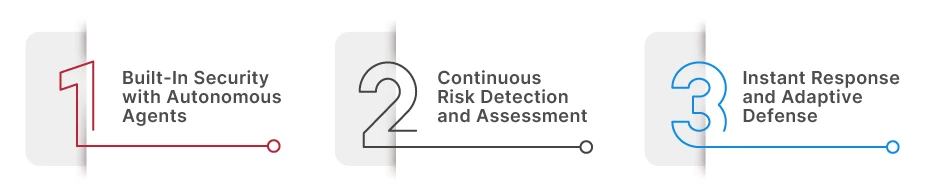
Agentic AI brings a brand-new security approach to DevSecOps. It seamlessly collaborates with vulnerability scanners to automatically detect and resolve security issues before escalating them into production. By Leveraging AI Agents, Enterprises can automate routine tasks like vulnerability patching and reduce the time needed for incident detection and resolution. Here’s how Agentic AI strengthens security in DevSecOps:
Built-In Security with Autonomous Agents:
Agentic AI embeds security directly into development workflows, making it a core component rather than an add-on. Autonomous agents continuously monitor systems and execute policies, ensuring compliance without disrupting productivity.
Continuous Risk Detection and Assessment:
Instead of relying on periodic scans, agentic AI performs real-time vulnerability assessments using models trained on security data. These agents also detect anomalies early, flagging threats before they become critical.
Instant Response and Adaptive Defense:
Agentic AI enables immediate responses to incidents, such as isolating compromised systems during a breach. These agents refine their strategies through continuous learning, helping organizations adapt to emerging threats effectively.
How to Successfully Implement DevSecOps with Agentic AI?
If you want to integrate DevSecOps with Agentic AI successfully, here’s a practical approach to get started:
Assess Current Security Practices: Evaluate your existing development and security processes to identify gaps and areas for improvement. This helps tailor AI-powered solutions to your specific needs.
Integrate AI Tools into DevOps Pipelines: Implement AI agents in DevSecOps pipelines to automate security testing, vulnerability scans, and threat monitoring. This enables real-time detection and response without slowing development.
Automate Threat Detection: Utilize Agentic AI to continuously analyze code, configurations, and infrastructure for vulnerabilities. Set up alerts to proactively mitigate risks before they escalate.
Continuous Monitoring and Response: Implement real-time threat intelligence with AI to ensure your environment remains secure at all times. Allow the system to suggest automated remediation or notify security teams for quick action.
Training and Awareness: Ensure your teams understand the integration of AI into DevSecOps workflows. This helps optimize the use of AI tools for better security results.
Thinking about upgrading your pipeline? This is where TestingXperts can support you with AI-driven DevSecOps implementation, automated security testing, and continuous compliance alignment—helping you ship faster without losing control of security.
How Does Agentic AI Strengthen CI/CD Pipelines?
|
Function |
Description |
Tools & Technologies Leveraged |
| Proactive Security Integration | Agentic AI integrates security checks at every CI/CD stage, ensuring early vulnerability remediation. | Checkmarx, SonarQube, GitHub Actions Security Rules. |
| Context-Aware Testing and Scanning | Triggers targeted scans based on risk context, reducing unnecessary test cases when handling security. | Synk, OWASP ZAP, GitLab CI with conditional jobs. |
| Autonomous Decision-Making and Adaptation | Based on current risks, make decisions during the pipeline (e.g., pause builds and adjust workflows). | Open Policy Agent (OPA), Jenkins Pipelines with AI plugins. |
| Real-time Incident Handling | Detects incidents in real-time and takes immediate action, like isolating systems and notifying teams. | Falco, AWS Lambda for auto-remediation. |
| Intelligent Tool Orchestration | Coordinates multiple tools intelligently, selecting the best one based on task and context. | Kubernetes Operators, Terraform Cloud. |
| Continuous Compliance Monitoring | Monitors security and compliance rules continuously, preventing violations before deployment. | HashiCorp Sentinel, AWS Config Rules, Prisma Cloud. |
| Increased Speed and Efficiency | Automates repetitive tasks and optimizes pipelines, reducing development and deployment times. | CircleCI, Azure DevOps, Harness.io. |
Future Impact of AI Agents on DevSecOps Practices
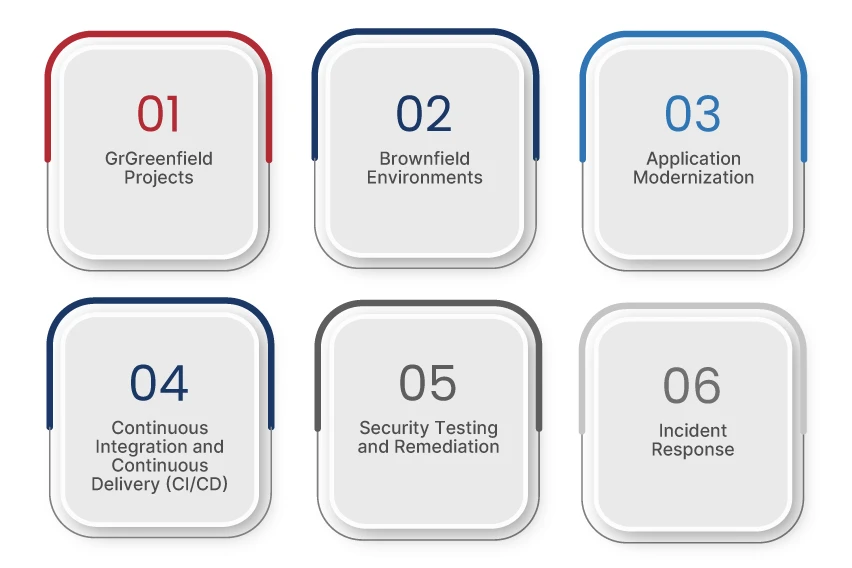
Greenfield Projects:
When developing new software, AI agents can accelerate the development cycle by generating initial code staging, implementing cloud infrastructure using Infrastructure as Code (IaC), and recommending architectural patterns based on project goals. These agents can also execute security best practices from the start, such as secure configurations and dependency management. This will make “secure by design” more achievable from day one.
Brownfield Environments:
In legacy systems, AI agents can analyze outdated codebases to detect outdated libraries, hardcoded secrets, and unpatched vulnerabilities. They can assist in refactoring by identifying technical debt and suggesting modernization paths. Additionally, agents can help containerize legacy applications, convert monoliths to microservices, and reduce manual migration overhead.
Application Modernization:
AI can streamline the application modernization process by automating the identification of outdated APIs, mapping service dependencies, and recommending cloud-native alternatives. It can support enterprises in containerization, migration to serverless platforms, and decoupling of tightly integrated components. By automating regression testing and updating CI pipelines, agents reduce risk during modernization while improving deployment velocity.
Continuous Integration and Continuous Delivery (CI/CD):
AI agents enhance CI/CD by dynamically adjusting build and test workflows based on code changes, risk levels, and historical trends. They can identify flaky tests, predict deployment failures, and reroute workflows for optimal efficiency. Over time, these agents learn from pipeline performance and adapt to reduce bottlenecks, increase test coverage intelligently, and shorten feedback loops.
Security Testing and Remediation:
AI agents elevate security testing by integrating real-time SAST/DAST scans based on the nature of the code changes, not just fixed schedules. They can prioritize vulnerabilities by context (e.g., reachable from external interfaces), suggest fixes based on learned patterns, and even generate secure patches for known issues. This proactive and contextual security handling reduces developer fatigue and shortens remediation time.
Incident Response:
During incidents, AI agents can correlate signals from various sources, such as logs, metrics, and user behavior, to detect threats early and determine their scope. They can execute predefined runbooks or dynamically assemble responses. Post-incident agents assist in root cause analysis and update monitoring or detection rules based on what was learned.
How does Tx Help You Streamline DevSecOps Pipeline with Agentic AI?
Integrating security into fast-paced development workflows becomes critical and complex as businesses accelerate digital transformation. Tx addresses this challenge by combining its deep expertise in DevSecOps with the emerging power of Agentic AI to streamline and secure the entire CI/CD pipeline.
We leverage our proprietary accelerator, Tx-DevSecOps, to seamlessly embed security into your development lifecycle. This tool automates security testing, including Dynamic Application Security Testing (DAST) within the CI/CD pipeline, ensuring vulnerabilities are caught and resolved before deployment. It supports a shift-left approach, enabling early risk detection and proactive remediation without slowing delivery.
Our AI-driven accelerators, such as Tx-SmarTest and Tx-HyperAutomate, enhance DevSecOps automation by optimizing test coverage, identifying anomalies, and adapting test strategies. These agents can intelligently monitor pipeline behavior, suggest security improvements, and even take preemptive action when risks are detected.
Together, Tx’s DevSecOps and AI capabilities offer a future-ready framework that protects your software and evolves with it. By combining security, automation, and intelligent decision-making, we ensure your DevOps processes remain agile, compliant, and resilient in the face of modern threats.
Summary
Agentic AI enhances DevSecOps by enabling autonomous security testing services, real-time threat detection, and intelligent pipeline management. It helps integrate security early in the CI/CD process, automates risk assessment, and supports incident response. Tx applies this approach through tools like Tx-DevSecOps, Tx-SmarTest, and Tx-HyperAutomate to streamline development and ensure secure deployments. By combining automation with adaptive learning, we support faster releases, improved code quality, and stronger security across both new and legacy systems. To learn how we can assist you, contact our experts now.


Michael Giacometti
VP, AI & QE Transformation
Michael Giacometti is the Vice President of AI and QE Transformation at TestingXperts. With extensive experience in AI-driven quality engineering and partnerships, he leads strategic initiatives that help enterprises enhance software quality and automation. Before joining TestingXperts, Michael held leadership roles in partnerships, AI, and digital assurance, driving innovation and business transformation at organizations like Applause, Qualitest, Cognizant, and Capgemini.
FAQs
What is Agentic AI in the context of DevSecOps?
Agentic AI in DevSecOps refers to autonomous, decision-making AI agents that proactively manage and optimize development, security, and operations tasks. These agents continuously learn, adapt, and act within CI/CD pipelines to enforce security, improve code quality, and accelerate delivery.
How is Agentic AI different from traditional DevSecOps automation?
Unlike traditional automation, which follows predefined rules or scripts, Agentic AI operates autonomously. It can reason, learn from context, make decisions, and act dynamically. It allows intelligent responses to real-time changes, emerging threats, or code anomalies in DevSecOps workflows.
What benefits does Agentic AI bring to CI/CD pipelines?
Agentic AI enhances CI/CD pipelines by accelerating delivery, reducing human intervention, and proactively resolving issues. It enables real-time vulnerability mitigation, smarter test coverage, adaptive deployment strategies, and continuous security enforcement.
How does Agentic AI improve security testing?
Agentic AI improves security testing by autonomously identifying, prioritizing, and addressing vulnerabilities throughout the pipeline. It continuously learns from past threats and adapts to evolving attack patterns, enabling proactive threat detection and remediation during development.
Discover more