Recommended Blogs

How does Data Engineering in Retail Maximize Efficiency?

 Last Updated: June 3rd, 2026
 Read Time: 7 minutes
Table of Content
- Data Engineering in Retail
- Benefits of Data Engineering in the Retail Industry
- Data Engineering Use Cases in the Retail Industry
- How Do AI And Big Data Deliver Real-time Consumer Insights In Retail?
- Data Engineering Tools For Managing Inventory In A Way That Predicts Future Needs
- Data Pipelines For Tailored Shopping Experiences
- How can Tx help with Data Engineering in Retail?
- Summary
Share On


With high competition and rising consumer expectations, retailers always seek new tech solutions to improve their operational efficiency and CX in the retail industry. But the question is, “How can they keep up with these demands and remain competitive?” The answer is “data engineering.” As businesses require better data analytics systems, they need new ways to facilitate access to high-quality information for data scientists, analysts, and other stakeholders. Data engineering offers actionable insights to support strategic decisions, implement innovative tech solutions (AI, RPA, etc.), and optimize operations to improve business profit margins.
According to McKinsey & Company, organizations using data and digital technologies benefit significantly from decision-making and operational performance. It’s not just about handling data but rather about converting it into an asset supporting informed decision-making and better business outcomes. The best way to achieve this is by utilizing big data and behavior retail analytics, making the best plans and decisions, understanding customer requirements, uncovering market trends, and more.
Data Engineering in Retail
Data engineering is about designing and building systems to collect, store, and analyze data at scale. Retailers can collect huge amounts of data and assign the right technology and people to ensure its usability when it reaches data analysts and scientists. Implementing data engineering in the retail sector involves systematic data collection, storage, and processing to ensure it is accessible, reliable, and available for analysis. During the process, the data engineer performs the following tasks when working with data:
• Acquire datasets aligning with business requirements
• Support data streaming systems development
• Leveraging new systems for data analytics and BI operations
• Develop BI reports and algorithms to transform data into actionable and useful insights
• Build, test, and streamline database pipeline system
• Build new data validation methods and analytics tools
• Ensure compliance with security protocols and data governance policies
Benefits of Data Engineering in the Retail Industry
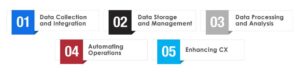
Almost 62% of retailers say using information and analytics gives them a competitive advantage, compared to 63% of cross-industry leaders. To better understand the role of data engineering in the retail industry, let’s take a look at the following factors that allow retailers to unlock significant efficiencies in their operations:
Data Collection and Integration:
Data engineering helps collect and integrate data from diverse sources, such as POS systems, online transactions, supply chain operations, and user feedback. It ensures that information is seamlessly integrated and offers a holistic view of business operations. Data integration allows for more accurate inventory management, personalized marketing strategies, and demand forecasting.
Data Storage and Management:
After collecting data, it must be stored securely and organized to facilitate retrieval and analysis. Retailers use data warehousing and cloud storage solutions for this purpose. These systems handle large-scale data operations, allowing retailers to adapt to changing business needs.
Data Processing and Analysis:
Data processing and analysis are at the core of data engineering, extracting valuable insights. Retailers deploy advanced analytics, ML algorithms, and real-time processing to decipher their data. This reveals patterns in customer behavior, operational bottlenecks, and cost-saving opportunities.
Automating Operations:
Data engineering facilitates the automation of routine tasks. This reduces the time and resources needed for manual data entry, report generation, customer service, etc. Retailers can allocate more resources to strategic tasks and innovation.
Enhancing CX:
Data engineering plays a crucial role in improving CX. Sophisticated data analysis can make personalized shopping experiences, optimized customer service, and targeted marketing campaigns possible. Retailers can design their services by understanding customer preferences and behaviors to meet specific needs, improving loyalty and satisfaction.
Data Engineering Use Cases in the Retail Industry
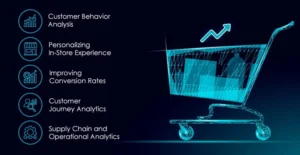
To understand the value of data engineering in the retail industry, let’s take a look at the top five use cases, which are currently being implemented by leading companies:
Customer Behavior Analysis:
Data-driven customer insights are important to resolve retail challenges, such as personalizing campaigns to improve revenue, optimizing customer conversion rates, lowering acquisition costs, and avoiding customer churn. These days, users interact with a brand through mobile devices, stores, eCommerce sites, social media, and more. This increases the complexity of the data type and the variety of retailers that have to categorize and analyze it. Data engineering helps unlock insights from customer behavior data (structured and unstructured), enabling retailers to combine, integrate, and analyze data to facilitate customer acquisition and loyalty.
Personalizing In-Store Experience:
Before big data was launched, merchandising was considered an art form. Retailers did not have any means to measure the impact of their merchandising decisions. Later, a new trend was introduced when big data and online sales grew. Shoppers would physically look for the products in-store and order them online later. This gave rise to tracking technology which offers new means to analyze store behavior and measure merchandising impact. Data engineering allows retailers to drive meaningful data to optimize their merchandising strategies, personalize the in-store experience, and offer discounts to encourage users to complete purchases. The end goal is to improve sales rates across all channels.
Improving Conversion Rates:
A 360° view of customers’ buying habits and prospects can help increase acquisition and lower costs. Retailers can then effectively target promotional campaigns. Earlier, customer data was limited to demographic data collection means. But today, user interaction is more due to the influence of social media and other channels. Data engineering allows retailers to correlate customer purchase histories with their behavior on social media sites. It often reveals unexpected insights that retailers can use to target their ads by placing them on multiple channels like Facebook pages, Insta Ads, TV shows, etc. They can test and measure the impact of their promotional strategies on conversion rates. Data engineering also helps identify user interests and generate personalized promotions.
Customer Journey Analytics:
Today, customers are more connected than ever because of smartphones, eCommerce, and social media. They can access information and decide what, where, and when to buy and at what price. Customers can make better buying decisions and purchase wherever and whenever they want. Due to this, marketers have to continuously analyze, understand, and connect with customers. It requires a data-driven approach to understand the customer’s journey across channels. Data engineering helps analyze structured and unstructured data, regardless of the type. This reveals patterns and insights about what’s happening in the customer journey, who are high-value customers, and the best approach to approach them.
Supply Chain and Operational Analytics:
Retailers face intense pressure to optimize their performance, service quality, budgets, and asset utilization. This will eventually help them gain a competitive edge and improve business performance. The key is using data engineering platforms to improve operational efficiency and unlock insights locked in machine, log, and supply chain data. It combines structure data from ERP, CRM, geolocation, public data, and mainframe and syncs them with unstructured data.
How Do AI And Big Data Deliver Real-time Consumer Insights In Retail?
Retailers have to cope with huge amounts of data that move quickly, such as POS systems, mobile apps, loyalty programs, and social connections. AI and large data pipelines work together to quickly figure out what this noise means.
Key features:
- Detecting customer sentiment in real time based on their behavior and feedback
- Setting prices based on demand, competitor activity, and customer interest
- Automatically finding buying patterns and micro-segments
- Making recommendations right away across web, in-store, and mobile touchpoints
This truly means that stores can do things right away. Teams can see right now what customers want and what’s affecting their buying decisions, instead of having to wait for weekly reports.
Data Engineering Tools For Managing Inventory In A Way That Predicts Future Needs
Strong data engineering pipelines enable stores to predict how much they will sell, avoid running out of stock, and stop having too much stock.
What it has:
- Putting together historical sales, promotions, and seasonal data
- Taking in real-time supply chain, logistics, and POS information
- Feeding harmonized data into ML forecasting models
- Setting up automatic triggers for stores and warehouses to restock
These features help stores have the right amount of stock on hand, lower carrying costs, and ensure that products are available across all channels. Predictive modeling also helps in planning ahead for busy times, new product launches, and price modifications.
Data Pipelines For Tailored Shopping Experiences
How well businesses can acquire, handle, and use client data affects how personalized their services are. Data pipelines make this feasible by putting together structured and unstructured data sources into a consumer profile that can be used.
Main parts:
- Taking in data from apps, loyalty programs, web analytics, CRM, and POS
- Making it easier to communicate with customers in different formats
- Creating a single perspective of each customer (identity resolution)
- Putting data into recommendation engines and personalization models
This leads to targeted marketing, individualized product recommendations, and hyper-personalized shopping experiences across all channels, which increases conversions and the value of each consumer.
How can Tx help with Data Engineering in Retail?
With its data engineering and quality assurance expertise, Tx is crucial in optimizing your retail operations. Our data quality testing services ensure your retail data is accurately processed and ready for analysis.
Partnering with Tx would give you the following benefits:
• We have deep expertise in analytics testing, data warehousing, and big data testing engagements.
• We assist retailers in harnessing the full potential of AI/ML and predictive analytics to understand and decipher customer behavior and market trends.
• Automation is the key to business success. Our test automation experts utilize advanced in-house accelerators, such as Tx-HyperAutomate, Tx-SmarTest, etc., to help you integrate automation with routine tasks like data entry, report generation, and resource allocation.
• Our customized data quality testing approach ensures data accuracy at various levels of data engineering projects.
• By partnering with Tx, you can transform your data into a strategic asset to drive informed decision-making, optimize operational efficiency, and improve CX.
Summary
Data engineering is necessary for retailers to stay competitive, meet consumer expectations, and enhance CX. It involves handling data strategically from the acquisition and integration to analysis and practical application. The process enables retailers to make better business decisions, optimize supply chain operations, and implement innovative solutions like AI, RPA, etc.
This leads to reduced operational costs, better decision-making, and improved CX. Data engineering supports advanced predictive analytics and ML to pave the way for robust fraud detection and pricing strategies. However, one must partner with an experienced data engineering specialist like Tx to ensure its successful integration with retail operations.
To know how we can help, contact our experts now.

VP and Global Head Data & AI Practice
Results-oriented Data Analytics & AI Specialist with 24+ years of experience in multiple roles, including Practice Leader with P&L ownership. Expert in building Data Analytics practices, defining market strategies, and leading large-scale transformation initiatives. Skilled in Business Intelligence, Data Engineering, Cloud platforms (Azure, AWS, GCP), AI/ML, and Data Governance, with a strong focus on customer-centric solutions and strategic alliances.
FAQs
What are the advantages of using cloud data engineering in retail?
Cloud data engineering makes it easier to scale up, decreases the cost of infrastructure, speeds up analytics, and ensures that data is always available. Retailers can swiftly adapt to changes in demand, simply add new data sources, and keep their systems very reliable.
How does using predictive inventory management make retail work better?
Predictive models assist merchants in effectively predicting demand by combining sales, supply chain, and outside market data. This makes sure that stock levels are always at their best, cuts down on waste, stops stockouts, and makes it easier to estimate income.
How safe is client information in retail data engineering systems?
Strong governance principles, access controls, encryption, and constant monitoring are all important for security. Modern retail data systems also use tokenization, anonymization, and regulatory frameworks like GDPR or PCI-DSS to keep client information safe at all times.
How might data engineering improve the management of the supply chain in retail?
Data engineering brings together logistics data, inventory feeds, supplier information, and sensor data to give you real-time visibility. This helps with route optimization, faster restocking, fewer operational bottlenecks, and more accurate forecasting across the supply chain.
Summarize with



Discover more